


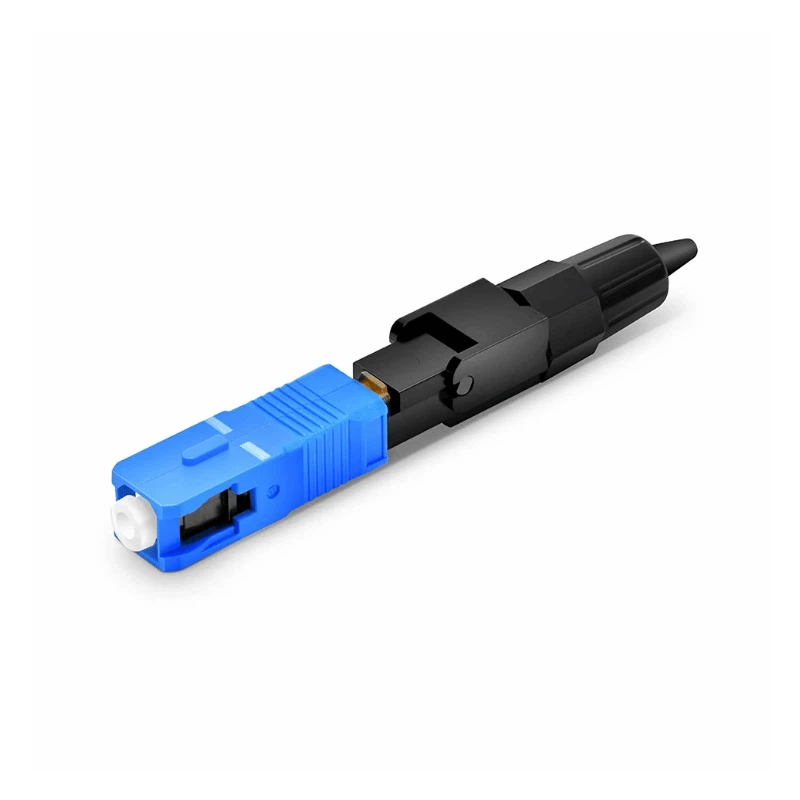
Technical Specifications
| Parameter | Value |
|---|---|
| Connector Type | SC (Subscriber Connector) UPC |
| Fiber Type | Singlemode 9/125μm (OS2) |
| Polishing Type | UPC (Ultra Physical Contact) |
| Structure | Simplex |
| Cable Diameter | 2.0mm with strain-relief boot |
| Insertion Loss | ≤ 0.3 dB (typical) |
| Return Loss | ≥ 50 dB |
| Operating Wavelength | 1310 nm / 1550 nm |
| Operating Temperature | -40°C to +75°C |
| Storage Temperature | -40°C to +85°C |
| Durability | ≥ 500 mating cycles |
| Compliance | IEC 61754, TIA-568, RoHS |
| Ferrule Material | Ceramic (Zirconia) |
| Housing Material | High-performance polymer |
Customization & OEM/ODM Service
As a leading fiber optic cable connector manufacturer, we provide comprehensive OEM and ODM services tailored to your project requirements. Our engineering team works directly with system integrators, network operators, and telecommunications companies to deliver customized solutions that meet exact specifications.
simulator
SC, LC, FC, ST, or hybrid configurations
Fiber Types
OS1, OS2 (singlemode); OM2, OM3, OM4, OM5 (multimode)
Cable Outer Diameter
0.9mm, 2.0mm, 3.0mm, or custom dimensions
Jacket Material & Color
PVC, LSZH, plenum-rated; custom color matching available
Cable Length
Any length from patch cords to pre-terminated assemblies
Branding
Logo printing on connector housing and cable jacket
Key Features
Superior Optical Performance
Insertion loss ≤ 0.3 dB and return loss ≥ 50 dB ensure optimal signal transmission with minimal reflection.
UPC Polishing Technology
Ultra Physical Contact polishing minimizes back reflection, making it ideal for high-speed digital and analog applications.
OS2 Single-mode Fiber
9/125μm core/cladding diameter optimized for long-distance transmission at 1310/1550 nm wavelengths.
Durable Construction
Rated for ≥ 500 mating cycles with robust strain-relief boot protecting the 2.0mm cable diameter.
Wide Operating Range
Functions reliably across -40°C to +75°C temperature range for diverse deployment environments.
Standards Compliant
Fully compliant with IEC 61754 and TIA-568 standards, RoHS certified for environmental safety.
Applications

Telecommunications Networks
Central office interconnections, long-haul transmission systems, and metropolitan area networks (MANs).

FTTH/FTTX Projects
Fiber-to-the-home and fiber-to-the-premises deployments requiring reliable subscriber connections.

Data Centers
Server-to-switch connectivity, storage area networks (SANs), and backbone infrastructure.

Enterprise Networks
Campus backbone cabling, building-to-building links, and high-speed LAN/WAN connections.


Industrial Networks
Manufacturing automation, process control systems, and harsh environment installations.
Case Study: Data Center Implementation

Challenge
A large cloud service provider needed to upgrade their data center infrastructure to support 400Gbps connectivity between servers and switches. The existing infrastructure was experiencing signal loss and reliability issues with their current fiber optic connectors.
Solution
Our SC UPC single-mode connectors were selected for their superior optical performance and durability. The low insertion loss (≤ 0.3 dB) and high return loss (≥ 50 dB) ensured optimal signal transmission, while the robust design withstood the rigorous demands of the data center environment.
FAQ
Q: What is the difference between UPC and APC polishing?
A: UPC (Ultra Physical Contact) polishing provides a flat, highly polished end face with a slight curvature to ensure optimal physical contact between fibers. APC (Angled Physical Contact) polishing adds an 8° angle to the end face, which reduces back reflection to extremely low levels (typically ≥ 60 dB). APC connectors are often used in high-speed, analog, or wavelength-division multiplexing (WDM) applications where minimizing reflection is critical.
Q: What is the difference between single-mode and multimode fiber?
A: Single-mode fiber has a smaller core diameter (typically 9μm) that allows only one mode of light to propagate, enabling longer transmission distances (up to several kilometers) with minimal signal loss. Multimode fiber has a larger core diameter (typically 50μm or 62.5μm) that allows multiple modes of light to propagate, which limits transmission distance but allows for higher data rates over shorter distances (up to a few hundred meters).
Q: What is insertion loss and why is it important?
A: Insertion loss is the amount of optical power lost when a signal passes through a connector. It is measured in decibels (dB) and is critical because excessive loss can reduce signal strength below acceptable levels, leading to errors or complete signal failure. Our SC UPC connector is designed for low insertion loss (≤ 0.3 dB), ensuring minimal signal degradation.
Q: What is return loss and why is it important?
A: Return loss is the measure of light reflected back toward the source due to impedance mismatches at the connector interface. It is also measured in decibels (dB) and is important because reflected light can cause signal interference, reduce system performance, and even damage sensitive laser sources. Our SC UPC connector provides high return loss (≥ 50 dB), minimizing these issues.
Q: Can I use this connector for outdoor applications?
A: While our standard SC UPC connector is designed for indoor use, we offer weatherproof versions specifically engineered for outdoor applications. These outdoor-rated connectors feature enhanced sealing and ruggedized construction to protect against moisture, dust, and temperature extremes. Please contact our sales team for more information on our outdoor fiber optic connector solutions.

Ready to Enhance Your Fiber Optic Network?
Our SC UPC Single-mode 9/125 connector delivers the performance and reliability your network demands.
Hot Tags: fiber optic cable sc upc connector, China fiber optic cable sc upc connector manufacturers, suppliers, factory


