Your Professional Fiber Optic Splice Closure Supplier
DIMI is a professional manufacturer of high-reliability fiber-optic products, delivering precision engineering, certified quality, and scalable production.
We run two ISO-certified plants (12,800 m², incl. 2,100 m² clean areas) with 22 CNC machining centers, 10 die-casting machines (Zn/Al), 16 high-tonnage stamping presses, 12 injection-molding cells, and in-house anodizing, powder coating, and hot-dip galvanizing—covering suspension clamps, dead-end/tension clamps, brackets, hangers, and closure hardware.
-
![12 Core Horizontal Fiber Optic Splice Closure]() 12 Core Horizontal Fiber Optic Splice Closure12 Core Horizontal Fiber Optic Splice Closure for FTTH Outdoor NetworksEngineered by Dimifiber to protect drop-cable and distribution splices in aerial, wall-mount, duct, handhole and direct-buried
12 Core Horizontal Fiber Optic Splice Closure12 Core Horizontal Fiber Optic Splice Closure for FTTH Outdoor NetworksEngineered by Dimifiber to protect drop-cable and distribution splices in aerial, wall-mount, duct, handhole and direct-buried -
![48 Fibre Optic Splice Closure]() 48 Fibre Optic Splice ClosureKey FeaturesIP68 Environmental ProtectionFully sealed against water, dust, and moisture ingress for reliable outdoor performance in harsh conditions.Mechanical Sealing TechnologyRotary mechanical
48 Fibre Optic Splice ClosureKey FeaturesIP68 Environmental ProtectionFully sealed against water, dust, and moisture ingress for reliable outdoor performance in harsh conditions.Mechanical Sealing TechnologyRotary mechanical -
![96 Fibers 1In-2Out Inline Splice Closure, Heat-Shrink Seal, Wall/Pole Mount, IP68]() 96 Fibers 1In-2Out Inline Splice Closure, Heat-Shrink Sea...IP68 ProtectionSuperior environmental protection against dust, water, and extreme temperatures for reliable outdoor performance.Heat-Shrink SealingAdvanced heat-shrink sealing technology ensures
96 Fibers 1In-2Out Inline Splice Closure, Heat-Shrink Sea...IP68 ProtectionSuperior environmental protection against dust, water, and extreme temperatures for reliable outdoor performance.Heat-Shrink SealingAdvanced heat-shrink sealing technology ensures -
![144 Fibers 2In-4Out Dome Fiber Optic Splice Closure]() 144 Fibers 2In-4Out Dome Fiber Optic Splice ClosureThe 144 Fibers 2In-4Out Dome Fiber Optic Splice Closure is a versatile and reliable fiber management solution engineered for splicing, branching, and protecting fiber connections in demanding network
144 Fibers 2In-4Out Dome Fiber Optic Splice ClosureThe 144 Fibers 2In-4Out Dome Fiber Optic Splice Closure is a versatile and reliable fiber management solution engineered for splicing, branching, and protecting fiber connections in demanding network


Parameter
|
Material |
PP+GF (Polypropylene + Glass Fiber) |
|
Cable Port Quantity |
4 Ports (2 In + 2 Out) |
|
Cable Port Type |
2 Round ports + 1 oval port (optional configurations) |
|
Sealing Type |
Mechanical Seal (Rotary Compression) |
|
Cable Diameter Range |
Φ8–18mm (round ports), Φ10–20mm (oval port) |
|
Splice Capacity (Maximum) |
48 Fibers |
|
Splice Tray Capacity |
12 Fibers per tray |
|
Splice Tray Count (Maximum) |
4 Trays |
|
Protection Grade |
IP68 (submersion resistant to 1.5m for 60 minutes) |
|
Operating Temperature |
-40°C to +65°C |
|
Storage Temperature |
-40°C to +60°C |
|
Relative Humidity |
≤95% at +30°C |
|
Atmospheric Pressure |
70–106 kPa |
|
Application |
Aerial, Duct, Pole/Wall Mount, Handhole, Direct Burial |
|
Splice Tray Size |
Standard 12F tray: approx. 140mm × 110mm |
|
Closure Size (D × H) |
Φ120mm × 300mm |
|
Weight |
Approximately 1.5–1.8 kg (with trays and accessories) |
|
Compliance |
IEC, Telcordia GR-771, RoHS, REACH |
Benefits of Fiber Optic Splice Closure
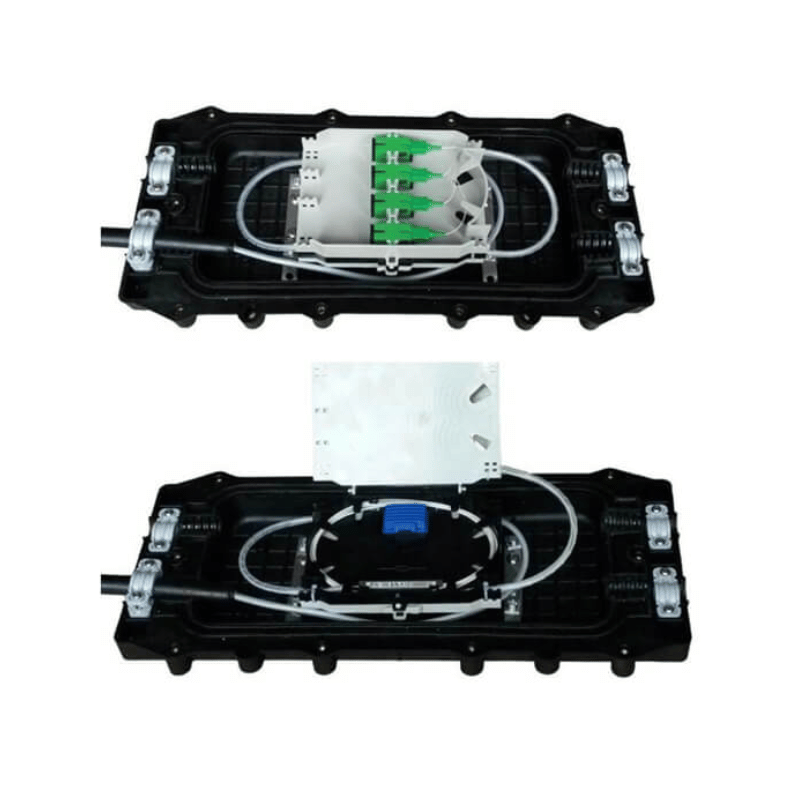
Protection Against Environmental Factors
Fiber optic splice closures protect fiber connections from environmental threats like moisture, temperature fluctuations, and contamination. Advanced designs use sealing barriers to prevent water ingress, which can cause signal attenuation and corrosion. High-quality materials ensure stability during temperature changes and prevent stress-induced fiber breaks. Sealed environments and filtration systems block dust and particles, maintaining reliable optical performance.
Prevention Of Physical Damage
Fiber optic splice closures provide mechanical protection through vibration resistance, impact resistance, and strain relief. Vibration-damping materials and flexible mounting systems shield internal components in high-disturbance environments like traffic or industrial areas. Reinforced housings and strategic designs protect connections from impacts during construction,maintenance, or vandalism.
Improved Signal Performance
Fiber optic splice closures ensure reliable signal quality by maintaining stable environmental conditions and controlling humidity to prevent moisture-induced signal loss. Sealed enclosures protect optical performance from external weather changes. Rigid designs and precise mounting systems eliminate movements that could disrupt splice alignment and degrade performance. Effective sealing prevents contamination while preserving optical interface quality and connection stability over time.
Simplified Maintenance
Fiber optic splice closures improve maintenance with tool-free opening mechanisms for quick access, reducing service time and costs. Organized internal layouts, with color-coded trays and clear labels, simplify splice identification and speed up troubleshooting. Modular designs allow field replacement of sealing elements and splice trays without replacing the entire closure. This reduces inventory needs, extends service life, and guarantees cost-effective maintenance.
Enhanced Network Longevity
Long-term network reliability relies on fiber optic splice closures preventing degradation over time. Effective sealing and quality materials protect components from corrosion and UV-induced damage. Advanced polymers and coatings safeguard enclosures from sunlight and maintain integrity during extended exposure. Engineering designs also address thermal cycling, preventing material fatigue and preserving sealing effectiveness across temperature changes.
Support For Scalability
Fiber optic splice closures with expandable tray systems and modular designs support growing bandwidth demands without requiring full infrastructure replacements. Future-proofing features, like standardized interfaces and adaptable configurations, ensure compatibility with evolving technologies.

Application of Fiber Optic Splice Closure
Using in Telecommunications Networks
In traditional telecommunications networks, fiber optic splice closure is used extensively. They are deployed in both long-haul and local loop installations. For long-haul networks, which span vast distances, fiber optic box are vital for maintaining the integrity of the fiber optic cables. When fiber optic cables are laid over hundreds or even thousands of kilometers, there are inevitable breaks or the need to connect different cable segments. Fiber splice box provides a secure environment for splicing these fibers together.
Using in Data Centers
Data centers are the nerve centers of modern digital infrastructure. With the exponential growth of data traffic, fiber optic connectivity within data centers has become more critical than ever. Fiber optic splice closure is used to manage the complex network of fiber optic cables within data centers.
Using Cable Television (CATV) Networks
In CATV networks, fiber optic splice closure is used to distribute video and other multimedia signals. As fiber optic cable providers strive to offer high-definition and ultra-high-definition programming, fiber optic has become the preferred medium for signal transmission.
Working Of Fiber Optic Splice Closure
Fusion Splicing
This is the most common method, where the two fiber ends are precisely aligned and then welded together using an electric arc. Fusion splicing offers the lowest loss and least reflectance, as well as the strongest and most reliable joint between fibers.
Mechanical Splicing
This method aligns the fiber ends in a specially designed mechanical fixture that holds the fibers together in alignment. Mechanical splices are quicker and easier to perform than fusion splices but typically have higher loss and are less reliable.
Logistics
We will help you to choose the best shipping way according to your detail requirements. By sea, by air, or by express, etc.
The time frame of an order delivery is divided into two parts
Processing time: 7-14 Days
Shipping time: 20~30 Days
Shipping methods
DDP, DAP, EXW, etc.
Shipping fee
The shipping fee will be changed according to every pacel's weight.
FAQ
As one of the most professional fiber optic splice closure manufacturers and suppliers in China, we're featured by quality products and good service. Please rest assured to wholesale custom made fiber optic splice closure from our factory.