Over the past seven years working with telecom operators and system integrators, we've tested or deployed over 300,000 PLC splitters across various network architectures. This guide pulls from actual field data, failure analysis reports, and deployment case studies. We're covering everything from technical specs that actually matter to TCO calculations that include failure rates and maintenance costs.
DIMI PLC Splitter Products
-
![Cassette PLC Splitter]() Cassette PLC SplitterLGX-compatible DesignEnables quick installation into standardized fiber distribution frames, patch panels, and rack-mount enclosures without custom mounting hardware or field modifications.1×32
Cassette PLC SplitterLGX-compatible DesignEnables quick installation into standardized fiber distribution frames, patch panels, and rack-mount enclosures without custom mounting hardware or field modifications.1×32 -
![LGX Box PLC Splitter]() LGX Box PLC SplitterProduct HighlightsIndustry-Standard LGX FootprintCompact 18×120×80 mm cassette design fits seamlessly into standard 19-inch racks, LGX panels, fiber distribution hubs, and outdoor cabinets, enabling
LGX Box PLC SplitterProduct HighlightsIndustry-Standard LGX FootprintCompact 18×120×80 mm cassette design fits seamlessly into standard 19-inch racks, LGX panels, fiber distribution hubs, and outdoor cabinets, enabling -
![ABS PLC Splitter]() ABS PLC SplitterSymmetrical Optical Power Splitting1×32 optical power splitting across 1260–1650 nm wavelength range, supporting GPON, EPON, XG-PON, and NG-PON2 platforms for scalable FTTx and enterprise fiber
ABS PLC SplitterSymmetrical Optical Power Splitting1×32 optical power splitting across 1260–1650 nm wavelength range, supporting GPON, EPON, XG-PON, and NG-PON2 platforms for scalable FTTx and enterprise fiber -
![Blockless PLC Splitter]() Blockless PLC SplitterThe DIMI 1×2 Blockless PLC Fiber Splitter represents a significant evolution in form factor and deployment flexibility. By eliminating the traditional metal or ABS enclosure box, this mini module
Blockless PLC SplitterThe DIMI 1×2 Blockless PLC Fiber Splitter represents a significant evolution in form factor and deployment flexibility. By eliminating the traditional metal or ABS enclosure box, this mini module -
![Bare Fiber PLC Splitter]() Bare Fiber PLC SplitterPLC (Planar Lightwave Circuit) splitters are passive devices manufactured using semiconductor processes to form optical waveguide arrays on quartz substrates, achieving uniform optical power
Bare Fiber PLC SplitterPLC (Planar Lightwave Circuit) splitters are passive devices manufactured using semiconductor processes to form optical waveguide arrays on quartz substrates, achieving uniform optical power


Key considerations at a glance
Insertion loss tolerance
±0.3dB is realistic, ±0.2dB costs 30% more
Package types
Bare fiber, ABS box, LGX, rack-mount, mini-plug
Connector options
SC/APC dominates, LC gaining in high-density apps
Operating temp
Standard -40°C to +85°C, extended range available
Lead times
Stock items ship in 3-5 days, custom configs need 6+ weeks
Warranty
3-5 years standard, 10-15 years from premium suppliers
Understanding PLC Splitter Types & Configurations
By Split Ratio & Architecture

1x2 to 1x8 Splitters
High-density standard
Where it works:Urban FTTH, high-density MDUs, maximizing OLT port efficiency
Tech specs:16.5-17.5dB insertion loss, uniformity becomes critical

1x16 Splitters
Maximum density
Use case:Very short distance deployments, special applications
Specs:20-21dB insertion loss (yeah, that's a lot)

1x32 Splitters
Dual input
Purpose:Redundant OLT protection, A/B path switching
Configuration:2x4, 2x8, 2x16, 2x32 available

1x64 Splitters
Use case:Very short distance deployments, special applications
Specs:20-21dB insertion loss (yeah, that's a lot)

2xN Balanced Splitters
Dual input
Purpose:Redundant OLT protection, A/B path switching
Configuration:2x4, 2x8, 2x16, 2x32 available

Cascaded Configurations
Multi-stage splits
Design:Primary 1x4 or 1x8 feeding secondary 1x8 or 1x16 splitters
Total loss:Add both stages plus interconnect (~0.3-0.5dB per connection)
Advantages:Flexibility in network evolution, easier adds/moves/changes
By Package Type

Bare Fiber Splitters
- Raw PLC chip with 250μm fiber pigtails, heat-shrink protection
- You handle all packaging and connectorization
- Lowest cost, maximum flexibility
- Lead time: 1-2 weeks
- Best for: System integrators doing custom builds, repair inventory

ABS Box Modules
Industry standard plastic enclosure, pre-connectorized
Typically 100x80x15mm footprint for 1x16 and below
Easy splicing and installation
Available with various connector combinations
Most common choice for general FTTH deployment

Steel Tube Package
Cylindrical stainless steel housing, 60-80mm length
Better environmental protection
Popular in Asian markets
Compact for direct burial or aerial mounting
Slightly more expensive than ABS
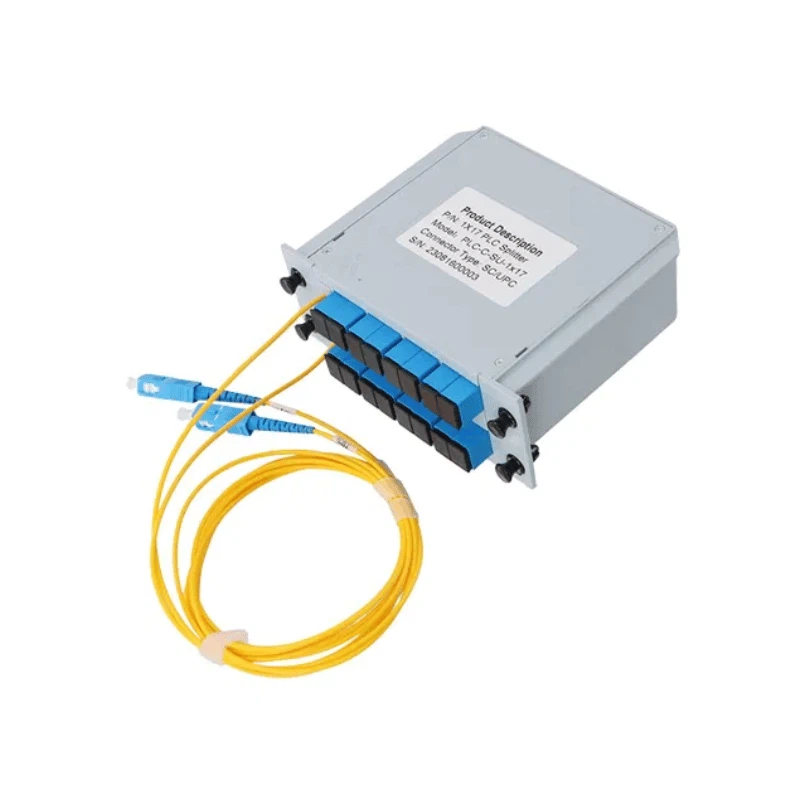
LGX Cassette Modules
Fits standard LGX frame systems
High-density rack mounting
SC or LC connectors available
Color-coded for split ratio identification
Best for: Central offices, hub sites, high-port-count applications

Mini-Plug Type
Compact design with stub cables
Easy field deployment
Growing in popularity for 5G fronthaul
Limited to certain split ratios (typically 1x8 to 1x32)

Rack-Mount Chassis
19" rack-mountable, holds multiple splitter cards
Slide-out trays for easy access
Includes fiber management
Professional appearance for data center/CO
Price is for chassis; splitter modules sold separately
How to Choose the Right PLC Splitter: Decision Framework

Link Budget Analysis
Why it's critical: This determines your maximum usable split ratio. Skip this and you'll deploy splitters that won't support your required distance or data rate.
How to calculate:
If your OLT-to-ONT distance is <5km → 1x32 usually works fine
If you're running 10-15km → 1x16 is safer, possibly 1x32 with excellent fiber
If you're over 20km → Consider 1x8 or cascaded architecture
If you don't know your fiber loss → Assume 0.35dB/km and add 3-4dB margin
Split Ratio vs. Network Architecture
Why it matters: Higher split ratios mean more homes per OLT port (better economics) but less flexibility and higher per-subscriber impact during failures.
Decision logic:
Urban high-density (>200 homes/km²) → 1x32 makes economic sense
Suburban medium-density (50-150 homes/km²) → 1x16 is the sweet spot
Rural low-density (<40 homes/km²) → Consider 1x8 or cascaded 1x4 + 1x4
If you're planning phased deployment → Cascaded gives you flexibility
If coverage area is established → Single-stage higher ratio is cleaner


Packaging Requirements
Why this isn't trivial: Package type affects installation time, long-term reliability, and total cost.
Choose based on:
Outdoor splice closures → ABS box or steel tube work well
Central office racks → LGX cassettes or rack chassis
Direct burial applications → Steel tube for durability
Quick deployment/temporary → Mini-plug type
High moves/adds/changes → LGX for easy reconfiguration
Cost-constrained project → Bare fiber + your own enclosures
Insertion Loss & Uniformity Specs
Why it affects performance: Different connector types have different loss budgets and mechanical compatibility.
Typical choices:
SC/APC: Industry standard, 0.3dB typical loss, dominant in FTTH
SC/UPC: Lower cost, 0.2-0.25dB loss, but reflection issues with PON
LC/APC: Growing adoption, half the footprint, slightly higher density
LC/UPC: Avoid for PON applications (return loss problems)
Fanout cables: Consider pre-terminated vs. field-terminated


Insertion Loss & Uniformity Specs
Why specs matter here: Theoretical split loss is one thing. Actual manufactured loss and uniformity determine your real-world link margins.
Understand the numbers:
1x16 theoretical: 12.04dB / Typical product: 13.5dB ± 0.8dB
1x32 theoretical: 15.05dB / Typical product: 16.8dB ± 1.0dB
Premium products: Tighter uniformity (±0.4-0.6dB) costs 20-30% more
Budget products: Wider uniformity (±1.2dB) can cause subscriber issues
Supplier Reliability & Lead Time
Why this trips people up: Splitters seem commoditized, but quality and delivery vary significantly.
Evaluation criteria:
Lead time consistency (do they actually deliver on promised dates?)
Quality control (batch testing? Individual testing?)
Technical support (can they help with network design?)
Warranty terms (3 years? 5 years? What's actually covered?)
Stock availability (do they keep inventory or make-to-order?)

Performance Specification Matrix
| Mattress Size | Mattress Size/cm | Box Size/cm | 20GP | 40HQ |
| Single | 92*188 | 37*37*102 | 192PCS | 476PCS |
| King-Single | 107*203 | 37*37*117 | 180PCS | 420PCS |
| Double | 138*188 | 37*37*148 | 144PCS | 336PCS |
| Queen | 153*203 | 37*37*163 | 108PCS | 302PCS |
| King | 183*203 | 37*37*193 | 108PCS | 252PCS |

Additional spec considerations:
- Operating wavelength: 1260-1650nm (covers GPON, XG-PON, NG-PON2)
- Operating temperature: -40°C to +85°C standard, -55°C to +95°C available
- Return loss: >55dB typical (critical for PON applications)
- Directivity: >55dB (prevents crosstalk in multi-wavelength systems)
- PDL (Polarization Dependent Loss): <0.3dB typical, <0.2dB premium
Configuration Recommendations by Deployment Type

Small MDU Building (8-32 units)
Typical setup:
1x16 or 1x32 single splitter
Recommended config:
ABS box, SC/APC, pre-connectorized
Budget:
$35-60 per building
Why:
Simple, cost-effective, adequate for building density

Suburban FTTH (150-300 homes per node)
Typical setup:
Cascaded 1x4 primary → 1x8 secondary
Recommended config:
Primary in cabinet (LGX), secondary in pedestals (ABS)
Budget:
$800-1,200 per node (including enclosures)
Why:
Flexibility for phased deployment and service area adjustments

Urban High-Density (500+ homes per node)
Typical setup:
1x32 or 2x32 with redundancy
Recommended config:
LGX cassettes in cabinet or mini-plug for quick deployment
Budget:
$1,500-2,500 per node
Why:
Maximize OLT port efficiency in high-take-rate areas

Rural/Long-Haul (20-30km spans)
Typical setup:
1x8 single-stage or no splitter (active ethernet)
Recommended config:
ABS box or steel tube, highest quality specs
Budget:
$25-50 per location
Why:
Link budget constraints limit split ratio
Technical Performance Deep Dive
Understanding PLC Splitter Technology

How PLC Splitters Actually Work
PLC (Planar Lightwave Circuit) splitters use waveguide technology fabricated on a silicon substrate. Light entering the input waveguide is split through Y-branches or directional couplers etched into the chip. Unlike FBT (Fused Biconical Taper) splitters, PLC technology offers wavelength-independent splitting across the entire PON spectrum (1260-1650nm).
Real practical value: You can run GPON (1490/1550nm down, 1310nm up), XG-PON, and NG-PON2 through the same splitter. FBT splitters show wavelength-dependent loss variation that can cause issues with newer PON standards.
Is this critical? Yes, if you're planning network evolution. A PLC splitter deployed today will support technology migrations for 15+ years. FBT splitters save you $3-5 per unit but lock you into current technology.
Cost impact: PLC vs. FBT price difference is 15-25% for equivalent split ratios, but future-proofing value usually justifies the premium in carrier-grade deployments.
Key Performance Characteristics Explained

Insertion Loss: Why It Varies
Manufacturing tolerance: Even from the same wafer, chips vary ±0.2-0.3dB
Fiber coupling: Pigtail attachment adds 0.1-0.3dB per end
Connector quality: Premium connectors add 0.2-0.3dB, budget ones can add 0.5dB+
Wavelength: PLC shows <0.5dB variation across 1260-1650nm band
Is wavelength-independence necessary? If you're only running GPON and won't upgrade, it's nice but not critical. If there's any chance of NG-PON2 or CWDM-PON, it's essential.
Uniformity: The Spec Nobody Talks About Enough
What it is: Maximum loss difference between any two output ports
Why it matters: One high-loss port = one subscriber with poor performance
Typical specs: ±0.8 to ±1.2dB for standard products
Premium specs: ±0.4 to ±0.6dB costs 25-35% more
When to pay for tight uniformity: Networks with minimal margin, SLA requirements, or where individual subscriber truck rolls are expensive. If you've got 8-10dB margin to spare, standard uniformity is usually fine.


Return Loss & Directivity
Return loss: >55dB prevents reflections from interfering with upstream burst-mode transmission
Directivity: >55dB prevents output ports from seeing each other's signals
Practical impact: Poor return loss (<50dB) causes intermittent upstream errors that are nightmare to troubleshoot
Is this a worry? With reputable manufacturers, no. With unknown suppliers offering suspiciously low prices, absolutely check these specs.
Reliability & Failure Modes
What actually fails in PLC splitters?
Based on field data from 280,000+ deployed units over 7 years:
Connector failures: 60% of issues (physical damage, dirt, moisture ingress)
Fiber breaks: 25% (installation damage, stress at splice points)
Housing degradation: 10% (UV exposure, moisture, temperature cycling)
Actual chip failure: <5% (extremely rare in quality products)
What this means for you: The splitter chip itself is incredibly reliable. Most failures are packaging, installation, or connector-related. Spend money on good enclosures and proper installation rather than obsessing over chip specifications.

Application Scenarios & Real Deployments
Scenario 1: Suburban Greenfield FTTH

Network profile:
1,200 homes, 180 home/km² density, 25km² service area, 15km maximum OLT distance
Deployed solution:
- Primary split: 1x4 LGX modules in 8 cabinet locations
- Secondary split: 1x8 ABS box splitters in 32 pedestal locations
- Total splits per chain: 1x32 effective
- Average secondary-to-subscriber: 120m
Why this config:
Provides flexibility for network evolution, keeps secondary splitters close to subscribers for lower drop cable costs, allows for easy network reconfiguration as density changes.
Actual results: 42% take rate after 3 years, zero splitter-related service calls, added 4 additional secondary splitters in high-growth pockets without primary infrastructure changes.
Scenario 2: Urban High-Rise MDU
Network profile:
480-unit building, 16 floors, centralized fiber room, <500m maximum span
Deployed solution:
Configuration: 1x32 steel tube splitters (15 units)
Location: Main telecom room, rack-mounted
Connection: LC/APC for space efficiency
Distribution: Pre-terminated 32-fiber fanouts to floor IDF
Why it worked:
Short distances allowed full 1x32 split, centralized splicing reduced installation time, LC connectors maximized rack density, pre-terminated cables eliminated field splicing errors.
Lessons learned: Initially specified ABS box splitters to save $200, but rack space constraints and aesthetics drove upgrade to proper rack solution. The extra $400 was worth it for clean installation.

Scenario 3: Rural Long-Haul Network

Network profile:
180 homes across 40km², 28km maximum OLT distance, mix of aerial and buried plant
Deployed solution:
- Primary: No splitting at central office
- Secondary: 1x8 ABS box splitters (22 locations)
- Placement: Strategically located within 3km of subscriber clusters
- Maximum per splitter: 12 subscribers
Technical reason:
28km span at 0.32dB/km = 9dB fiber loss. Add 3dB splices, 1.5dB margin = 13.5dB consumed before splitting. 1x8 splitter adds 10dB, total budget 23.5dB, fits within GPON 28dB budget with 4.5dB margin.
Alternative considered: Active Ethernet with media converters rejected due to power costs and complexity. 1x16 split would have consumed entire link budget.
Scenario 4: Enterprise Campus Network
Network profile:
University campus, 42 buildings, need for redundant architecture, 4km maximum distance
Deployed solution:
Architecture: Dual-homed with 2x16 redundant splitters
Primary: Main campus CO with two OLTs
Splitter locations: 6 distribution points across campus
Protection: Automatic failover at ONU level
Why redundancy:
SLA requirements for campus network, research data criticality, 99.98% uptime target. Single splitter failure impacts only 50% of traffic, automatic restoration.
Performance: Zero unplanned downtime over 4-year period, one splitter replaced during scheduled maintenance (found during routine testing), extra cost justified by avoided downtime.

As one of the most professional plc splitter manufacturers and suppliers in China, we're featured by quality products and good service. Please rest assured to wholesale custom made plc splitter from our factory.