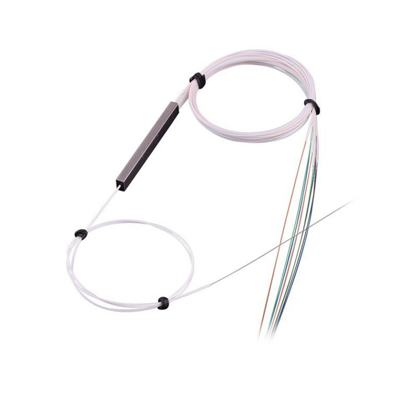
Flexible Customization for Your Projects
Split Ratios
Available in 1×2, 1×4, 1×8, 1×16, 1×32, 1×64, as well as balanced configurations like 2×2, 2×4, 2×8, 2×16, 2×32, 2×64 for multi-level splitting architectures.
Connector Types
SC/APC (standard), SC/UPC, LC/APC, LC/UPC, or mixed connector configurations to match headend equipment, ONT devices, and existing infrastructure - or specify "no connector" for fusion splicing in sealed enclosures.
Fiber Types
LG.657A1 (standard), G.657A2 (tighter bend radius for ultra-compact spaces), or G.652D for legacy compatibility, all meeting ITU-T specifications.
Input/Output Fiber Length
Adjust from 0.5m to 3m or specify custom lengths to eliminate excess coiling in cabinets or provide extra reach for complex routing paths.
Fiber Diameter Options
Choose 0.9mm tight-buffer for indoor patch cord style, 2.0mm for ruggedized outdoor pigtails, or 3.0mm for armored protection in harsh environments.
Labeling & Port Identification
Custom port numbering, sequential labeling (e.g., "Port 1 of 32"), color-coded legs for quick field identification, and alphanumeric schemas matching your network documentation standards.
Package Form Factor
Beyond mini module, we offer bare fiber (for direct splicing), compact ABS box type, LGX cassette (19" rack compatible), high-density cassettes for ODF/FDB integration, and 1U/2U rack-mount chassis with slide-out trays.
OEM/ODM Branding
Apply your company logo, part numbers, QR codes, and custom packaging labels - ideal for system integrators, private-label distributors, and contractors serving multiple clients.
Detailed Technical Specifications
| Parameter | Value | Unit | Notes |
|---|---|---|---|
| Split Ratio | 1×2 | - | Symmetrical |
| Insertion Loss | ≤4.1 | dB | @1310/1490/1550 nm |
| Uniformity | ≤0.4 | dB | Between output ports |
| Return Loss | ≥55 | dB | SC/APC connectors |
| PDL | ≤0.2 | dB | Polarization-dependent loss |
| WDL | ≤0.3 | dB | Wavelength-dependent loss |
| TDL | ≤0.5 | dB | Temperature-dependent loss |
| Directivity | ≥55 | dB | Isolation between ports |
| Operating Wavelength | 1260-1650 | nm | Full PON spectrum |
| Operating Temperature | -40 to +85 | °C | All-weather operation |
| Storage Temperature | -40 to +85 | °C | Extended temperature range |
| Humidity | 0-95 | % | Non-condensing |
| Fiber Type | G.657A1 | - | Bend-insensitive singlemode |
| Fiber Count | 1 input, 2 outputs | - | 900μm tight-buffer |
| Connector Type | SC/APC | - | Factory-terminated |
| Dimensions | 4×60×7 | mm | Blockless mini module |
| Weight | ≤5 | g | Excluding fiber pigtails |
| Compliance | ITU-T G.657A1, Telcordia GR-1209, GR-1221 | - | Telecom standards |
Features
Blockless Mini Module Architecture
The elimination of rigid metal or plastic housings reduces weight by over 70% compared to traditional ABS box splitters, making this module ideal for space-constrained environments such as pole-mounted splice closures, underground vaults, and high-density fiber management panels.
The exposed PLC chip is hermetically sealed and mechanically reinforced with buffer protection, ensuring durability without bulk. Installation crews can position and secure the module within seconds using cable ties or existing tray clips, accelerating project timelines and reducing material costs.
Ultra-Low Insertion Loss ≤4.1 dB
Achieving insertion loss below 4.1 dB at 1310/1490/1550 nm wavelengths maximizes the available power budget for downstream transmission, directly translating to longer fiber spans, higher split ratios in cascaded architectures, or additional system margin for future service upgrades.
For operators planning 20 km+ feeder runs or deploying XGS-PON with tighter power budgets, every tenth of a dB matters - this splitter preserves critical headroom while maintaining manufacturing consistency across production batches.
Superior Uniformity ≤0.4 dB
Uniformity measures the maximum power difference between output ports. At ≤0.4 dB, this splitter ensures both outputs receive nearly identical signal strength, eliminating "hot" and "cold" ports that can cause provisioning headaches or service degradation.
For network planners, this means simplified link budget calculations, predictable subscriber performance, and reduced need for per-port compensation or optical amplifiers. Uniformity this tight is especially valuable in POL deployments where hundreds of endpoints must deliver consistent user experience.
G.657A1 Bend-Insensitive Fiber
G.657A1 fiber meets ITU-T specifications for reduced macro-bend loss, tolerating bend radii as tight as 10 mm with negligible attenuation increase. This allows installation teams to route pigtails through congested pathways, wrap excess length in compact loops, and navigate around obstacles without worrying about signal degradation.
In outdoor cabinets subject to thermal cycling and vibration, bend-insensitive fiber maintains stable performance even as fiber management trays shift or settle over time. The 900μm tight-buffer coating provides additional mechanical protection and ease of handling during fusion splicing.
Factory-Terminated SC/APC Connectors
Each output pigtail is factory-terminated with SC/APC connectors, featuring 8-degree angled physical contact that delivers ≥55 dB return loss - critical for minimizing back-reflections that can degrade burst-mode upstream transmission in PON systems.
Pre-polished connector end-faces are inspected under microscope and interferometer to ensure IEC-compliant geometry, eliminating field polishing variability and connector-related failures. For integrators and contractors, this means faster installations, fewer tools in the truck, and consistent, repeatable connections that pass acceptance testing the first time.
All-Weather Operating Temperature
Qualified for -40 to +85°C operating temperature range, this splitter withstands the harshest environmental extremes without performance drift.
Cold-weather deployments in northern climates, desert installations with high daytime temperatures, and industrial facilities with thermal cycling all benefit from components engineered for wide thermal stability.
Temperature-dependent loss (TDL) is held to ≤0.5 dB across the full range, ensuring that link margins calculated at commissioning remain valid throughout seasonal changes and decades of service life.
Connectivity Solutions & Network Topologies
Placement in PON/FTTx Topologies

In a typical GPON or EPON network, the optical line terminal (OLT) in the central office generates downstream signals across 1260–1650 nm wavelengths.
These signals travel over feeder fiber to the first-stage splitter (such as this 1×2 module), which divides the optical power into separate distribution paths.
Each path may terminate at additional splitters or proceed directly to optical network terminals (ONTs/ONUs) at subscriber premises.
Upstream signals from ONTs are time-division multiplexed and combined back through the splitters to the OLT.
Centralized Split Architecture
In centralized split designs, a single high-ratio PLC splitter (such as 1×32 or 1×64) is placed in the central office, headend equipment room, or main distribution frame, directly feeding all subscribers from one location.
The blockless 1×2 splitter serves as the first-stage split in cascaded configurations, where the OLT output is divided into two primary feeder paths. Each path then connects to secondary splitters (e.g., 1×16 or 1×32) located in remote distribution hubs or street cabinets.
This topology minimizes the number of active ports required on OLT chassis, simplifies fiber management at the headend, and allows operators to incrementally deploy additional splits as subscriber counts grow - all while maintaining clear line-of-sight for troubleshooting and optical time-domain reflectometry (OTDR) testing.

Distributed Split Architecture

Distributed splitting places lower-ratio splitters (such as 1×2, 1×4, or 1×8) closer to end users - often in neighborhood aggregation boxes, building basement vaults, or floor distribution panels - with final-stage splits (1×8, 1×16) positioned within 500 meters of subscribers.
This approach reduces feeder fiber count from the central office, lowers overall insertion loss by shortening individual fiber links, and enables flexible subscriber provisioning without disturbing upstream infrastructure.
The blockless 1×2 splitter excels in this role: its compact form factor fits seamlessly into small enclosures, pre-terminated connectors allow quick cross-connects to subscriber drop cables, and low loss preserves budget for the remaining cascade stages.
For campus networks, data centers, and enterprise POL deployments, distributed splitting offers modular scalability, localized troubleshooting, and easier future capacity expansion.
Application Scenarios
FTTx & FTTH Access Networks
The blockless 1×2 splitter serves as the first-stage split in fiber-to-the-home deployments, dividing a single OLT output into two feeder paths serving separate neighborhoods or apartment complexes. Operators benefit from reduced OLT port count, simplified feeder fiber management, and the ability to incrementally add secondary splits as subscriber demand grows.
PON-Based Campus Networks
Universities, corporate campuses, and multi-tenant office buildings deploying GPON or EPON for unified voice-data-video services use 1×2 splitters at building entrance points or floor aggregation nodes. The compact mini module design fits into existing telecommunications closets, vertical cable risers, and equipment racks without requiring additional mounting hardware.
Passive Optical LAN (POL)
Hotels, hospitals, government facilities, and large office buildings leveraging POL architectures for reduced power consumption, cabling complexity, and equipment room space deploy blockless splitters throughout the structured cabling infrastructure. The 1×2 configuration allows balanced load distribution across building wings or floors.
Data Center Interconnects
Data centers use PLC splitters to tap optical signals for performance monitoring, protocol analysis, and security inspection without interrupting production traffic. The 1×2 splitter divides the signal, sending one output to the destination equipment and the other to test instruments or optical spectrum analyzers. High return loss and low PDL preserve signal quality.
CATV & RF Video Overlay
Cable operators providing analog or digital video services over PON networks use splitters to distribute 1550 nm RF video overlay signals alongside data services. Wide wavelength coverage (1260–1650 nm) and low WDL ensure transparent, distortion-free video delivery. The blockless design allows integration into headend combining nodes.
Outdoor Fiber Distribution
Street-level cabinets, pole-mounted enclosures, and underground vaults benefit from the mini module's compact footprint and rugged construction. Installation crews can mount the splitter directly to splice trays using cable ties or adhesive pads, eliminating the need for bulky mounting brackets. All-weather temperature rating ensures reliable operation.
Building Entry Enclosures
Multi-dwelling units (MDUs), office buildings, and residential high-rises use small wall-mounted or flush-mount boxes for floor-level fiber distribution. The blockless splitter's 4×60×7 mm footprint maximizes usable space within these compact enclosures, allowing designers to pack more functionality into smaller, less obtrusive housings.
Temporary Deployments
For rapid network rollouts, disaster recovery operations, or temporary event connectivity, the plug-and-play nature of pre-terminated splitters accelerates deployment velocity. Contractors can quickly interconnect portable OLT equipment, temporary distribution nodes, and subscriber terminals with minimal tools and training.
Industrial Facilities
Industrial environments with harsh conditions benefit from the splitter's rugged design and wide temperature range. The blockless form factor fits into compact control cabinets, while bend-insensitive fiber handles tight routing through industrial equipment. Factory-terminated connectors ensure reliable performance in vibration-prone environments.

Ready to Optimize Your Network?
Experience the benefits of our blockless PLC fiber splitter technology for your FTTx and PON deployments.
Hot Tags: blockless plc splitter, China blockless plc splitter manufacturers, suppliers, factory