DIMI’s Engineering Strength & Experience
DIMI focuses on engineered-to-order fiber optic hardware for aerial networks, with years of project experience serving telecom operators and contractors. We provide reliable solutions such as customized suspension clamps, drop wire clamps, stainless steel bands, buckles, and dead end clamps for harsh outdoor conditions.
Customization Capabilities & Product Options
We offer full OEM/ODM customization, including structure, size, materials, coatings, clamping force, and pre-assembled kits. Logos, labels, and packaging can be tailored to your brand and project standards to reduce on-site work and total deployment cost.
Testing, Quality & Certification
All customized fittings undergo strict mechanical and environmental tests to verify tensile strength, durability, and weather resistance. DiMi supports third-party testing and related certifications as needed, helping you meet operator and regulatory requirements with confidence.
Fiber Optic Cable Hardware Products
-
![ADSS Cable Tension Clamp]() ADSS Cable Tension ClampDIMI ADSS cable tension clamps securely terminate and anchor All-Dielectric Self-Supporting fiber optic cable at line ends, section points and angle poles or towers. Our range includes preformed
ADSS Cable Tension ClampDIMI ADSS cable tension clamps securely terminate and anchor All-Dielectric Self-Supporting fiber optic cable at line ends, section points and angle poles or towers. Our range includes preformed -
![Fiber Tension Clamp]() Fiber Tension Clamp-Secure tension on poles, walls, terminals and angle points — designed to grip firmly without crushing the cable jacket.-Model range for ADSS, FTTH drop, round, flat and Figure-8 cables, selectable
Fiber Tension Clamp-Secure tension on poles, walls, terminals and angle points — designed to grip firmly without crushing the cable jacket.-Model range for ADSS, FTTH drop, round, flat and Figure-8 cables, selectable -
![Stainless Steel Drop Wire Clamp]() Stainless Steel Drop Wire ClampProduct FeaturesThe DIMI FIBER stainless steel drop wire clamp is built for aerial telecom and fiber installations in harsh environments. Premium 304 stainless steel and advanced serrated shim
Stainless Steel Drop Wire ClampProduct FeaturesThe DIMI FIBER stainless steel drop wire clamp is built for aerial telecom and fiber installations in harsh environments. Premium 304 stainless steel and advanced serrated shim -
![Down Lead Clamp]() Down Lead ClampProduct FeaturesThe DIMI FIBER Down Lead Clamp is designed to securely guide and protect ADSS and OPGW cables along poles and transmission towers, from suspension point to ground or splice box. Its
Down Lead ClampProduct FeaturesThe DIMI FIBER Down Lead Clamp is designed to securely guide and protect ADSS and OPGW cables along poles and transmission towers, from suspension point to ground or splice box. Its -
![Ratchet Banding Tool]() Ratchet Banding ToolProduct FeaturesThe DIMI FIBER Ratchet Banding Tool delivers professional-grade tensioning and cutting for telecom, utility, and industrial projects. Its ratchet mechanism provides smooth, controlled
Ratchet Banding ToolProduct FeaturesThe DIMI FIBER Ratchet Banding Tool delivers professional-grade tensioning and cutting for telecom, utility, and industrial projects. Its ratchet mechanism provides smooth, controlled -
![Standard Banding Tool]() Standard Banding ToolProduct FeaturesThe DIMI FIBER Standard Banding Tool is a drop-forged manual tensioning tool for fiber optic, utility pole, and infrastructure installations. It delivers up to 2,400 lbs tension
Standard Banding ToolProduct FeaturesThe DIMI FIBER Standard Banding Tool is a drop-forged manual tensioning tool for fiber optic, utility pole, and infrastructure installations. It delivers up to 2,400 lbs tension -
![Galvanized Steel Strapping]() Galvanized Steel StrappingProduct FeaturesDIMI FIBER galvanized steel strapping delivers high tensile strength and excellent corrosion resistance for securing heavy-duty loads in telecom, power utility, construction, and
Galvanized Steel StrappingProduct FeaturesDIMI FIBER galvanized steel strapping delivers high tensile strength and excellent corrosion resistance for securing heavy-duty loads in telecom, power utility, construction, and -
![CATV Drop Wire Clamp]() CATV Drop Wire ClampProduct FeaturesDIMI FIBER CATV Drop Wire Clamp is a universal messenger drop clamp designed for modern broadband and cable TV networks. It provides secure, strain-free support for coaxial cables
CATV Drop Wire ClampProduct FeaturesDIMI FIBER CATV Drop Wire Clamp is a universal messenger drop clamp designed for modern broadband and cable TV networks. It provides secure, strain-free support for coaxial cables -
![Wedge Tension Anchor Clamp]() Wedge Tension Anchor ClampProduct FeaturesDIMI FIBER Wedge Tension Anchor Clamp is designed for FTTH/FTTX and last-mile aerial deployments, providing secure dead-end anchoring for fiber optic and telecom drop cables. The
Wedge Tension Anchor ClampProduct FeaturesDIMI FIBER Wedge Tension Anchor Clamp is designed for FTTH/FTTX and last-mile aerial deployments, providing secure dead-end anchoring for fiber optic and telecom drop cables. The -
![Straight Cable Suspension Clamp]() Straight Cable Suspension ClampProduct FeaturesDIMI FIBER Straight Cable Suspension Clamp is purpose-built for straight-run aerial installations with line angles up to 30°, providing secure support at pole-mounted positions. It
Straight Cable Suspension ClampProduct FeaturesDIMI FIBER Straight Cable Suspension Clamp is purpose-built for straight-run aerial installations with line angles up to 30°, providing secure support at pole-mounted positions. It -
![Suspension Clamp for Fiber Optic Cable]() Suspension Clamp for Fiber Optic CableProduct FeaturesThe DIMI FIBER Suspension Clamp for Fiber Optic Cable is engineered for telecommunications and power utility networks, providing secure support for aerial fiber routes. Featuring
Suspension Clamp for Fiber Optic CableProduct FeaturesThe DIMI FIBER Suspension Clamp for Fiber Optic Cable is engineered for telecommunications and power utility networks, providing secure support for aerial fiber routes. Featuring -
![Angle Suspension Clamp]() Angle Suspension ClampProduct FeaturesDIMI FIBER Angle Suspension Clamp is designed for aerial telecom and power distribution lines, providing secure cable support on line angles up to 60°. With a robust aluminum alloy
Angle Suspension ClampProduct FeaturesDIMI FIBER Angle Suspension Clamp is designed for aerial telecom and power distribution lines, providing secure cable support on line angles up to 60°. With a robust aluminum alloy


Fiber Suspension Clamps: The Backbone of Aerial Network Stability

Fiber suspension clamps represent one of the most essential elements in aerial fiber optic installations. These specialized fiber optic cable hardware components are engineered to support self-supporting aerial cables, ADSS (All-Dielectric Self-Supporting) cables, and figure-eight drop cables along transmission line routes without compromising cable integrity or signal quality.
Key Applications


Key Technical Specifications and Applications
Material Science and Durability
The most reliable fiber suspension clamps utilize high-grade aluminum alloys or UV-resistant engineered polymers, specifically formulated to withstand decades of exposure to harsh environmental conditions.
Temperature cycling from -40°C to +60°C, intense UV radiation, ice loading, and wind-induced vibrations all place tremendous stress on aerial fiber optic cable hardware.
Superior suspension clamps incorporate weather-resistant coatings and corrosion inhibitors that maintain structural integrity throughout their service life.


Installation Efficiency Advantages
One of the most significant value propositions of professionally designed fiber suspension clamps is their installation speed. Advanced designs feature tool-free installation mechanisms or simple bolt assemblies that reduce installation time by up to 60% compared to traditional methods.
For large-scale deployments involving thousands of suspension points, this efficiency translates directly into substantial labor cost savings and accelerated project timelines.
Drop Wire Clamps for Aerial Cable: Precision Engineering for Last-Mile Connectivity
Drop wire clamps serve as the critical connection point between the main distribution network and individual subscriber locations. These specialized fiber optic cable hardware components must perform the demanding task of securing drop cables to buildings, utility poles, and other structures while maintaining proper cable tension and preventing signal degradation.

Understanding Drop Wire Clamp Technology

Professional-grade drop wire clamps are available in two primary configurations, each optimized for specific installation scenarios. The wire wrap type requires no cable insertion—installers simply wrap the cable according to the clamp's groove pattern, achieving secure fastening in seconds. This design excels in retrofit situations where minimizing installation complexity is paramount.
Compression-type drop wire clamps, alternatively, require cable insertion into the clamp body, with a wedge mechanism providing progressive tensioning. This configuration offers superior holding strength for longer span applications or in environments subject to significant wind loading. Both designs incorporate protective features that preserve cable jacket integrity, ensuring no damage to the insulation layer that could compromise signal quality or moisture resistance.

Wire Wrap Type
- No cable insertion required
- Simple groove pattern wrapping
- Ideal for retrofit installations
- Fastest installation time

Compression Type
- Wedge mechanism for tensioning
- Superior holding strength
- Excellent for long spans
- Ideal for high wind environments

Leading manufacturers ensure their drop wire clamps maintain compatibility with standard P-hooks, span clamps, drive rings, and other aerial fiber optic cable hardware accessories. This standardization simplifies procurement, reduces inventory complexity, and ensures installers can source compatible components from multiple suppliers when necessary.
For large telecommunications providers managing nationwide deployments, this interoperability represents a significant operational advantage.
Stainless Steel Strip: The Foundation of Secure Hardware Mounting
Stainless steel banding strips, while perhaps less visually prominent than other fiber optic cable hardware components, play an indispensable role in creating secure, long-lasting installations.
Material Grades and Environmental Performance
The telecommunications industry typically employs stainless steel strips in grades 201, 304, and 316, with selection driven by environmental exposure requirements. Grade 201 offers cost-effective performance for standard installations, while 304 stainless steel provides enhanced corrosion resistance for coastal or industrial environments.
For the most demanding applications—marine installations, chemical plant proximity, or extreme humidity conditions—316 stainless steel delivers superior performance through its molybdenum content, which dramatically improves resistance to chloride corrosion.

Stainless Steel Grade Comparison

Grade 201
• Good corrosion resistance for standard environments
• Cost-effective solution for general applications
• Suitable for inland installations with moderate conditions
• 16% chromium, 5% nickel, 2% manganese

Grade 304
• Excellent corrosion resistance for most environments
• Suitable for coastal areas with moderate salt exposure
• Good performance in industrial environments
• 18% chromium, 8% nickel composition

Grade 316
• Superior corrosion resistance in harsh environments
• Ideal for marine, industrial, and high-humidity locations
• Enhanced chloride resistance from molybdenum content
• 16% chromium, 10% nickel, 2% molybdenum

Engineering Advantages for Network Infrastructure
The unique properties of stainless steel make it ideal for telecommunications applications. Unlike alternative fastening materials, stainless steel maintains tensile strength across wide temperature ranges, resists UV degradation, and provides decades of maintenance-free service.
For fiber optic cable hardware installations in remote or difficult-to-access locations, this longevity eliminates costly return visits for hardware replacement or adjustment.
Customizable Dimensions
Premium fiber optic cable hardware suppliers offer stainless steel strips in customizable dimensions to match specific project requirements.
Width Options
• 1/2" (12.7mm)
• 5/8" (15.9mm)
• 3/4" (19.1mm)
• Custom widths available
Thickness Options
• 0.6mm standard
• 0.76mm heavy-duty
• Custom thicknesses available
Length availability from 30 to 50-meter coils provides flexibility for projects of varying scales, from small FTTH deployments to large-scale backbone infrastructure installations.

Stainless Steel Banding Tools: Precision Installation Equipment

The quality of fiber optic cable hardware installation directly impacts network reliability, maintenance requirements, and overall system longevity. Professional-grade stainless steel banding tools represent essential equipment for any serious telecommunications contractor.
Tool Design and Functionality
Modern banding tools incorporate sophisticated mechanical systems that perform three critical functions: tensioning, sealing, and cutting stainless steel bands. The tensioning mechanism utilizes ratchet or lever action to achieve precise, repeatable band tension without over-stressing mounting hardware or damaging secured components.
This controlled tensioning capability proves especially important when securing delicate fiber optic cable hardware components that could be damaged by excessive compression forces. The integrated cutting mechanism eliminates the need for separate tools, streamlining the installation process and reducing the equipment burden for field technicians. Premium tools feature hardened steel cutting edges that maintain sharpness through thousands of cutting cycles, ensuring clean, burr-free cuts that won't create safety hazards or compromise installation aesthetics.


Ergonomics and Field Usability
Telecommunications installers often work in challenging positions—climbing poles, working from aerial lifts, or accessing rooftop installations—where tool handling and operation become critical safety considerations.
Leading manufacturers design banding tools with ergonomic handles, balanced weight distribution, and intuitive operation that reduces installer fatigue during extended use. Tools weighing between 2-4 pounds strike an optimal balance between durability and portability.
Versatility Across Applications
Professional banding tools accommodate various band widths, typically ranging from 4mm to 20mm (approximately 1/4" to 3/4"), enabling contractors to standardize on a single tool platform for diverse fiber optic cable hardware installation requirements.
This versatility simplifies equipment procurement, reduces training requirements, and minimizes the tool inventory field crews must transport to job sites.

Stainless Steel Buckles: Critical Connection Points in Hardware Systems
Stainless steel buckles, also referred to as clips or seals, serve as the crucial connection point in banding systems, securing fiber optic cable hardware components to poles, towers, and structures.

Premium stainless steel buckles incorporate specially designed tooth patterns that engage with the banding strip, creating mechanical interference that prevents slippage under load. The tooth geometry, angle, and pattern density all contribute to grip strength—inferior designs may allow gradual slippage under sustained tension or thermal cycling, potentially leading to hardware loosening and network maintenance requirements.
The buckle body design must balance several competing requirements: sufficient material thickness to prevent deformation under installation forces, smooth external surfaces to avoid damaging adjacent cables or installer injury, and compact dimensions that minimize visual impact in installations where aesthetics matter. Leading fiber optic cable hardware manufacturers employ advanced stamping and forming processes to achieve these design objectives.

Material Selection and Corrosion Resistance
Like stainless steel strips, buckles are manufactured in various stainless steel grades (201, 304, 316) to match specific environmental requirements.
The material selection for buckles must consider galvanic corrosion potential when used in conjunction with aluminum or other metal hardware components. Professional-grade buckles incorporate surface treatments or material compositions that minimize galvanic action, ensuring long-term connection integrity.

Compatibility and Standardization
The telecommunications industry benefits from general standardization in buckle dimensions and band width compatibility, allowing contractors to source components from multiple suppliers while maintaining installation consistency.
However, subtle variations in tooth design, buckle throat depth, and other parameters mean that optimal performance often requires matching buckles with bands from the same manufacturer, particularly for mission-critical fiber optic cable hardware installations.

Performance Specifications
Working Load Limit: Up to 2,000 N depending on size and grade
Temperature Range: -40°C to +120°C
Band Width Compatibility: 6mm to 20mm
Material Thickness: 0.5mm to 1.0mm
Service Life: 25+ years in typical environments
Dead End Clamps: Engineering Solutions for Cable Termination
Dead end clamps, also known as anchoring or tension clamps, represent the terminal points in aerial fiber cable installations where cables change direction, terminate at equipment locations, or transition between support structures. These critical fiber optic cable hardware components must withstand the full mechanical load of cable spans while preventing stress concentration that could damage optical fibers.

01
Cable Termination Points
Securely terminating cables at equipment locations
02
Directional Changes
Maintaining proper tension at cable direction changes
03
Structure Transitions
Transitioning between different support structures
04
Tension Management
Managing cable tension in long-span installations
Installation Methods and Hardware Integration
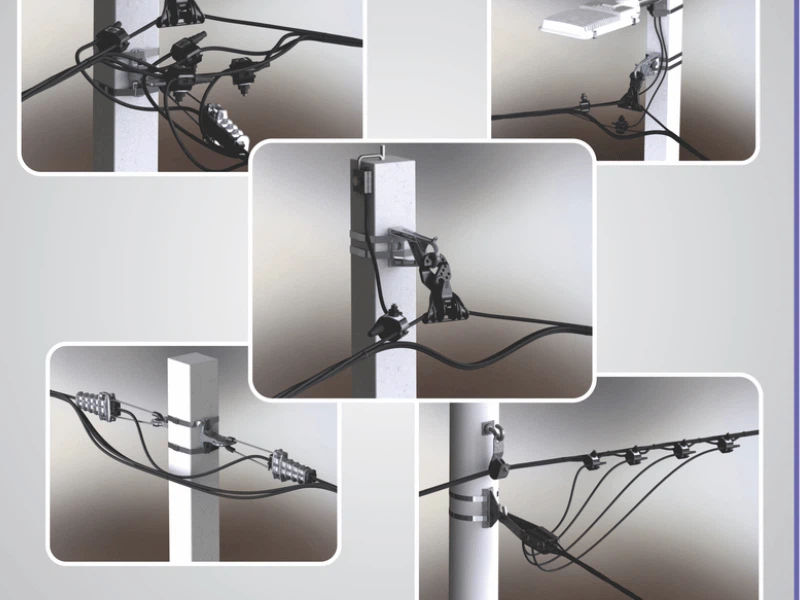
Dead end clamps integrate with mounting hardware through various connection methods, including pole bands, bolt-on brackets, and direct attachment systems. The selection depends on support structure type, installation height, and expected cable loads.
Comprehensive fiber optic cable hardware solutions include compatible mounting brackets and fasteners, simplifying procurement and ensuring proper component matching.
Environmental Protection Features
Exposed to weather extremes throughout their service life, dead end clamps require robust environmental protection. Premium designs incorporate UV-resistant polymers, corrosion-resistant metal alloys, and sealed entry points that prevent moisture infiltration.
UV Resistance
Specialized polymer components resist degradation from prolonged sunlight exposure
Temperature Resistance
Materials engineered to withstand extreme temperature fluctuations

Moisture Protection
Sealed designs prevent water ingress that could cause internal corrosion
Ice Loading Protection
Reinforced construction handles additional loads from ice accumulation
Customer-Focused Solutions
Addressing pain points across different market segments with tailored fiber optic cable hardware solutions
Telecommunications Service Providers Solutions

Supply Chain Consistency and Volume Fulfillment
Large-scale network deployments consume enormous quantities of hardware components. A major FTTH buildout might require hundreds of thousands of drop wire clamps, suspension clamps, and associated fiber optic cable hardware annually. Inconsistent supply availability or quality variation between production lots can derail deployment schedules, inflate costs, and compromise network reliability.

DIMI Solution
Leading hardware manufacturers addressing tier-one carriers maintain substantial inventory reserves, operate multiple production facilities to ensure supply redundancy, and implement rigorous quality control systems that eliminate lot-to-lot variation. Advanced supply chain management, including vendor-managed inventory programs and just-in-time delivery capabilities, ensures hardware availability matches deployment schedules without requiring carriers to maintain excessive inventory investments.
Standardization Across Multi-Vendor Ecosystems
Telecommunications networks often incorporate equipment and materials from numerous suppliers, creating compatibility challenges that complicate installations and limit component interchangeability. This complexity increases procurement burden, complicates installer training, and can create field situations where available components don't integrate properly.


DIMI Solution
Professional fiber optic cable hardware suppliers prioritize standards compliance and compatibility testing with common telecommunications equipment. Detailed technical documentation, including compatibility matrices and installation guides for various cable types and mounting scenarios, empowers network planners to specify hardware confidently. Some manufacturers offer customization services that adapt standard products to match unique network requirements while maintaining production efficiency.
Telecommunications Solutions

Installation Speed and Labor Productivity
Labor costs typically represent the largest component of installation project budgets, often exceeding 60% of total costs for aerial FTTH deployments. Hardware designs that require complex installation procedures, specialized tools, or multiple adjustment steps dramatically inflate labor hours and reduce crew productivity.

DIMI Solution
Premium hardware manufacturers design products specifically optimized for rapid installation. Features like tool-free installation, self-centering mechanisms, visual installation indicators, and universal mounting compatibility can reduce installation time by 40-60% compared to traditional designs. For contractors installing thousands of connection points, these efficiency gains translate directly into substantial labor cost savings and improved project margins. Additionally, products engineered for intuitive installation reduce training requirements, allowing contractors to deploy less experienced technicians effectively while maintaining installation quality.
Callback Reduction and Warranty Costs
Installation defects, premature hardware failure, or performance issues discovered after project completion generate costly callbacks that eliminate project profitability. Each service call consumes labor hours, vehicle expenses, and material costs—often exceeding the original installation cost—while damaging contractor reputation with customers and general contractors.

DIMI Solution
Professional-grade fiber optic cable hardware from reputable manufacturers dramatically reduces failure rates through superior materials, rigorous testing, and design validation. Products backed by comprehensive warranties, typically ranging from 5 to 25 years, provide contractors with confidence and recourse should issues arise. Additionally, manufacturers offering technical support, installation training, and troubleshooting assistance help contractors avoid installation errors that could generate future callbacks.

Network Equipment Suppliers and Distributors
Product differentiation and market positioning in competitive supply channels

International Infrastructure Projects
Managing complexity at scale across diverse global markets
Material Science and Manufacturing Excellence
The foundation of superior performance in professional fiber optic cable hardware
Advanced Material Engineering
Stainless Steel Metallurgy
The stainless steel used in professional telecommunications hardware undergoes specialized processing to optimize properties for aerial applications. Cold rolling processes increase tensile strength while maintaining ductility, allowing bands and buckles to withstand high tensions without brittle failure.
Surface finishing processes, including passivation treatments, enhance corrosion resistance by promoting stable chromium oxide layer formation. Different stainless steel grades offer distinct property profiles optimized for various environmental conditions.
Polymer Material Science
Modern fiber optic cable hardware increasingly incorporates advanced engineered polymers that offer compelling advantages in specific applications. UV-stabilized nylon compounds maintain mechanical properties despite years of sunlight exposure, while their inherent electrical insulation eliminates concerns about galvanic corrosion or electrical conductivity.
Premium polymer components incorporate sophisticated additive packages including UV stabilizers, antioxidants, impact modifiers, and color pigments. These additives, precisely formulated and thoroughly dispersed during manufacturing, ensure consistent long-term performance across the product's service life.
Precision Manufacturing Processe
Computer-Controlled Machining
Modern hardware manufacturing employs CNC (Computer Numerical Control) machining and forming equipment that achieves tolerances impossible with traditional manufacturing methods. Suspension clamps with precisely matched mating surfaces eliminate stress concentration points that could damage cables.
This manufacturing precision translates directly into field performance. Components that fit together smoothly install faster, require less installer adjustment, and deliver more consistent results across diverse installation conditions.
Quality Assurance Protocols
Leading manufacturers implement comprehensive quality management systems exceeding ISO 9001 requirements. Incoming raw material inspection verifies compliance with specifications before production begins.
In-process quality checks during manufacturing catch deviations before they affect finished products. Final inspection protocols ensure only conforming products reach customers.
Environmental Durability: Engineering for Decades of Reliable Service
Ultraviolet Radiation Resistance
Sunlight exposure represents one of the most significant degradation mechanisms for outdoor hardware. UV-resistant formulations and protective coatings maintain integrity despite decades of sunlight exposure.
Temperature Cycling and Thermal Stress
Aerial hardware experiences dramatic temperature variations. Professional designs account for thermal expansion through careful material selection and engineering to prevent fatigue failure.
standardized production
Sealed designs, drainage features, corrosion-resistant materials, and protective coatings provide redundant protection against water infiltration and moisture damage.
Installation Best Practices

Fiber Suspension Clamp Installation
Proper suspension clamp installation begins with selecting appropriate clamp models for the specific cable type and span conditions. Clamps must accommodate the cable diameter without excessive compression while providing sufficient grip.
Installation position along cable spans significantly impacts performance. Suspension clamps positioned at intervals matching cable sag calculations distribute loads optimally.
Clamp orientation matters more than many installers realize. J-hook designs should be positioned so cable weight naturally seats the cable into the hook's deepest position.

Drop Wire Clamp Best Practices
Drop wire clamps must maintain proper cable tension to prevent sagging while avoiding over-tensioning that could damage optical fibers. Industry guidelines typically recommend limiting tensile load on drop cables to 80% of the rated cable strength.
The wire wrapping technique for wrap-style clamps requires care to ensure proper engagement. Installers should follow the manufacturer's specified wrapping pattern.
For compression-type drop wire clamps, wedge insertion depth critically affects performance. Following manufacturer torque specifications ensures optimal performance.

Stainless Steel Banding Installation
Achieving proper banding tension represents the most critical factor in successful stainless steel band installations. Insufficient tension allows hardware movement, while excessive tension may deform mounting hardware.
The banding pattern—how bands wrap around poles or mounting hardware—affects installation strength and longevity. Manufacturers typically recommend specific wrapping patterns.
Proper buckle installation ensures reliable band retention. The buckle should be positioned on the band's smooth side, with teeth engaging the band's textured surface for optimal grip.

Dead End Clamp Application Guidelines
Dead end clamps require careful matching to specific cable constructions. ADSS cables with aramid yarn strength members need clamps designed to grip the aramid effectively without damaging the yarn or outer jacket.
Installation preparation includes ensuring the cable is clean and free from damage at the clamping location. Any jacket nicks, abrasions, or contamination can compromise clamp grip or create future failure points.
Orientation of dead end clamps relative to cable routing affects performance and appearance. Clamps should be positioned so the cable's natural routing aligns with the clamp body, avoiding sharp bends or unnatural cable positions.
As one of the most professional fiber optic cable hardware manufacturers and suppliers in China, we're featured by quality products and good service. Please rest assured to wholesale custom made fiber optic cable hardware from our factory.