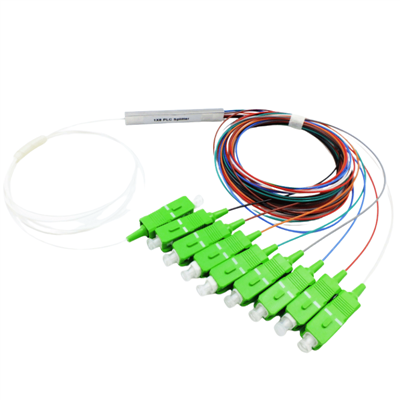
Technical Specifications
| Parameter | 1×2 | 1×4 | 1×8 | 1×16 | 1×32 |
|---|---|---|---|---|---|
| Operating Wavelength | 1260~1650nm | 1260~1650nm | 1260~1650nm | 1260~1650nm | 1260~1650nm |
| Fiber Diameter | 250μm | 250μm | 250μm | 250μm | 250μm |
| Insertion Loss (Max.) | ≤3.8dB | ≤7.1dB | ≤10.2dB | ≤13.5dB | ≤16.6dB |
| Insertion Loss Uniformity (Max.) | ≤0.4dB | ≤0.6dB | ≤0.8dB | ≤1.2dB | ≤1.5dB |
| Return Loss | ≥55dB | ≥55dB | ≥55dB | ≥55dB | ≥55dB |
| PDL (Max.) | ≤0.2dB | ≤0.2dB | ≤0.2dB | ≤0.3dB | ≤0.3dB |
| Directivity | ≥55dB | ≥55dB | ≥55dB | ≥55dB | ≥55dB |
| Fiber Type | G.657A1 | G.657A1 | G.657A1 | G.657A1 | G.657A1 |
| Operating Temperature | -40 to 85°C | -40 to 85°C | -40 to 85°C | -40 to 85°C | -40 to 85°C |
| Dimensions (H×W×D) | 0.16"×1.57"×0.16" (4×40×4mm) |
0.16"×1.57"×0.16" (4×40×4mm) |
0.16"×1.57"×0.16" (4×40×4mm) |
0.16"×1.97"×0.28" (4×50×7mm) |
0.16"×1.97"×0.28" (4×50×7mm) |
Customization Services
The DIMI PLC splitter product line covers a complete range of splitting ratio configurations including 1×2, 1×4, 1×8, 1×16, 1×32, 1×64, as well as 2×2, 2×4, 2×8, 2×16, 2×32, 2×64, meeting different scale requirements from small office networks to large carrier access networks.
Splitting Ratio
Supports asymmetric splitting (such as 1×3, 1×5, 1×12) and unequal splitting (each output port optical power distributed according to specified ratios).
Pigtail Parameter
Pigtail length options include 0.5m/1.0m/1.5m/2.0m or specified lengths; diameter options include 0.9mm, 2.0mm, 3.0mm.
Connector Type
Besides standard SC/APC, options include SC/UPC, LC/APC, LC/UPC, FC/APC, FC/UPC connectors, or bare fiber termination.
Identification & Label
Housing can be silk-screened with customer logos, project names, port numbers; pigtails can include custom tags for asset management.
Package Form
Besides ABS box type, options include steel tube type, miniaturized packaging, rack-mount type, wall-mount type, and IP65 protection grade outdoor models.
Fiber Type
Fiber types can include G.652D, G.657A1, G.657A2, or multimode OM3/OM4 fiber to meet specific application requirements.
Product Highlights
Wide Wavelength Coverage
1260~1650nm, supporting coexistence of multi-generation PON technologies including GPON, XG-PON, and 10G-EPON, enabling stable splitting transmission from central office to end users
Low Insertion Loss
≤16.6dB typical insertion loss with ≤1.5dB uniformity, ensuring consistent optical power distribution across all 32 output ports, guaranteeing sufficient link budget and reducing system maintenance costs
Compact Design
Compact ABS box design (18×120×80mm), compatible with rack mounting, wall-mount distribution boxes, fiber splice closures, and various deployment spaces, flexibly addressing centralized or distributed splitting requirements
Bend-Insensitive Fiber
G.657A1 bend-insensitive single-mode fiber, maintaining low additional loss even at 10mm bending radius, adapting to high-density cabling environments in cabinets and narrow cable trays
Plug-and-Play Installation
Pre-terminated SC/APC connectors for plug-and-play installation, reducing on-site splicing work, accelerating project deployment speed, and minimizing risks from manual operation errors
Wide Operating Temperature
-40~85℃ wide operating temperature range, passing rigorous temperature cycling and humidity tests, reliably applicable to outdoor fiber distribution cabinets, non-air-conditioned equipment rooms, and harsh environments
Core Feature
Bend-Insensitive Fiber Design
Utilizing bend-insensitive single-mode fiber compliant with ITU-T G.657A1 standard, the additional loss at 1550nm wavelength under 10mm bending radius is ≤0.5dB, significantly reducing microbending loss risks compared to traditional G.652D fiber.
This characteristic is particularly important in space-constrained scenarios such as high-density cabinet cabling, fiber storage in splice closures, and corner routing, preventing link loss increases or signal interruptions caused by excessive fiber bending.
Meanwhile, it maintains excellent compatibility with G.652D fiber, ensuring seamless integration with existing networks.
01
Low Loss and High Return Loss Suppression
Under 1×32 splitting configuration, typical insertion loss is ≤16.6dB (including connector loss), approaching the theoretical splitting loss value of 10×log₃₂≈15.05dB, with excess loss controlled within reasonable range.
Uniformity ≤1.5dB ensures minimal optical power variation among the 32 output ports, preventing imbalanced scenarios where "remote users experience weak signals while nearby users receive excessive power."
SC/APC angled polishing achieves ≥55dB return loss, effectively suppressing back-reflected light's impact on laser stability, protecting central office OLT equipment and improving system signal-to-noise ratio, especially suitable for high-speed PON systems and CATV analog signal transmission scenarios.
02
Wide Wavelength and Low Dispersion Characteristics
The 1260~1650nm wide operating wavelength range covers O-band, C-band, and L-band, supporting multi-wavelength multiplexing applications including 1310nm upstream, 1490nm downstream, and 1550nm video overlay.
Wavelength-dependent loss (WDL) ≤0.5dB ensures minimal loss variation across different wavelengths after splitting, meeting coexistence requirements for multi-generation technologies like GPON (1310/1490nm), XG-PON (1270/1577nm), and 10G-EPON (1270/1577nm).
Polarization-dependent loss (PDL) ≤0.3dB has minimal impact on polarization-sensitive high-speed coherent optical signals, reserving sufficient margin for future network upgrades.
03
Plug-and-Play Pre-Terminated Solution
All input and output ports are pre-installed with SC/APC connectors, with connector insertion loss already included in the overall loss specification.
On-site installation requires no fusion splicing equipment-only SC flanges or adapters are needed to complete end-to-end connections. This design significantly shortens project deployment cycles, reduces skill requirements for construction personnel, and minimizes failure risks caused by unstable on-site splicing quality.
The 1.5-meter pigtail length has been validated through practical engineering, meeting cabinet routing requirements while avoiding space waste and loss accumulation from excessive length.
04
Uniform Splitting and Signal Consistency
Leveraging the inherent advantages of PLC planar waveguide technology, this product achieves highly uniform splitting across 32 output ports. Throughout the entire operating wavelength range, the optical power difference between any two output ports is ≤1.5dB, far superior to fused biconical taper splitters.
This uniformity ensures that each terminal in multi-user scenarios receives essentially consistent optical power, preventing degraded user experience or insufficient link budget due to uneven splitting, particularly suitable for user-dense residential communities and commercial buildings.
05
Typical Applications

FTTH Fiber-to-the-Home
In residential community broadband access scenarios, PLC splitters are deployed in floor fiber distribution boxes or community equipment rooms, distributing carrier feeder fiber signals to optical network terminals (ONTs) in individual households.

FTTB Fiber-to-the-Building
Providing high-speed internet access and enterprise dedicated line services for commercial office buildings and industrial parks. Splitters are installed in floor equipment rooms or basement machine rooms.

Data Center Cabling
In small to medium data centers or enterprise machine rooms, serving as an important component of optical distribution frames (ODF), enabling flexible distribution from backbone fibers to server cabinet racks.

POL Passive Optical LAN
Deploying POL networks in large buildings such as hotels, hospitals, schools, and government office buildings to replace traditional copper cable Ethernet architecture.

CATV Distribution
Applied in the fiber segment of cable television HFC networks, distributing 1550nm modulated optical signals from headend equipment rooms to optical receivers in communities or districts.

5G Fronthaul & Midhaul
Used in 5G base station construction for fronthaul fiber links between BBU and AAU, or in midhaul segments for BBU pooling scenarios through WDM technology.

Need Custom Solutions?
If you have special technical requirements or bulk procurement needs, please contact the DIMI technical support team. We will provide optimized bare fiber PLC splitter solutions and professional pre-sales consulting services based on your network architecture and engineering environment.
Contact Sales Team
Hot Tags: bare fiber plc splitter, China bare fiber plc splitter manufacturers, suppliers, factory