Utility poles may look simple, but they are critical to modern infrastructure. Every day, they carry the electricity, internet, telephone, CATV and street lighting that millions of people depend on-so they are often called power poles, telephone poles, or distribution poles.
From rural lines crossing fields to dense city streets filled with power conductors and fiber optic cables, utility poles are the backbone of overhead power and communication networks. Choosing the right pole material, structure and hardware is not just a technical detail; it directly affects safety, reliability, maintenance cost and overall network performance. This guide helps network planners, engineers, project owners and buyers compare different types of utility poles and select the best option for their projects.
What Is a Utility Pole?

What is on a utility pole?
A utility pole is a vertical support structure designed to carry overhead lines and related equipment for power, telecom and other public services. While the traditional image is a simple wooden pole with a few wires, today's utility poles can be made from wood, steel, concrete, fiberglass/composite or ductile iron, and they often support a complex mix of:
- Power conductors for transmission and distribution
- Copper or fiber optic communication cables
- Street lighting and traffic signals
- Transformers, reclosers and switchgear
- Wireless antennas and small-cell equipment
In short, a utility pole is a compact "infrastructure tower" that concentrates multiple services in a small footprint along a route.
Why Utility Poles Still Matter in Modern Networks?
Despite the growth of underground cabling, utility poles remain critical because they:
- Reduce construction cost and time for long routes and rural areas
- Simplify maintenance and upgrades, since lines and hardware are visible and accessible
- Support multi-service deployments, combining power, telecom and fiber on the same structure
- Allow progressive network expansion, adding new circuits or cables as demand grows
For many utilities and telecom operators, the fastest way to expand coverage or roll out new services is still to use existing utility poles or install new overhead lines rather than build entirely new underground corridors.
Overview of Common Utility Pole Materials and Structures
Modern utility poles are available in several main materials, each with its own performance profile and typical use case:
- Wooden utility poles – traditional, low initial cost, easy to handle, but limited lifespan and higher inspection needs.
- Steel utility poles – high strength, long life, flexible designs for higher voltages and heavy loads.
- Concrete utility poles – very durable and stable, well suited for harsh environments, but heavy to transport and install.
- Fiberglass / composite utility poles – lightweight, corrosion-resistant and electrically insulating, ideal for corrosive or hard-to-access locations.
- Ductile iron utility poles – high-strength, long-life premium solution for mission-critical lines and severe environments.
Structurally, utility poles can be single poles, H-frames, guyed or self-supporting structures, and in some cases transition to higher structures such as monopoles or lattice towers for transmission lines.
In the following sections, this guide will examine each type of utility pole in detail, discuss design and engineering considerations, review hardware and accessories, and provide practical selection advice and FAQs to help you plan and purchase the right solution for your next project.
How Utility Poles Are Classified?

Classification by Material
| Material | Description | Key strengths | Typical use |
| Wooden utility poles | Traditional wood poles (pine, cedar, fir) with preservative treatment | Low initial cost; easy handling and climbing; natural insulation | Rural / suburban distribution; telephone lines; temporary or low–medium voltage |
| Steel utility poles | Tubular or multi-sided galvanized steel poles | High strength-to-weight ratio; long service life; flexible heights | Urban distribution; transmission structures; narrow or constrained corridors |
| Concrete utility poles | Reinforced or prestressed concrete poles | Excellent resistance to rot, insects and fire; very stable | Coastal and industrial areas; flood plains; high fire-risk zones; long-term routes |
| Fiberglass / composite poles | Fiber + resin composite, lightweight and corrosion-resistant | Low weight; electrical insulation; corrosion resistance; aesthetic options | Corrosive or remote locations; environmentally sensitive areas; joint power–telecom routes |
| Ductile iron utility poles | Cast ductile (nodular) iron poles, solid or in segments | High strength; excellent fatigue and impact resistance; very long life | Mission-critical lines; severe climates; premium projects focused on reliability |
Classification by Function and Voltage Level
Another practical way to classify utility poles is by what they carry and at what voltage level they operate.
Transmission line poles/towers
These structures carry high-voltage transmission circuits over long distances between substations.
Designed for very high mechanical loads, large conductor bundles and long spans.
Often taller, with larger clearances and more complex hardware than distribution or telecom poles.
Distribution line poles
Distribution poles carry medium-voltage lines that deliver power from substations to neighborhoods and commercial areas.
Commonly support transformers, reclosers, switchgear and low-voltage service drops.
Most "power poles" seen along streets fall into this category.
Telecom / CATV / fiber optic poles
These poles support communication services: copper telephone cables, coaxial CATV lines and fiber optic cables.
May be dedicated telecom poles, or more often, lower attachment levels on shared power poles.
Hardware focuses on cable support, tensioning and protection rather than high-voltage insulation.
Street lighting and traffic signal poles
These poles primarily support lighting fixtures, traffic signals and related equipment.
Loads are dominated by luminaires, brackets and wind acting on the fixtures.
In some corridors, lighting poles are combined with power or telecom functions.
Hybrid or shared-use poles
In many networks, a single pole carries power, telecom and sometimes lighting together.
Vertical space on the pole is divided by function and governed by clearance rules and safety codes.
Shared-use designs can reduce total pole count and construction cost, but require careful coordination between different utilities.
Classification by Structural Form
Finally, utility poles and line supports can be grouped by their structural configuration and how they resist loads.
Single-pole structures
These are the classic single vertical poles used in most distribution and telecom routes.
Economical and quick to install.
Adequate for moderate spans and loads where right-of-way is limited and aesthetics matter.
H-frame and multi-pole structures
H-frame structures use two or more poles connected by cross-members.
Provide higher stability, wider conductor spacing and greater load capacity than a single pole.
Often used in sub-transmission and transmission lines, or where large line angles and heavy equipment must be supported.
Guyed vs. self-supporting poles
Guyed poles rely on guy wires and anchors to resist unbalanced loads, wind and line tension.
Typically lighter and more economical.
Require additional space for anchors and guy leads.
Self-supporting poles resist loads without guying, using larger sections or stiffer materials.
Cleaner appearance and smaller footprint.
Higher material and foundation cost, but ideal where space is constrained or guy wires are undesirable.
Monopole vs. lattice structure
Monopoles are single, usually tubular or multi-sided poles with a compact footprint.
Common in urban transmission, telecom towers and high-capacity distribution lines.
Lattice structures are built from multiple steel members forming a truss-type tower.
Very efficient for extremely high loads and long spans.
Typically used in high-voltage transmission corridors rather than standard street-side poles.
By combining these three classification perspectives-material, function/voltage and structural form-engineers can describe and specify utility poles precisely, and select the most suitable design for each section of a network.
Wooden Utility Poles
Wooden utility poles are the "classic" option in many countries and are still the most common pole material worldwide for distribution and telephone lines. Even as steel, concrete and composite poles grow in popularity, wood remains attractive because it is economical, familiar to utilities, and supported by mature design and manufacturing standards.

Typical Wood Species and Standards
In practice, only a limited group of straight, strong tree species are suitable for utility poles. The most widely used include:
Southern yellow pine – the dominant pole species in the United States, especially for distribution lines.
Douglas fir – common for transmission and higher-strength applications.
Western red cedar – valued for natural decay resistance and lighter weight.
Other regional species such as jack pine, lodgepole pine, red pine and Alaska yellow cedar, depending on local forests and standards. Wikipedia+1
In North America, the key reference for wooden poles is ANSI O5.1 – Wood Poles – Specifications and Dimensions. This standard:
Defines approved species, pole classes and standard lengths.
Specifies minimum dimensions (top circumference, groundline circumference, straightness).
Sets requirements for conditioning and treatment, including seasoning, steam conditioning, incising and preservative penetration/retention.
Other regions use equivalent national or utility standards, but the core idea is similar: control species, geometry, strength and treatment so wooden poles behave predictably as structural members.
Manufacturing and Preservative Treatment
Although a wood pole looks "natural", the manufacturing process is quite controlled:
Harvesting and initial selection
Straight trees of suitable species and diameter are felled and cut to length.
Logs are inspected for unacceptable defects such as large knots, severe sweep, rot or mechanical damage. The ANSI Blog
Debarking, peeling and shaping
Bark is removed and the surface is peeled or shaved to a relatively smooth, uniform taper.
Ends are trimmed and the pole is cut to a standard length and class. The ANSI Blog+1
Seasoning and conditioning
Moisture is reduced by air drying, kiln drying, Boulton drying or steam conditioning, depending on species. Wood Utility Poles+1
In some cases, poles are incised (small cuts on the surface) or bored at the groundline to improve preservative penetration. The ANSI Blog+1
Preservative treatment
Poles are pressure-treated in cylinders with preservatives. Historically, creosote was common; today many utilities prefer alternatives such as pentachlorophenol (Penta), copper naphthenate, CCA/ACZA or newer systems like DCOI, depending on regulation and environmental policies.
Standards from ANSI, ASTM and the American Wood Protection Association (AWPA) define retention levels, penetration depths and quality control tests.
Branding and final inspection
Each pole is marked (branded) with information such as manufacturer, year, species, class and preservative system, typically in accordance with ANSI O5.1.
Environmental concerns around certain preservatives (especially creosote and older arsenical systems) have led to stricter regulations and a shift toward less hazardous chemicals, but the basic principle remains the same: a properly treated wood pole should resist decay and insects for decades in service.
Key Advantages of Wooden Utility Poles
Wooden poles remain popular because they offer a combination of practical benefits that is hard to match:
Low initial cost and wide availability
Wood is often the cheapest structural material per installed pole, especially in regions with strong forestry industries. Manufacturing infrastructure and supply chains are mature, which keeps procurement simple and lead times short. Cobb Lumber+1
Relatively light and easy to handle
Compared with concrete or ductile iron, wooden poles are lighter and can be handled with smaller cranes or even manually on some sites. This is particularly valuable in rural or remote areas with limited access for heavy equipment.
Natural electrical insulation
Although not a perfect insulator, dry wood has significantly higher electrical resistance than steel. This helps reduce the risk of stray currents through the pole body and simplifies some aspects of insulation and safety design.
Climbing and field work familiarity
Lineworkers are very familiar with climbing wooden poles using gaffs, and many existing work practices, tools and training programs are designed around wood. This can translate into efficient construction and maintenance.
Proven performance and standards
Wooden poles have over a century of field history. Design values, inspection methods and replacement strategies are well-documented in standards such as ANSI O5.1 and the National Electrical Safety Code (NESC). T
Limitations and Challenges
At the same time, wood has inherent vulnerabilities that utilities must manage carefully:
Decay, insects and woodpecker damage
Even with good treatment, fungal decay, termites and other insects can gradually weaken the pole, especially near the groundline where moisture and oxygen are present. In some regions, woodpeckers are reported as the leading cause of pole damage, creating cavities that reduce strength and invite further decay.
Fire risk and weathering
Wood is combustible. In wildfire-prone areas or under high fault currents, wood poles can ignite or be badly charred, compromising structural integrity. UV exposure, moisture cycling and freeze–thaw can also cause surface cracking and checking over time.
Shorter service life and higher inspection frequency
Typical service life for wood poles is often quoted in the 25–50 year range, strongly influenced by climate, soil and treatment quality. Because deterioration is not always visible, utilities must implement regular inspection and remedial treatment programs, which add ongoing operational cost.
Environmental and regulatory pressure
Some traditional preservatives are under increasing regulatory scrutiny, especially in environmentally sensitive areas. This can limit where certain treated poles can be used and influence long-term procurement strategy. Wikipedia+1
For projects where very long life, minimal inspection or high fire resistance are critical, utilities may prefer steel, concrete or composite alternatives, despite higher upfront cost.
Typical Applications and When to Use Wooden Poles
Because of their cost and handling advantages, wooden utility poles are still a very rational choice in many scenarios:
Rural distribution and telephone lines
Long routes, relatively low structure density, and modest mechanical loads make wood attractive.
Access may be difficult for heavy lifting equipment, so a lighter pole that can be handled by smaller crews is an advantage. Wikipedia+1
Low-to-medium voltage distribution in temperate climates
Where wildfire risk is moderate and soils are not excessively aggressive, treated wood can deliver decades of service at low cost. Wikipedia+1
Temporary or semi-permanent installations
For construction power, temporary lines, or pilot projects, wooden poles are often the most economical and readily available option.
Networks with established wood pole maintenance programs
Many utilities already have trained inspection crews, treatment protocols and replacement planning for wood. In such systems, continuing with wooden poles can make economic sense, especially for standard spans and voltages. Wood Utility Poles
In summary, wooden utility poles are not obsolete-they remain a practical, cost-effective solution where environmental conditions and reliability requirements are compatible with their natural limitations. In the next sections, this guide will compare wood with steel, concrete, composite and ductile iron poles to help you decide when upgrading to alternative materials is justified.
Steel Utility Poles
Steel utility poles have become a key alternative to traditional wood and concrete poles, especially in urban, high-load and long-life projects. With high strength, predictable material properties and fully recyclable steel, they offer utilities a durable and flexible platform for modern power and communication networks.

Types of Steel Utility Poles
Although "steel pole" is a generic term, there are several common structural forms:
Tapered tubular poles
These poles are made from round or polygonal (e.g. 8-, 12- or 16-sided) steel shells, often formed from flat plate and welded along a longitudinal seam.
The diameter decreases from base to top, creating a tapered profile.
This shape efficiently resists bending and wind loads while keeping weight under control.
Widely used for distribution lines, transmission structures, lighting and telecom.
Multi-sided poles
Multi-sided poles are technically tubular, but the cross-section is formed as regular polygons (often 8, 10 or 12 sides) instead of a smooth circle.
Multi-sided geometry improves bending strength and stiffness compared with flat faces.
The polygonal shape also helps with fit-up of hardware and bolt-on accessories.
Common in high-capacity distribution and sub-transmission lines.
Stepped and swaged poles
In some designs, the pole cross-section is built from multiple segments with different diameters:
Stepped poles: diameter changes in discrete steps between sections.
Swaged poles: the upper section is swaged (reduced) to fit into the lower section, providing a smooth transition and higher stiffness.
These designs are used where extra stiffness or height is required, for example:
Heavier conductor loads or larger line angles,
Combined functions (power + lighting + telecom on one pole),
Tall urban structures where deflection limits are tight.
Materials, Corrosion Protection and Standards
Carbon steel grades
Steel utility poles are typically made from structural carbon steels (e.g. S355 / S275, ASTM A572, ASTM A36, or equivalent GB/T / regional grades). The choice depends on required yield strength, wall thickness, weldability and local availability.
Hot-dip galvanizing and coatings
Because steel can corrode, surface protection is critical:
Hot-dip galvanizing (HDG) – poles are dipped in molten zinc, forming a zinc–iron alloy layer that provides barrier + sacrificial protection, and is the most common solution.
Additional coatings – zinc-rich primers plus paint, polymer or powder coatings, or duplex systems (HDG + paint) are used for extra durability or coastal / industrial environments.
With correct detailing and coating, steel utility poles can reach 50+ years of service life with limited structural degradation.
Relevant design and safety standards
Steel poles must comply with both structural codes and electrical safety rules:
Structural: standards for steel structures, wind and ice loads (EN, AISC/ASCE/IEC or national codes).
Electrical: codes such as NESC or regional equivalents, defining clearances, load combinations, safety factors and working space.
Utility specs: may further specify minimum grades and thicknesses, galvanizing and coating requirements, welding and testing procedures.
For buyers, the key is to ensure that poles are fully engineered, coated and tested to these standards, with proper documentation from the manufacturer.
Concrete Utility Poles

Types of Concrete Utility Poles
| Type | Structure / Process | Key Features | Typical Use Cases |
|---|---|---|---|
| Pre-stressed concrete poles | Steel strands/wires tensioned before or during casting; concrete cures in compression | Higher bending strength, fewer cracks, slimmer section | Transmission and distribution poles, long-life projects |
| Spun concrete poles | Concrete cast in rotating mold, often hollow section | High density, smooth finish, stronger and lighter than solid | High-performance lines, tall poles, lighting & transmission |
| Non-spun (cast) concrete poles | Concrete cast in static mold, may be solid or partially cored | Simpler production, heavier for same strength | Shorter, lower-load poles, local networks |
Strength, Durability and Environmental Performance
| Performance Aspect | Concrete Utility Poles | Compared to Wood | Compared to Bare / Poorly Protected Steel |
|---|---|---|---|
| Rot / decay resistance | Immune to biological rot | Much better | Better (no biological decay) |
| Insects / animals | Not affected by insects or woodpeckers | Much better | Similar (both unaffected by insects/woodpeckers) |
| Fire resistance | Non-combustible, can withstand high temperatures for a time | Far better (wood burns) | Generally better in wildfires |
| Humidity / high moisture | Very good, no rot; reinforcement needs proper cover | Much better | Better if concrete quality is good |
| Coastal / salt exposure | Good with proper design and cover for steel inside | Better (no preservative leaching) | Often better than exposed steel |
| Flooded / wet soils | Good; no decay, no chemical leaching as with treated wood | Better (no preservative issues) | Better or similar, depending on steel protection |
Advantages of Concrete Utility Poles
| Advantage | What It Means in Practice | When It Matters Most |
|---|---|---|
| Long service life, minimal maintenance | 50+ years possible with limited structural maintenance | Long-term transmission/distribution projects |
| Excellent stability and rigidity | Small deflections under wind/line loads; stable clearances | Crossings over roads, railways, congested urban areas |
| High fire and heat resistance | Non-combustible, better performance in wildfire and high-fault scenarios | Wildfire-prone regions, fault-critical networks |
| No rot, insects, woodpeckers | Eliminates common wood failure modes | Humid, forested, insect-heavy areas |
| Good environmental compatibility | No preservative chemicals; less concern for leaching into soil and water | Coastal, wetlands, protected environments |
| Predictable engineering behavior | Well-known structural properties, easy to model and design | Complex load cases, stringent safety and reliability codes |
Limitations and Drawbacks
| Limitation / Challenge | Impact on Project | Mitigation / Design Consideration |
|---|---|---|
| Very heavy | Higher transport and lifting cost; need larger cranes and trucks | Plan logistics early; use spun/hollow designs where possible |
| Difficult to modify in the field | Hard to drill or cut; risk of cracking and exposing reinforcement | Finalize hardware positions in design; pre-cast inserts |
| Strict handling requirements | Risk of internal cracks or spalling if mishandled | Use correct lifting points and slings; trained crews |
| Foundation and soil demands | Heavy weight increases foundation load; risk of settlement in soft soils | Detailed geotechnical design; larger or improved foundations |
| Brittle failure mode | More sudden failure at extreme overload vs. ductile yielding | Higher safety factors; conservative design in high-risk areas |
Typical Applications
| Application Scenario | Why Concrete Poles Are Suitable | Notes for Design / Selection |
|---|---|---|
| Coastal lines / marine environments | Good resistance to salt, humidity and wind; no wood rot or preservative leach | Use high-quality concrete cover & corrosion detailing |
| Flood plains / high-water areas | No decay in wet soils; no preservative contamination | Pay attention to scour, uplift and foundation design |
| Wildfire-prone regions | Non-combustible; better survival in wildfires than wood | Check high-temperature performance for critical lines |
| Long-term infrastructure (weight less critical) | Very long life and low maintenance over decades | Suitable where road access and large cranes are available |
| Industrial / corrosive environments | Resistant to many industrial atmospheres; no wood preservatives | Pair with corrosion-resistant hardware and fasteners |
| Critical crossings (roads, railways, rivers) | High stiffness, tight clearance control | Often combined with spun/pre-stressed high-performance designs |
Fiberglass / Composite Utility Poles
Fiberglass / composite utility poles are engineered structures made from high-strength fibers embedded in a polymer resin matrix. Unlike wood, steel or concrete, their properties can be tuned during design, making them especially attractive where low weight, high corrosion resistance and electrical insulation are required.

What Are Fiberglass / Composite Utility Poles?
Composite poles are built from two main components:
Reinforcing fibers – typically glass fibers (sometimes combined with carbon or aramid) that carry most of the tensile and bending load.
Resin matrix – usually polyester, vinyl ester or epoxy, which binds the fibers together, transfers loads and protects against moisture and mechanical damage.
Common manufacturing methods include:
Filament winding – continuous fibers impregnated with resin are wound around a mandrel in controlled angles, then cured.
Pultrusion / molding – fibers are pulled or laid into a die or mold, saturated with resin and cured under heat and/or pressure.
Quality control focuses on fiber/resin ratio, curing, dimensions and mechanical tests, so the finished pole has predictable strength and stiffness.
Mechanical and Electrical Properties
From an engineering perspective, composite poles offer:
High strength and tailored stiffness
Ultimate bending strength comparable to or higher than wood, depending on design.
Stiffness can be tuned via fiber orientation and wall thickness to meet deflection limits for given spans and wind loads.
Controlled deflection
Designers can target specific top-of-pole deflection criteria, even with low overall mass.
This is important for clearances over roads, railways and crossings.
Natural corrosion resistance
The composite shell does not rust or rot and is highly resistant to moisture, salt and many industrial chemicals.
Electrical insulation
The pole body is non-conductive, which simplifies some aspects of grounding and reduces the risk of dangerous touch potentials compared with bare steel structures.
Advantages of Composite Utility Poles
Key benefits of fiberglass / composite poles include:
Lightweight and easy to handle
Much lighter than concrete and often lighter than equivalent wood or steel poles.
Enables transport with smaller trucks and cranes; in some remote locations, installation is possible with light equipment or helicopters.
Excellent corrosion resistance and long life
No rot, insect attack, woodpecker damage or metallic rust.
Particularly attractive in coastal, high-humidity and industrial environments, where traditional materials suffer.
Built-in electrical insulation
The non-conductive structure adds a layer of safety for joint power–telecom routes and areas with frequent lightning or induced voltages.
Aesthetic and environmental flexibility
Poles can be supplied in different colors, surface textures and slim profiles that blend into urban, residential or scenic environments.
No preservative leaching into soil or water as with some treated woods.
Applications and Use Cases
Composite utility poles are especially attractive for:
Remote or hard-to-access areas
Mountainous terrain, forests, islands or off-road routes where heavy cranes cannot reach.
Low weight reduces logistics cost and allows smaller installation teams.
Corrosive environments and coastal zones
Lines exposed to salt spray, high humidity or aggressive industrial atmospheres.
Composite poles can dramatically reduce corrosion-related failures and maintenance compared with steel and wood.
Wetlands, flood plains and environmentally sensitive sites
Locations where soil and water protection is important and where repeated heavy maintenance access is undesirable.
Joint power–telecom overhead lines
Shared structures carrying distribution circuits, CATV and fiber on the same pole.
Electrical insulation and corrosion resistance support safe, long-term multi-service operation.
Strategic reliability-critical spans
Key crossings (highways, rivers, critical feeders) where high strength, low maintenance and corrosion resistance are essential.
Ductile Iron Utility Poles

Structural and Corrosion Performance
Ductile iron poles are usually designed as hollow, tapered castings with wall thickness optimized for bending strength and stiffness. Structurally, they offer:
High load capacity for bending and compression, comparable to or better than many steel and concrete designs in similar applications.
Stable stiffness and deflection behavior over the entire service life.
For corrosion protection, ductile iron poles typically use:
Hot-dip galvanizing,
And/or exterior coatings (paint, powder or duplex systems).
With proper protection and detailing, ductile iron poles can achieve service lives of several decades with minimal structural degradation, making them attractive for long-horizon investments.
Advantages and Trade-Offs
Key advantages
Long-term performance and low maintenance
No rot or insect damage, no internal corrosion like poorly protected steel.
Inspection cycles and corrective maintenance can be reduced compared with wood and some steel solutions.
Weight vs. concrete and steel
Typically lighter than equivalent concrete poles, easing transport and erection.
Heavier than thin-wall steel poles, but with very robust wall thickness and impact resistance.
High reliability image
Suitable for utilities that want a "fit-and-forget" solution on critical routes and are willing to pay for premium materials.
Main trade-offs
Higher initial cost
Casting, machining and protective coatings make ductile iron poles more expensive per unit than standard wood or many steel poles.
Availability and lead time
Fewer manufacturers offer ductile iron poles compared with wood or steel, so lead times and regional availability must be confirmed early in project planning.
Typical Applications and Project Types
Ductile iron utility poles are best used where their premium characteristics can be fully leveraged:
Mission-critical power lines
Feeders to hospitals, data centers, industrial plants and key substations.
Sections where outages have very high financial or safety impact.
Harsh environmental conditions
Coastal, high-humidity, industrial or chemically aggressive areas.
Regions with frequent storms, ice loading or high wind where robust structures are required.
Replacement for concrete or wood in premium projects
Upgrading aging wood or concrete poles on strategic routes to improve reliability and reduce long-term maintenance.
New build projects where a long design life and low inspection burden are part of the specification.
In short, ductile iron utility poles are not a mass-market choice, but a high-end solution for utilities and project owners who prioritize maximum reliability, durability and lifecycle performance over lowest initial cost.
Utility Pole Accessories and Pole Line Hardware
A utility pole is only as reliable as the hardware that connects conductors, cables and equipment to it. Pole line hardware must safely carry mechanical loads, maintain electrical clearances and withstand the environment for decades with minimal maintenance.
This section gives a system-level overview of the main hardware families so designers and buyers can specify complete, compatible solutions, not just "a pole plus some fittings".

Structural Hardware
Structural hardware connects the pole to cross arms, guys and anchors and defines how wind, ice, conductor tension and equipment weight are transferred into the structure.
Cross arms and cross arm braces
Function: Support conductors (and sometimes telecom cables) away from the pole to provide phase spacing and clearances.
Types: Wood, steel or composite cross arms; flat, angle or tubular braces.
Key points:
Design for bending and torsion under unbalanced loads.
Use proper arm brackets, through-bolts and large washers/backing plates to spread load into the pole, especially for concrete and composite poles.
Pole bands, brackets and mounting hardware
Function: Provide flexible mounting points around the pole circumference without excessive drilling.
Examples: Pole bands for cross arms, transformers, closures or street lights; universal brackets with slotted holes.
Key points:
Use curved saddles that match the pole profile to avoid local crushing.
Use multiple bolts or band paths to distribute load.
Anchor rods, guy anchors and guy wires
Function: Transfer unbalanced line tension and angle loads into the ground.
Components: Screw or plate anchors, anchor rods, guy wires/stays, preformed guy grips, guy clamps, turnbuckles.
Key points:
Anchor capacity must cover maximum unbalanced load plus safety factors.
Corrosion protection is critical at the soil interface and splash zone.
Electrical Hardware
Electrical hardware ensures that conductors and primary equipment are mechanically secure, properly insulated and protected against faults and surges.
Insulators and conductor clamps
Function: Provide mechanical support and electrical insulation between live conductors and grounded structures.
Types: Pin, post and suspension insulators; suspension, tension/dead-end and jumper clamps.
Key points:
Match creepage distance, mechanical rating and voltage class.
Use armor rods and protective fittings where needed to prevent conductor damage and vibration fatigue.
Arresters, transformers and switchgear mounting
Function: Mount equipment with adequate clearances and safe access.
Examples: Transformer brackets and platforms; mounting hardware for cutout switches, reclosers, sectionalizers, capacitor banks; surge arrester brackets.
Key points:
Check combined static and dynamic loads (weight, wind, switching and short-circuit forces).
Maintain safe working space and required switching clearances.
Grounding systems and bonding hardware
Function: Safely dissipate fault and lightning currents and equalize potentials between metallic parts.
Components: Ground rods/electrodes, grounding conductors, ground clamps, bonding straps and connectors for poles, guys, messengers, OPGW down-leads and equipment housings.
Key points:
Achieve low, stable earth resistance, especially for HV and joint-use poles.
Bond all exposed metallic parts within reach to the grounding system to reduce touch and step voltages.
Telecom and Fiber Optic Hardware
As more fiber and telecom services move onto existing poles, telecom-specific hardware is just as important as traditional power fittings.
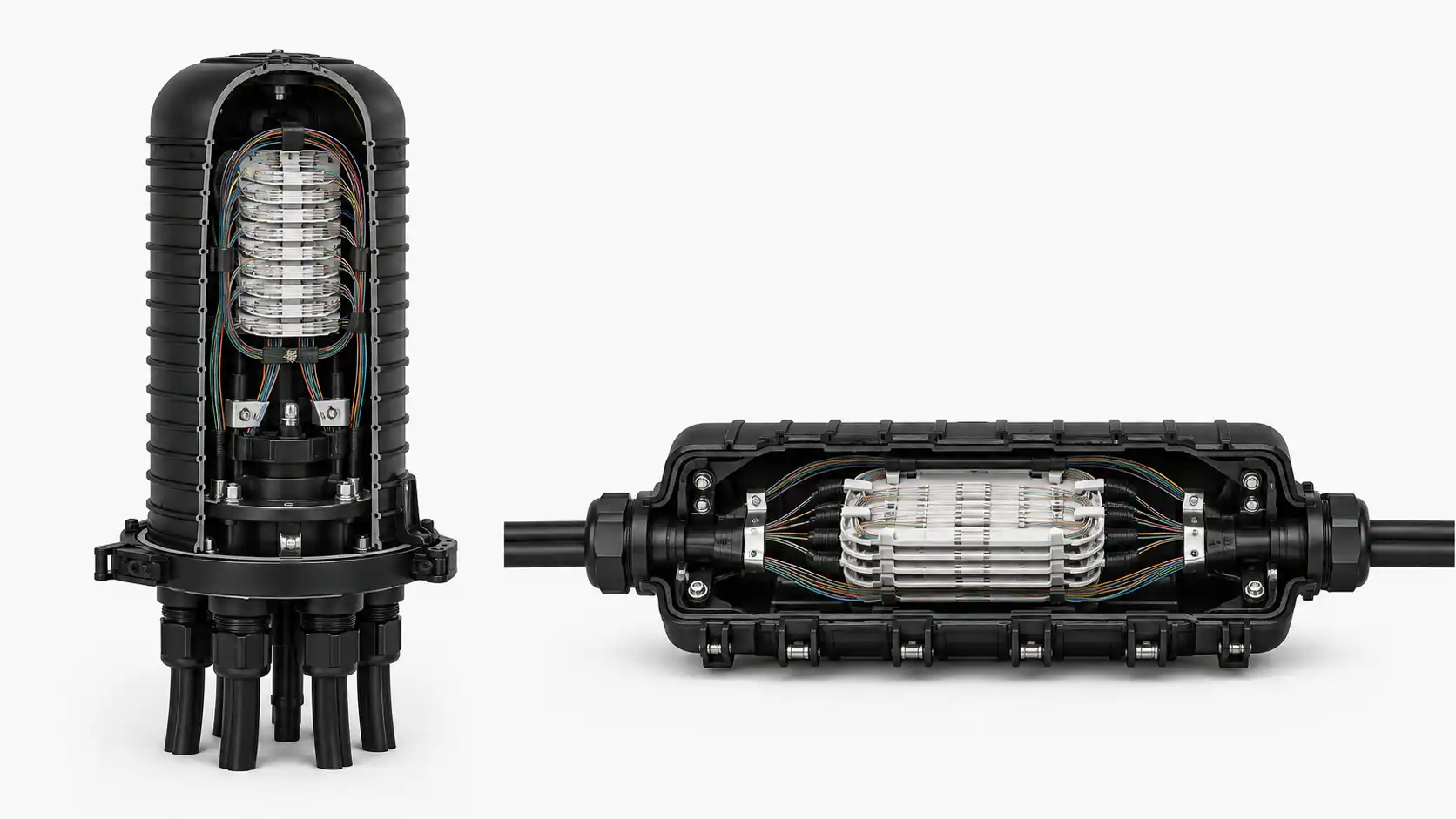
Fiber optic termination and splice closures
Function: Protect splices and terminations from moisture, mechanical damage and UV.
Mounting: Pole-mounted closures with banding brackets or back plates; distribution terminals and drop cabinets for FTTH/FTTx.
Key points:
Provide enough slack storage and bend control.
Ensure closures/boxes are accessible for maintenance without entering high-voltage zones.
Suspension clamps and tension clamps for ADSS and Figure-8
Function: Carry cable weight and tension safely under wind and ice loading.
Types: Suspension clamps (often with cushions or armor rods) at intermediate spans; tension/dead-end clamps or preformed dead-ends at terminations and angles.
Key points:
Match clamp design to cable type, diameter and rated tensile strength.
Use pole bands, universal brackets or cross arms to anchor clamps without damaging the pole.
Cable brackets, hooks and messenger hardware
Function: Organize and support telecom cables and drops.
Examples: Messenger clamps for copper/coax strands and Figure-8 messengers; cable brackets and hooks; drop wire clamps.
Key points:
Maintain clear separation from power circuits and preserve climbing space.
Use stainless or galvanized materials appropriate for the environment (coastal, industrial, etc.).
Corrosion Protection and Fasteners
Fasteners and small fittings often corrode or fail first, so they must be specified explicitly.
Bolts, nuts, washers and treatments
Function: Provide durable, secure connections between hardware and the pole.
Common choices: Hot-dip galvanized bolts, nuts and flat/spring washers; large or square washers/plates to spread load on wood, concrete and composite poles.
Protection:
Hot-dip galvanizing as the baseline.
Additional top coats or sealants in very aggressive environments.
Stainless vs. hot-dip galvanized options
Hot-dip galvanized steel – cost-effective for most climates; widely used for structural hardware, cross arms, brackets and guy components.
Stainless steel (e.g. 304/316) – preferred in coastal, high-humidity and chemical environments, and common for telecom/fiber banding, small clamps and fasteners where long-term appearance and corrosion resistance matter.
Choosing the right combination of base material and coating system is critical to match the pole's design life in each environment.
Integrated Pole Line Hardware Solutions
Instead of ordering fittings one by one, many utilities and contractors prefer pre-engineered hardware packages matched to specific line types and pole materials.
One-stop kits for distribution lines
Kits can be configured for:
Single- or double-circuit distribution poles.
Tangent, angle and dead-end structures.
Standard voltage classes and span ranges.
Typical contents:
Cross arms and braces, insulators and conductor clamps.
Guy anchors, guy wires and grips.
Pole bands, brackets, bolts, nuts and washers sized for the chosen pole material.
Hardware packages for overhead fiber projects
Tailored for ADSS, OPGW or Figure-8 builds on existing or new poles.
Can include:
Suspension and tension clamps matched to the cable.
Pole bands, universal brackets, splice-closure brackets and slack-storage hardware.
Messenger clamps, drop wire clamps and small telecom brackets.
Benefits:
Ensures mechanical and geometric compatibility across all components.
Simplifies procurement and reduces on-site improvisation and rework.
By treating utility poles and pole line hardware as a single integrated system, project owners can achieve higher reliability, cleaner installations and smoother construction-and at the same time create a clear path to promote their own hardware product lines as complete, ready-to-install solutions.
FAQ about Utility Poles

What are utility poles made of?
Modern utility poles are most commonly made from wood, steel, concrete, fiberglass/composite, and ductile iron.
Wood (pine, cedar, fir) is preservative-treated for decay and insect resistance.
Steel poles are tubular or multi-sided and usually hot-dip galvanized.
Concrete poles are reinforced or pre-stressed for high stiffness and durability.
Fiberglass/composite poles use fibers in a resin matrix for low weight and corrosion resistance.
Ductile iron poles are cast structures with high strength and very long service life.
How tall is a typical utility pole?
Most distribution poles are about 10–15 m (35–50 ft) tall, depending on voltage, span length and clearance requirements. Transmission structures can easily reach 18–40 m (60–130 ft) or more, especially for river, highway or railway crossings.
How deep are utility poles buried in the ground?
A common rule of thumb is:
Burial depth ≈ 10% of the pole length + 0.6 m (2 ft)
So a 12 m (40 ft) pole is typically buried about 1.8–2.0 m (6–6.5 ft). Very tall poles or poor soil conditions may require deeper embedment or special foundations.
How much does a utility pole weigh?
Weight depends on material, length and design. As a rough guide for a 12 m (40 ft) pole:
Wood: ~250–500 kg (550–1,100 lb)
Steel: ~350–800 kg (770–1,760 lb)
Concrete: ~800–1,500+ kg (1,760–3,300+ lb)
Fiberglass/composite: ~100–300 kg (220–660 lb)
Always use the manufacturer's specified weight for transport and lifting calculations.
How long do wooden / steel / concrete / composite utility poles last?
Typical service-life ranges under normal conditions are:
Wooden poles: ~25–50 years
Steel poles: ~40–60+ years (with good coatings)
Concrete poles: ~50+ years
Fiberglass/composite poles: often 40–50+ years, depending on UV and environmental exposure
Ductile iron poles: typically 50–75+ years in premium applications
Actual life depends on climate, loading, soil, inspections and maintenance practices.
How do I know when a utility pole should be replaced?
A pole is usually replaced when:
There is visible structural damage (rot, cracks, severe spalling, major impact damage, excessive lean).
It fails strength or groundline tests during inspection.
It no longer meets clearance or loading requirements after adding new circuits or equipment.
It falls below the utility's defined condition or safety threshold in its inspection program.
Can existing wooden poles be reused for overhead fiber optic cables?
Yes, many FTTH/FTTx projects reuse existing wood distribution poles, but only after checking:
Remaining strength and load capacity for additional cable and hardware.
Clearances and space in the communication zone.
Pole condition (no severe decay, leaning or damage).
Joint-use agreements between power and telecom operators.
When these conditions are met, fiber can be added using appropriate suspension clamps, tension clamps, pole bands, splice closures and drop hardware.
Where can I buy utility poles and pole line hardware in bulk?
Bulk purchases typically go through:
Utility pole manufacturers (wood, steel, concrete, composite, ductile iron), who can provide engineering data and custom designs.
Pole line hardware manufacturers/system suppliers, offering full ranges of cross arms, insulators, clamps, pole bands, anchors, brackets, splice closures, messenger hardware and fasteners.
If this is for your company site, you can finish with a soft CTA, for example:
"For bulk orders of utility poles and complete pole line hardware solutions, please contact our engineering team for technical support and factory-direct pricing."