CWDM and DWDM represent two distinct wavelength-division multiplexing approaches standardized by the ITU, each tailored to different network requirements. CWDM, defined under ITU-T G.694.2, employs a relatively wide 20nm channel spacing across the 1270–1610nm wavelength range, accommodating up to 18 channels. This makes it well suited for metro and access networks where transmission distances typically remain below 80km. DWDM, governed by ITU-T G.694.1, operates within the primary DWDM bands - the C-band and L-band (1525–1610nm) - and utilizes much narrower channel spacing of either 0.8nm or 0.4nm, corresponding to 100GHz and 50GHz on the ITU-T grid respectively. With the ability to multiplex over 80 wavelength channels onto a single fiber, DWDM is the predominant solution for long-haul, high-capacity backbone transport systems.
Both technologies solve the same fundamental problem - getting more data through existing fiber infrastructure - but they make very different trade-offs in cost, capacity, and reach. This guide walks through those differences and helps you determine which technology fits your network.

What Is CWDM Technology?
With 18 channels and a wavelength spacing of 20nm, CWDM's wide channel gaps mean its transceivers can use uncooled lasers that tolerate wavelength drift caused by temperature changes. This makes CWDM modules simpler, cheaper, and lower in power consumption compared to their DWDM counterparts.
CWDM supports data rates up to 10G per channel in most practical deployments and can reach distances of approximately 80km without optical amplification. However, CWDM cannot use EDFA amplifiers to extend beyond this range - its channels spread across too wide a spectrum for a single amplifier to cover.
What Is DWDM Technology?
DWDM's channel spacing of just 0.8nm or 0.4nm demands cooled lasers with precise temperature control to keep each wavelength stable and prevent signal interference between adjacent channels. This is the primary reason DWDM transceivers cost more and consume more power than CWDM modules.
This narrow spacing within the C-band is not arbitrary. The C-band sits at the point of lowest attenuation in silica fiber, and it is also the exact gain window of EDFA (Erbium-Doped Fiber Amplifier) technology. This means DWDM wavelengths can be amplified and transmitted across thousands of kilometers - something CWDM fundamentally cannot do. DWDM also supports much higher per-channel rates, including 100G, 400G, and beyond using coherent detection technology.
Wavelength Comparison
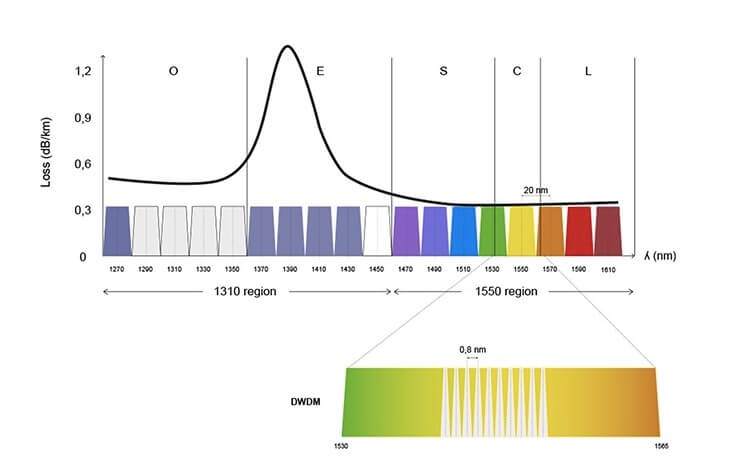
The most intuitive way to understand the difference is to look at where the ITU channels for CWDM and DWDM sit on the optical spectrum. The 18 CWDM wavelengths are spread across a 340nm range. Over 80 DWDM channels are packed into a roughly 37nm window within the C-band. In fact, the entire DWDM channel grid occupies a space equivalent to about two CWDM channels - the ones centered near 1530nm and 1550nm.
DWDM can carry far more data because it uses the spectrum more efficiently, fitting dozens of channels where CWDM fits two.
Why CWDM Loses Channels Over Distance
Standard single-mode fiber has a region of elevated signal loss between approximately 1370nm and 1430nm, caused by residual water ions (OH⁻) in the glass. In this zone, attenuation can reach around 1.0 dB/km - roughly four times higher than the normal 0.25 dB/km seen elsewhere in the spectrum. This is known as the water peak.
For short links under 40km, the extra loss in this region is manageable and all 18 CWDM channels remain usable. But as distance increases beyond 40km, the four to five channels that fall within the water peak zone become too lossy to maintain a reliable signal. This effectively reduces CWDM's usable capacity from 18 channels to roughly 8 to 10 at longer distances.
DWDM avoids this problem entirely because all of its channels are concentrated in the C-band, which sits in the lowest-loss region of the fiber spectrum. Modern low water peak fiber (G.652.D) does reduce the water peak effect, but it does not solve CWDM's other fundamental limitation: the inability to amplify.
CWDM vs DWDM: Key Differences
| Aspect | CWDM | DWDM |
|---|---|---|
| Channels | 18 (8–10 at longer distances) | 40–96+ |
| Channel spacing | 20nm | 0.8nm (100GHz) / 0.4nm (50GHz) |
| Wavelength range | 1270–1610nm | C-band: 1528–1565nm |
| Max reach without amplification | ~80km | ~80–120km |
| Max reach with amplification | Not supported | Thousands of km (EDFA) |
| Practical per-channel rate | Up to 10G | 100G, 400G, and higher |
| Laser type | Uncooled DFB | Cooled DFB / EML / Tunable |
| Relative transceiver cost (10G) | Lower (baseline) | ~1.2–1.8x higher |
| Operational complexity | Very low (passive, plug-and-play) | Low (passive) to moderate (active with amplifiers) |
Dimi's Tips
The capacity gap is not incremental - it is exponential. CWDM's theoretical maximum is around 18 channels at 10G each, totaling 180Gbps. DWDM at 80 channels of 100G delivers 8Tbps on a single fiber - and with 400G coherent optics, far more.
Cost is more than transceiver price. CWDM transceivers cost less per unit. But total network cost depends heavily on how many fibers you need. Both WDM technologies reduce fiber count, but DWDM reduces it far more aggressively. When dark fiber is leased rather than owned, or when fiber routes are congested, DWDM's higher per-module cost can be more than offset by fiber savings. The traditional assumption that CWDM is always cheaper holds true only when channel counts are low and fiber is readily available.
Passive DWDM is not complex. In reality, passive DWDM systems - which cover the majority of enterprise and metro deployments under 80km - work identically to CWDM: a pair of MUX/DEMUX units, standard transceivers, and no active components in the optical path. The increased operational burden only appears when you add amplifiers and active line systems for long-haul transmission.
Should You Use CWDM or DWDM?
When to choose CWDM
CWDM works well when your transmission distance is under 40km, your channel requirement is eight or fewer, and your per-channel bandwidth stays at 10G or below. Typical use cases include enterprise campus interconnects between buildings, small storage area network extensions, and metro access networks with moderate capacity needs. If you already have a CWDM deployment with channels to spare, there is no need to migrate.
When to choose DWDM
Choose DWDM when your link distance exceeds 80km, when you need more than ten independent channels, when any link requires 100G or above, or when you are building a new network that needs to scale over a five to ten year horizon. Data center interconnect at 100G or 400G speeds, metro core ring networks, and any scenario requiring optical amplification all point to DWDM without ambiguity.
Hybrid deployment of both
If you have an existing CWDM system that is running out of channels but you are not ready for a full DWDM migration, a hybrid approach can serve as a bridge. By repurposing the 1530nm and 1550nm CWDM channel windows, you can overlay up to 13 DWDM channels within each 20nm window using 100GHz spacing - adding up to 26 new channels while keeping your existing CWDM services running.
However, there are constraints. EDFA amplification cannot be used on a hybrid link because it would interfere with the surrounding CWDM channels. The DWDM overlay channels are limited to passive reach, and wavelength planning becomes more complex.
FAQ
Q: Can I upgrade from CWDM to DWDM without replacing the fiber?
A: Yes. Both CWDM and DWDM operate over standard G.652 single-mode fiber. The fiber itself does not need to be replaced - only the MUX/DEMUX units and transceivers change. This is one of the reasons a phased migration from CWDM to DWDM is practical.
Q: Do CWDM and DWDM transceivers work in the same switches and routers?
A: Generally, yes. Both CWDM and DWDM transceivers are available in standard form factors such as SFP, SFP+, SFP28, and QSFP28. As long as your switch or router has compatible ports and supports the data rate, it does not matter whether the transceiver uses a CWDM or DWDM wavelength - the host device sees a normal Ethernet or Fibre Channel link.
Q: What is a tunable DWDM transceiver and when should I consider one?
A: A tunable DWDM transceiver can be configured to operate on any channel across the C-band, rather than being fixed to a single wavelength at the factory. This significantly simplifies spare parts management - instead of stocking one backup module for each wavelength, you can keep a small number of tunable units that cover all channels. Tunable transceivers are particularly valuable in networks with many DWDM wavelengths or in environments where minimizing inventory complexity matters.
Q: Is CWDM technology becoming obsolete?
A: No. While DWDM dominates in high-capacity and long-haul scenarios, CWDM continues to serve a clear role in short-distance, cost-sensitive deployments. It is also finding new relevance in 5G fronthaul networks, where 25G CWDM LAN-WDM schemes are widely adopted for connecting radio units to baseband processing equipment.