Long-haul and metro networks are both fiber optic transport infrastructure, but they are built for different problems. Confusing the two leads to over-engineered deployments, unnecessary cost, or networks that cannot meet latency requirements. This article covers how they differ across distance, capacity, latency, and technology - and uses Google's B4 network as a concrete example of how the two layers work together in practice.
What Are Long-Haul and Metro Networks?
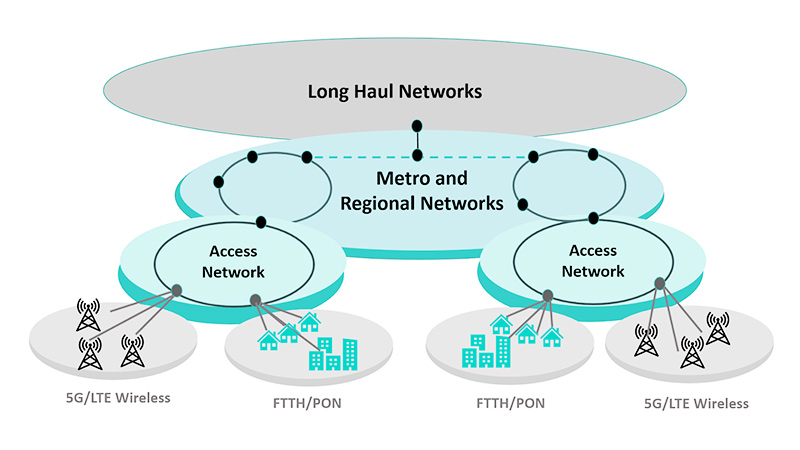
Long-haul optical fiber networks are backbone infrastructure built to carry data across cities, countries, and continents. Transmission distances typically range from 1,000 to 2,500 km, with some deployments exceeding 4,000 km. These networks form the primary arteries of global internet traffic, connecting metro networks to one another across vast geographic distances.
Metro networks - also called metropolitan area networks (MANs) - operate within a city or urban region, typically across distances of 80 to 1,000 km. They connect offices, data centers, campuses, and service provider points of presence (POPs) within a local area.
The two are not alternatives to each other. Long-haul networks connect metro networks across regions. Metro networks deliver that connectivity to end users and businesses locally.
Long-Haul and Metro Networks Differences
Transmission Distance and Coverage
Long-haul networks are engineered for intercontinental and inter-city spans, often beyond 2,500 km. Metro networks stay within city and regional boundaries, practically under 200 km in most deployments. The 300–800 km range is where both architectures are technically viable - in that overlap zone, the right choice depends on traffic patterns and latency requirements, not distance alone.
Network Capacity
Long-haul networks carry higher aggregate capacity, enabled by DWDM (Dense Wavelength Division Multiplexing) - a technology that transmits dozens of independent wavelengths simultaneously over a single fiber pair. Some long-haul systems exceed 80 wavelengths per fiber, reaching multiple terabits per second of total throughput.
Metro networks use CWDM (Coarse Wavelength Division Multiplexing) or smaller-scale DWDM. Capacity is lower, but sufficient for city-scale traffic. The economics favor simpler, lower-cost multiplexing at the metro layer.
Latency
Metro networks deliver lower latency - typically under 5ms end-to-end within a city - because shorter distances mean less propagation delay. This makes metro infrastructure the default choice for latency-sensitive applications: financial trading, real-time video, and distributed databases.
Long-haul networks carry higher latency. Propagation delay accumulates with distance, and signal amplification at intermediate nodes adds further overhead.
Technology and Equipment
The design philosophy behind long-haul transport diverges sharply from that of metropolitan networks. Where intercontinental and inter-city links prioritize spectral efficiency and reach - often stretching beyond 4,000 km through amplified, coherent transport fiber spans - urban-scale infrastructures operate under a fundamentally different set of constraints. Covering tens to hundreds of kilometers within and around city boundaries, metro networks must balance low latency, dense port capacity, and deployment economics, often favoring direct-detection or compact coherent pluggables over the high-performance but costlier solutions demanded by long-distance transmission.
Specifically: long-haul deployments require coherent optical technology as standard, with DSP chips compensating for dispersion across thousands of kilometers, and EDFA amplifiers deployed roughly every 80 km to maintain signal strength. Metro deployments rely primarily on direct-detection (IM-DD) transceivers - simpler, lower power, and significantly cheaper. Applying full long-haul coherent infrastructure to a metro deployment is overengineering that rarely makes financial sense.
| Long-Haul | Metro | |
|---|---|---|
| Coverage | Countries / Continents | City / Metro Area |
| Distance | 1,000 – 2,500 km+ | 80 – 1,000 km |
| Capacity | Higher (large-scale DWDM) | Lower (CWDM / small DWDM) |
| Latency | Higher | Lower (<5ms typical) |
| Core Technology | Coherent + EDFA | IM-DD / compact coherent |
| Best For | Cross-region backbone | Local, latency-sensitive apps |
Real-World Deployment: Google B4
Google's B4 network - documented in a public paper at SIGCOMM 2012 - shows how long-haul and metro networks function together at scale, and what happens when each layer is optimized for its actual purpose.
Google needed to keep its global data centers synchronized across three traffic types: large-scale data replication, user-facing services, and internal compute jobs. Each had different bandwidth and latency requirements. The existing WAN was leaving backbone link utilization at 30–40%, while real-time services still struggled to meet latency targets.
At the intercontinental layer, Google deployed long-haul fiber networks with DWDM coherent optical transport carrying multiple 100G wavelengths per fiber across transoceanic and transcontinental routes. A centralized SDN controller replaced traditional MPLS traffic engineering, dynamically shifting traffic based on real-time demand across the entire network. Backbone utilization climbed from 30–40% to near 100% - the same physical infrastructure carried significantly more traffic without adding fiber.
At the intra-regional layer, same-city and nearby data centers connected via metro infrastructure using short-reach, high-speed modules. Latency between facilities held consistently under 2ms - a hard requirement for Google Search and Ads, where response time directly affects revenue.
B4 makes the functional division concrete: long-haul determined how much data could move between continents; metro determined how fast that data could be served locally. Neither layer could substitute for the other.
Long-haul moves data across vast distances at high capacity, while metro delivers it locally with low latency. In most production environments, both layers coexist - the long-haul layer sets the ceiling on global capacity, the metro layer sets the floor on local performance. 400G ZR+ pluggable modules are now extending metro-class optics to distances that previously required full long-haul systems, gradually narrowing the gap between the two. But the core architectural logic - optimize for reach or optimize for latency - remains the deciding factor.
FAQ
Q: The 300–800 km range is the overlap zone. What is the most important factor in deciding which architecture to use?
A: Latency requirements. If any application in your deployment requires round-trip response times below 10ms - real-time databases, live video processing, trading systems - metro architecture is the right choice regardless of distance. If the workload is batch data transfer, backup, or replication with latency tolerance above 20ms, long-haul equipment is cost-competitive within this distance range.
Q: Google B4 used SDN to push backbone utilization to near 100%. Does this apply to standard enterprise long-haul deployments?
A: Not directly. B4 operates at a scale where Google controls both the optical layer and traffic sources across dozens of data centers. For most enterprises leasing wavelengths or dark fiber from carriers, SDN optimization happens on the carrier side. What enterprises can replicate is the traffic classification logic - separating latency-sensitive traffic from bulk transfers and treating them differently across the same infrastructure.
Q: Compact coherent pluggables are an option for metro deployments. When does coherent make more sense than IM-DD in a metro context?
A: When transmission distance exceeds 80 km, or when the per-wavelength capacity target exceeds 100G. Below these thresholds, IM-DD is simpler and lower cost. Above them, signal integrity requirements make coherent the more practical choice even in metro contexts - particularly in dense urban deployments where re-amplification is not possible due to physical access constraints.
Q: If 400G ZR+ is narrowing the gap between metro and long-haul, should new metro deployments wait for the technology to mature before adopting IM-DD infrastructure?
A: 400G ZR+ is already commercially available and deployed - it is not an emerging standard. Currently, ZR+ modules cost significantly more than IM-DD for equivalent short-distance transmission. For greenfield deployments under 80 km with no anticipated need to scale beyond that threshold, IM-DD remains the economically sound choice today.c