What is Multiplexing Technology?
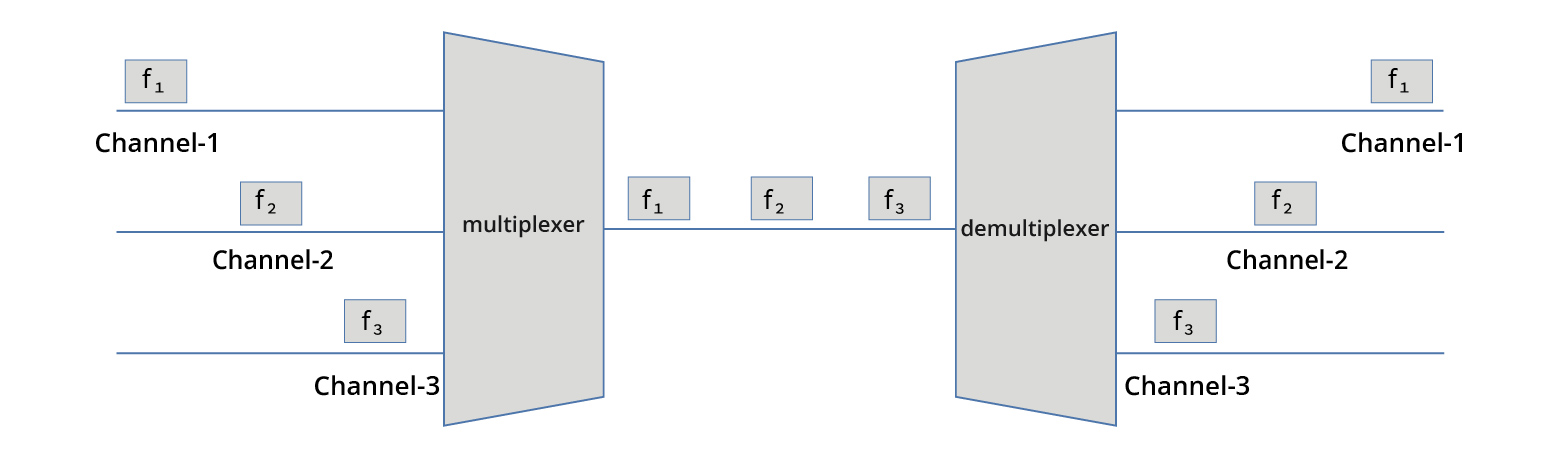
The core objective of multiplexing is to enable multiple independent signals to share the same transmission channel. By selecting different "dimensions/parameters" to isolate signals, it enhances link utilization. In fiber optic communications, it's also commonly regarded as a key means of expanding the capacity of existing fiber infrastructure. The most commonly used multiplexing techniques include Frequency Division Multiplexing (FDM), Time Division Multiplexing (TDM), and Wavelength Division Multiplexing (WDM). We will focus on providing in-depth coverage of these technologies.
Key Differences
The differences among Frequency Division Multiplexing (FDM), Time Division Multiplexing (TDM), and Wavelength Division Multiplexing (WDM) can be understood through the concept of "resource partitioning":
FDM (Frequency Division Multiplexing): Divides the total bandwidth into multiple frequency intervals, with each signal transmitting simultaneously within its own frequency band.
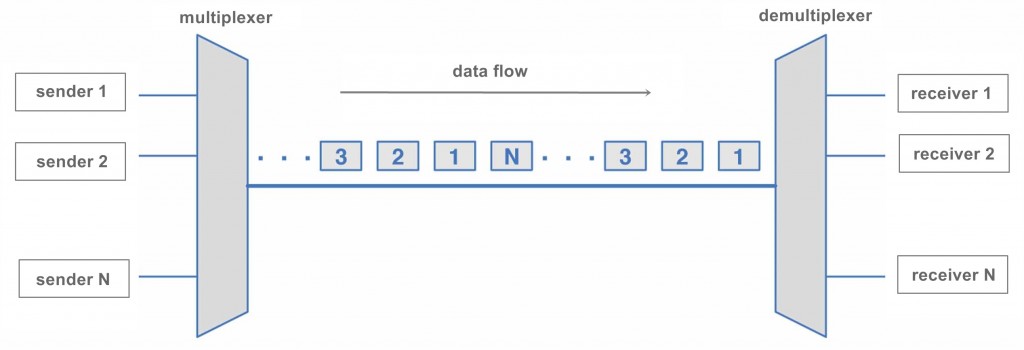
TDM (Time Division Multiplexing): Divides the transmission process into consecutive time slices/slots, with each signal being sent sequentially according to time slots; each can use the full bandwidth during its own time slot.
WDM (Wavelength Division Multiplexing): Uses different wavelengths (optical carriers) on the same optical fiber to carry different channels, enabling parallel transmission of multiple optical signals. This approach is similar to the frequency division concept, but the carrier medium is light.
What is FDM?
FDM is a typical "channel division" method: it splits the link bandwidth into multiple logical sub-channels, with each signal being assigned to a specific frequency band and transferred to the corresponding sub-channel through filtering, modulation, and other techniques. To reduce mutual interference between adjacent sub-channels, engineering practice typically employs guard bands to isolate frequency bands.
Typical Applications: FDM is widely used in broadcast television, satellite communication transponders, and long-distance lines in traditional telephone networks. The main advantage of this technology is that all channels can transmit simultaneously and continuously without requiring precise time synchronization, but due to the need for guard bands and complex filters, spectrum utilization is relatively low.
What is TDM?
TDM maps multiple signals to different time positions: the transmitter divides time frames into multiple time slots, with each service sending according to the slot sequence; the receiver restores each data stream according to the same timing rules.
Optical Time Division Multiplexing (OTDM), commonly seen in optical communications, is a variant of TDM. It utilizes the time resolution capability of optical pulses to interleave multiple low-speed optical channels within a fixed clock cycle, thereby increasing the effective transmission rate. However, as pulses narrow and distance increases, dispersion and other issues become more prominent, requiring corresponding compensation measures.
Typical Applications: TDM technology is widely applied in T1/E1 digital telephone lines, GSM and other 2G mobile networks, TDMA satellite communication systems, and SONET/SDH synchronous optical networks. The main advantage of TDM is the absence of crosstalk between channels and full utilization of the entire bandwidth, making it particularly suitable for digital signal transmission, though it requires precise time synchronization.
What is WDM?
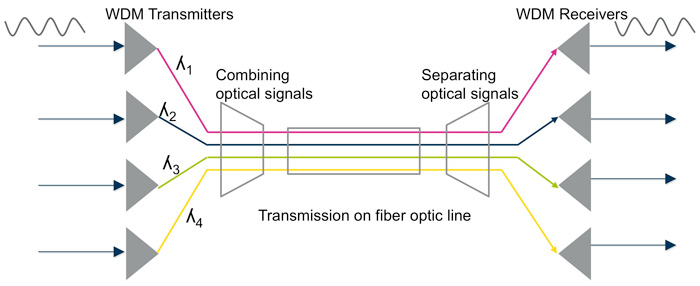
Wavelength Division Multiplexing (WDM) implements "wavelength-based parallelism" on optical fiber, combining multiple optical carriers of different wavelengths into the same fiber for transmission, then separating them by wavelength at the other end. An important engineering characteristic is that each wavelength channel can largely achieve protocol and rate decoupling.
Two common WDM systems are CWDM and DWDM (Dense Wavelength Division Multiplexing). They share the same principle but differ mainly in wavelength spacing, number of available channels, and dependency on optical domain amplification capabilities.
The capacity expansion approach of WDM is typically more granular: wavelength channels can be added as needed to increase capacity. However, this also means increased multiplexing/demultiplexing, optical power management devices, and engineering complexity, with corresponding increases in system complexity and operational requirements.
Side-by-Side Comparison of FDM, TDM, and WDM
|
Dimension |
FDM |
TDM |
WDM |
|
Multiplexed Resource |
Frequency/Frequency Band |
Time/Time Slot |
Wavelength (Optical Carrier) |
|
Typical Medium |
Wireless/Coaxial/Cable |
Various Digital Links |
Optical Fiber |
|
Transmission Mode |
Multiple channels simultaneously occupy different frequency bands |
Multiple channels alternately occupy time slots |
Multiple channels simultaneously occupy different wavelengths |
|
Key Engineering Considerations |
Frequency band planning, filtering, guard bands |
Frame structure design, clock and synchronization |
Wavelength stability, multiplexer/demultiplexer devices, optical power/dispersion and nonlinearity management |
|
Expansion Method |
Add available frequency bands or improve spectral efficiency |
Increase time slot rate/multiplexing level or optimize statistical multiplexing |
Add wavelength channels, or upgrade from CWDM to DWDM |
|
Common Scenario Analogy |
"Parallel Channels" |
"Time Slot Rotation" |
"Multiple Wavelengths Parallel on One Fiber" |
Conclusion
FDM is suitable for "frequency band channel division" scenarios, with engineering focus on frequency band isolation and filter implementation.
TDM aligns more closely with the temporal organization of digital systems, with stronger dependency on synchronization, frame, and time slot structures.
WDM is one of the most common capacity expansion approaches in fiber optic networks, significantly enhancing single-fiber carrying capacity through wavelength parallelism. In actual optical networks, it's common to combine multiple multiplexing methods to achieve better transmission and evolution results.