


In optical networks, transceivers (optical transceivers) and transponders (optical transponders) have similar names and overlapping roles in optical communication systems, but their applications are distinctly different. What are the significant differences in their architecture, capabilities, and deployment scenarios? Today, let's dive deep into the distinctions between these two devices.
What is a Transceiver?
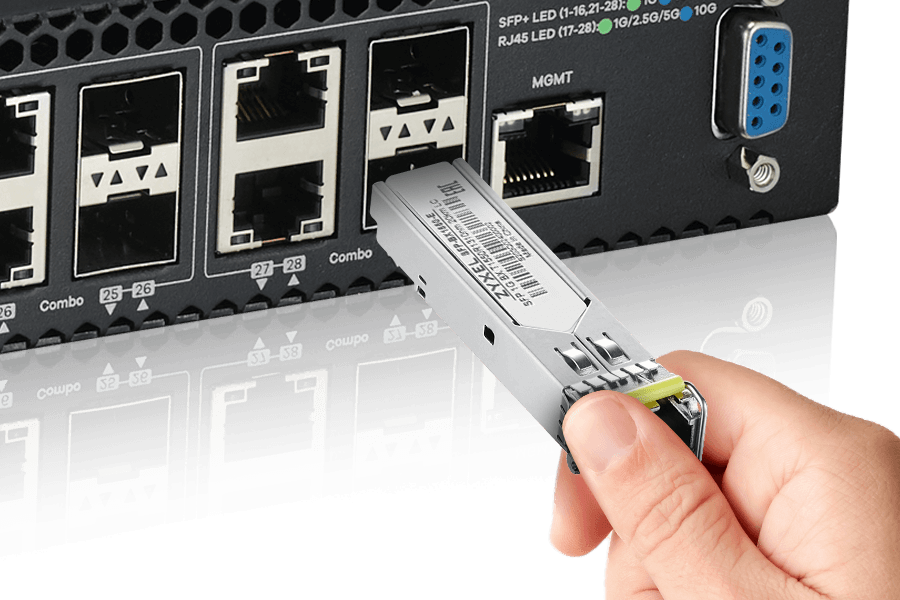
A transceiver (optical transceiver) is an optical module that integrates both transmitter and receiver functions into a single compact package. The word "transceiver" is a combination of "transmitter" and "receiver," enabling simultaneous data transmission and reception from both ends, providing bidirectional communication capability. Optical transceivers perform electrical-to-optical (E-O) conversion at the transmitting end and optical-to-electrical (O-E) conversion at the receiving end.
Key Features
Transceivers are pluggable modules that can be directly installed in network device ports, such as switches, routers, and servers. By converting electrical signals from host devices into optical signals for transmission and converting received optical signals back into electrical signals, these devices enable communication through fiber optic cables. Optical transceivers are widely deployed in data centers, enterprise networks, and cloud computing infrastructure, enabling high-speed data transmission and supporting high-bandwidth connections between data center facilities.
Common Types and Variants
There are numerous types of optical transceivers, including 1G SFP, 10G SFP+, 25G SFP28, 40G QSFP+, 100G QSFP28, 200G, and 400G, primarily designed for short-distance and long-distance transmission in networks.
Special Variants:
BiDi (Bidirectional) transceivers: Use different wavelengths to transmit and receive on a single fiber, reducing fiber infrastructure costs
CWDM transceivers: Use Coarse Wavelength Division Multiplexing technology for medium-distance transmission (typically up to 80km)
DWDM transceivers: Employ Dense Wavelength Division Multiplexing technology for long-distance, high-capacity transmission in metro and long-haul networks
Bidirectional optical transceivers primarily simplify cabling systems, increase network capacity, and reduce costs, with modules capable of data transmission and reception through a single fiber.
What is a Transponder?
A transponder (optical transponder) is a complex Optical-Electrical-Optical (OEO) conversion device that works by receiving optical signals, converting them to electrical signals, processing the data, and then converting them back to optical signals. It performs wavelength conversion, signal regeneration, and protocol adaptation functions in optical transmission systems. Unlike simple optical transceivers, optical transponders actively process optical signals to enable long-distance transmission and wavelength management in complex optical networks.
Core Functions
Wavelength Conversion: Optical transponders convert "gray light" (standard wavelengths) from client-side optical transceivers to "colored light" (specific DWDM wavelengths) compatible with wavelength division multiplexing systems. They can even convert between different wavelengths within the same WDM system, supporting "3R" technology.
3R technology represents critical signal processing functions performed by optical transponders, including:
Retime: Corrects timing jitter accumulated during transmission
Regenerate: Restores signal amplitude to original levels
Reshape: Reconstructs signal waveforms to eliminate distortion
For protocol and interface adaptation, optical transponders can adapt between different fiber types (multimode to single-mode), connector types (dual-fiber to single-fiber), and even different protocols, providing network flexibility.
Optical transponders come in various rate classes, including 10G, 25G, 100G, 200G, and 400G configurations. They are primarily deployed in:
WDM (Wavelength Division Multiplexing) systems: Enabling multiple wavelengths to share the same fiber infrastructure
OTN (Optical Transport Network): Providing carrier-grade transmission services with advanced monitoring and protection features
Long-haul transmission: Regenerating signals for ultra-long-distance connections spanning hundreds or thousands of kilometers

Transceiver vs Transponder: Key Differences
Optical transceivers and optical transponders are similar modules, both capable of converting full-duplex electrical signals to full-duplex optical signals. Optical transceivers use serial interfaces and are installed directly into network device ports through hot-swapping, with a single module capable of receiving and transmitting signals. Optical transponders use parallel interfaces for signal transmission and reception, requiring coordination with two fiber modules, positioned between client equipment and the optical transport network.
Primary Functions
Optical transceivers perform simple electrical-to-optical and optical-to-electrical conversion for bidirectional optical signal transmission in fiber communication systems, enabling network devices to communicate through fiber.
Optical transponders perform OEO conversion combined with wavelength transformation, not directly handling bidirectional communication, converting client signals to specific wavelengths suitable for WDM transmission systems, focusing on processing and forwarding.
Signal Processing Capability
Optical transceivers typically pass signals directly without active regeneration, relying on the original signal quality and fiber link capabilities.
Optical transponders provide comprehensive 3R regeneration, actively cleaning signals degraded by dispersion, polarization mode dispersion, and attenuation during long-distance transmission.
Physical Size and Power Consumption
Optical transceivers are compact hot-swappable modules with low power consumption, typically 1-15W depending on rate and transmission distance, designed for high-density deployment.
Optical transponders are larger devices that can easily handle low-rate parallel signals but have higher power consumption (20-50W or more).
Application Scenarios
Optical transceivers excel in scenarios requiring direct device-to-device connections:
- Campus network links
- Data center server-to-switch connections
- Short to medium-distance point-to-point links
Optical transponders are suitable for complex optical networks:
- WDM/DWDM systems requiring wavelength conversion
- Long-haul networks requiring signal regeneration
- OTN networks requiring protocol adaptation and advanced management
FAQ
Q: If using DWDM colored optical transceivers, do you still need optical transponders?
A: DWDM colored optical transceivers directly output specific wavelength signals compatible with DWDM systems and may not require optical transponders for shorter distance applications (typically within 80-120km). However, for longer distances, optical transponders are still needed to provide 3R regeneration and compensate for signal degradation.
Q: How to ensure compatibility?
A: For optical transceivers: Verify compatibility with host devices in terms of form factor (SFP, SFP+, QSFP28, QSFP-DD, etc.), rate, transmission distance, and wavelength. Use vendor-certified optical transceivers or thoroughly tested third-party compatible modules with appropriate coding.
For optical transponders: Ensure client-side interface compatibility with your existing equipment, verify wavelength output matches your DWDM grid specifications, and confirm protocol and data rates align with network requirements. In multi-vendor environments, adhere to industry standards (ITU-T, IEEE).
Q: Can optical transceivers replace optical transponders?
A: Optical transceivers with DWDM capability (tunable or fixed wavelength colored modules) can eliminate the need for separate optical transponders. However, optical transceivers cannot replicate the functionality of optical transponders, such as 3R regeneration, advanced protocol conversion, or complex wavelength management. For long-distance transmission exceeding 80-120km or networks requiring active signal regeneration, dedicated optical transponders remain necessary.
Q: What scenarios are Muxponders suitable for?
A: Muxponders are suitable for:
Aggregating multiple 10G clients into a single 100G wavelength
Consolidating 25G or 100G clients into 400G or higher rate wavelengths
Maximizing fiber capacity in bandwidth-constrained networks
Reducing per-bit transmission costs in high-capacity backbone networks


