


What is SC APC Fiber Optic Cable?
SC APC Fiber Optic Cables are high-performance single-mode fiber optic patch cords that use square-shaped SC connectors. These cables typically feature green SC connectors with APC polishing, offering excellent resistance to electromagnetic interference. This makes them an ideal choice for high-performance applications with strict requirements for interference control and attenuation.
Because of their durable structure, they are less likely to be damaged during installation or maintenance. They are widely used in CATV, Fiber to the Home (FTTH), and passive optical networks. In many real deployments, an sc/apc cable (also called an sc apc cable) is selected specifically to reduce optical reflection and improve signal stability.
What is SC?
SC refers to a connector type. The common ferrule size is a 2.5mm ferrule. It uses a simple push-pull locking mechanism and has a square-shaped housing with a larger interface size. SC connectors use physical contact polishing with a slightly curved end face, designed to ensure close physical contact between fiber cores and reduce loss and reflection.
Even after repeated plugging and unplugging, the cable can still maintain stable quality. This is why sc fiber products remain popular in access networks and many field engineering environments. In practical installation, an sc fiber connection is often preferred for its easy handling and reliable locking structure.

What is APC?
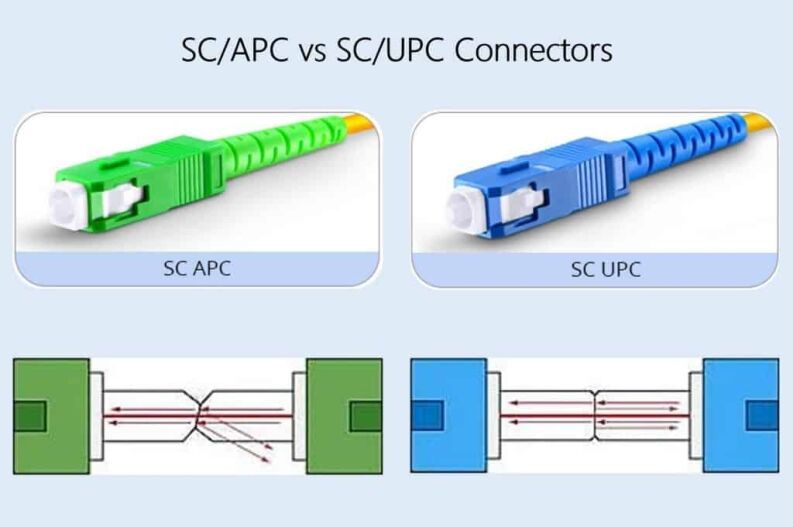
APC means Angled Physical Contact. When contact is established at the ferrule tip, the fiber end face is polished at an 8-degree angle. This ensures reflected light is directed into the cladding rather than reflected straight back into the transmitter. Compared with standard connectors, APC provides extremely low back reflection, significantly reducing optical return loss.
This plays a key role in maintaining high-quality signals in data transmission. In the industry, APC connectors are usually green and have an angled end face, while UPC connectors are typically blue with a flatter end face. Many users ask what does a.p.c. stand for-in fiber optics, apc stand for Angled Physical Contact, and it is commonly implemented as an apc optical connector solution to reduce reflection noise.

What Makes SC APC Fiber Optic Cable Unique?
Lower Return Loss (Less Back Reflection)
SC APC Fiber Optic Cable typically achieves a return loss of ≥60 dB, far exceeding UPC (commonly ≥50 dB). This advantage is especially obvious for stability in long links with splitters and multiple connections. Lower reflection means reduced interference to the light source and lower echo noise, improving signal quality and laser stability.
This is why many engineers choose sc apc products for reflection-sensitive deployments, and why a fiber connector sc apc option is preferred in PON and CATV environments.
Low Insertion Loss
SC APC Fiber Optic Cable uses a ceramic ferrule to ensure high core alignment accuracy, creating a more stable connection with lower loss. According to many manufacturer specifications, SC connectors can typically achieve a maximum insertion loss of ≤0.30 dB. Because the fiber end faces are tightly mated, loss caused by gaps is minimized.
This low-loss performance is one reason why sc apc fiber assemblies are widely chosen as an sc/apc patch cable for access networks and optical distribution systems.
Reliable Connection
SC uses a classic push-pull structure that locks firmly once inserted, making it less likely to loosen on-site and easier to maintain. A spring-loaded mechanism continuously applies pressure, ensuring consistent end-face contact and long-term stability.
Since APC connectors are usually green, it reduces installation mistakes. The SC interface size follows IEC standards (IEC 61754-4), improving cross-compatibility between vendors. This combination makes sc apc connector solutions highly reliable for field use, especially when paired with a proper apc connector design.
Typical Application Scenarios for SC APC Fiber Optic Cable
FTTH (Fiber to the Home)
It commonly appears at ONT optical ports (home gateways), home distribution boxes, and related FTTH points. It allows users to achieve high-speed data transmission with simple configurations under limited bandwidth. Since it is single-mode fiber, the material cost is also within an acceptable range for typical consumers.
In real FTTH usage, an sc apc to sc apc fiber optic internet cable (also written as sc/apc to sc/apc fiber optic internet cable) is often used between passive devices and customer-side terminals where reflection performance matters.
Telecom Industry Applications
In telecom networks, SC APC Fiber Optic Cable is widely used in demanding communication scenarios. It not only maintains signal quality over long-distance links, but also improves maintainability and scalability in complex network structures. Key examples include:
Point-to-Point Link Connections
Simplex fiber optic cables are often used to build point-to-point communication links, such as direct device interconnections, cross-room links in data facilities, or certain dedicated service lines.
In networks where bandwidth demand is predictable and business types are relatively fixed, point-to-point links reduce complexity and improve transmission certainty, helping telecom systems maintain long-term stability and continuity.
Data Networks and Data Center Transmission
In data centers or enterprise networks, simplex fiber is commonly used to connect switches, routers, and servers, supporting high-speed data transmission.
Because fiber offers strong EMI resistance and low transmission latency, deploying simplex fiber improves throughput efficiency while strengthening security and reliability-especially in link-quality-sensitive scenarios.
Mobile Backhaul Networks
In 4G/5G mobile networks, simplex fiber optic cables are a key part of backhaul infrastructure, connecting base station components (such as BBU/AAU) to core switching or aggregation nodes.
As video streaming, live broadcasting, and cloud services grow rapidly, backhaul capacity and stability requirements become stricter. In this case, simplex fiber's high bandwidth capacity helps support ongoing expansion and stable operation.
In these telecom deployments, the use of an apc cable and an apc fiber connector is often essential to keep return-loss-sensitive systems stable.
What's the Difference Between SC APC and SC UPC?
SC/APC vs SC/UPC Technical Comparison Table (Ready for Publishing)
|
Comparison Item |
SC/APC (Green) |
SC/UPC (Blue) |
|
Connector Type |
SC (push-pull / square housing) |
SC (push-pull / square housing) |
|
End-Face Polish |
APC (angled physical contact) |
UPC (ultra physical contact) |
|
End-Face Shape |
Angled end face (typically 8°) + slight curvature |
Nearly flat end face + slight curvature |
|
Color Identification (Industry Standard) |
Green (APC) |
Blue (UPC) |
|
Main Optimization |
Low reflection / high return loss |
General connection / low insertion loss |
|
Return Loss RL (Typical, higher is better) |
≥ 60 dB |
≥ 50 dB |
|
Insertion Loss IL (Typical, lower is better) |
≤ 0.30 dB |
≤ 0.30 dB |
|
Back Reflection |
Lower (angled face deflects reflection) |
Lower (some reflection still returns) |
|
Link Stability (multi-connector/splitting) |
More stable |
Generally stable (reflection accumulates more easily) |
|
Typical Applications |
FTTH/FTTx, GPON/EPON, ODN distribution, PLC splitters, CATV/RF Overlay |
Common digital communication, campus point-to-point links, general interconnects |
|
Common Install Location |
ONT, indoor panels, corridor boxes, splitters, ODF/cross-connect |
Standard ODF, general device interconnection |
|
Best Fit for Reflection-Sensitive Systems |
Yes (PON/CATV/splitters) |
For general reflection requirements |
|
Can It Be Mated with the Other Type? |
No (must not mate with UPC) |
No (must not mate with APC) |
|
Risk of Mixing |
Higher loss, worse return loss, end-face wear, unstable link |
Higher loss, worse return loss, end-face wear, unstable link |
|
Adapter/Coupler Requirement |
Must use SC/APC adapter (usually green) |
Must use SC/UPC adapter (usually blue) |
|
Cost |
Slightly higher (more complex polish) |
Lower (more common) |
|
Key Strength |
Lower reflection, more stable for splitters/access networks |
Broad compatibility, lower cost |
|
Limitation |
Cannot mix with UPC; must follow port specs strictly |
Weaker return loss vs APC in splitter-sensitive systems |
|
Recommended Selection |
More splitting/longer links/reflection-sensitive |
Standard point-to-point/non-sensitive systems |
This is why sc/apc fiber connector choices are often required in splitter-heavy access networks, while SC/UPC is common for general-purpose links.
FAQ
What's the difference between SC APC and LC APC fiber optic cables?
The difference is in the connector structure, not APC itself.
Density: SC is larger and lower density; LC is smaller and ideal for high-density panels and device ports (sc vs lc)
Applications: SC/APC is common in FTTH/ODN/splitters/indoor access; LC/APC is common on the equipment side (SFP modules), data centers, and DWDM interfaces (lc/apc)
Plugging experience: SC push-pull is better for field work; LC latch-style is better for high-density racks
In practice, an lc apc connector is frequently used on transceiver and equipment ports, while SC remains common in access distribution.
What are the best practices for maintaining SC/APC connectors?
Use professional fiber cleaning tools
Never touch the end face (ceramic ferrule surface) with hands
Inspect with a microscope before and after cleaning
Clean adapter and coupler ports as well
Always use dust caps when not in use
Handle carefully to prevent ceramic ferrule damage
This is critical for any apc connector fiber system, because contamination greatly impacts return loss and stability.
What's the difference between simplex and duplex SC/APC connectors?
Simplex: 1 fiber core, transmits only one signal direction
Duplex: 2 fiber cores (usually side-by-side), supports separate Tx/Rx paths
For Ethernet optical links requiring two-way transmission, duplex is more common. For PON/FTTH access (often single-fiber services), simplex is more common.
What are the disadvantages of SC connectors?
SC's main disadvantages are size and density:
Large connector size, takes up more panel space (not suitable for ultra-high-density cabling)
In data center device port scenarios, LC is usually more mainstream
What are the four main types of fiber optic connectors?
SC (common in engineering/access)
LC (common in equipment/high-density)
FC (threaded, once common in vibration-resistant applications)
ST (bayonet-style, seen in earlier systems)


