As a fiber optic connector manufacturer, we see fiber optic cable connectors as the "last-meter" precision interface that determines real-world link stability: a fiber optic connector is a plug-and-play fiber termination designed to deliver low-loss, repeatable connections between equipment ports, patch panels, and patch cords. In this guide, we break down fiber optic connector types using a practical framework-classification + application scenarios + selection rules-so you can quickly choose the right interface for data centers, telecom/FTTH, and outdoor deployments.
What Is a Fiber Optic Connector and Why It Matters?
A fiber optic connector is a precision, plug-and-play termination that aligns fiber cores to transmit light with minimal loss. It's the standard interface between active equipment ports, patch panels/ODF, and patch cords, enabling fast installation, reconfiguration, and troubleshooting. In real deployments, optical fiber connector quality and correct selection directly impact link budget, signal stability, and maintenance efficiency-especially in high-density data centers, FTTH distribution networks, and outdoor access points where connections may be frequently handled.

Connector vs Splice vs Adapter (Quick Differences)
Connector: A removable interface designed for quick plug/unplug operation. Best for flexibility, easy maintenance, and routine testing.
Splice: A permanent (fusion) or semi-permanent joint that typically delivers very low loss and strong long-term stability. Best for closures, long runs, and cable joints.
Adapter (Panel Coupler): A mating sleeve that aligns and joins two connectors (e.g., LC-LC, SC-SC) in panels or outlets, providing a standardized patching port.
Key Performance Metrics You Must Know
Insertion Loss (IL): The optical power loss introduced by a mated fiber optic cable connector pair. Lower IL preserves link margin and improves overall network reliability.
Return Loss (RL) / Reflectance: The amount of light reflected back toward the source due to end-face geometry and surface quality. Higher RL (lower reflectance) is especially important in reflection-sensitive links.
Durability & End-Face Cleanliness: Mating-cycle durability matters, but real-world performance often degrades due to contamination (dust/oil) or end-face damage, which can raise IL and worsen RL-making proper inspection and cleaning essential.
How Fiber Optic Connector Types Are Classified?
Fiber optic connector types are typically categorized by physical density, locking method, and fiber mode. Understanding these three dimensions makes selection easier-especially when you're balancing port density, handling convenience, and performance requirements across data centers, telecom/FTTH, and outdoor deployments.

By Ferrule Size & Form Factor (Density)
2.5 mm ferrule (traditional, larger footprint): SC fiber optic connector / FC / ST
These connectors use a larger ferrule and generally take up more panel space. They remain common in legacy systems, test environments, and many telecom distribution frames where density is not the main constraint.
1.25 mm ferrule (high density): LC connector fiber optic / MU
Smaller ferrules enable higher port density and are widely used in modern equipment and patching environments. LC is especially prevalent in data centers due to compact size and strong ecosystem support.
Multi-fiber ferrule (ultra-high density): MPO/MTP
MPO/MTP connectors terminate multiple fibers in a single interface, making them ideal for high-density trunking and parallel optics applications (e.g., 40G/100G/400G+ architectures).
By Coupling Mechanism (How It Locks)
Push-pull (quick latch): LC fiber optic connector / SC
Simple, tool-free insertion and removal. Widely used for fast patching and maintenance.
Bayonet (twist-lock): ST
A quarter-turn locking style that provides secure engagement and is often seen in older networks and some industrial environments.
Threaded (screw-on): FC
A threaded interface designed for stable, vibration-resistant connections-common in instrumentation, testing, and specialty applications.
Multi-fiber latch: MPO/MTP
A keyed, latched mechanism designed specifically for multi-fiber alignment and repeatable high-density connections.
By Fiber Mode
Singlemode (SMF)
Used for longer distances and higher-performance backbone links in telecom and many enterprise networks. Often paired with tighter reflectance requirements depending on the application.
Multimode (MMF)
Common in short-reach, high-bandwidth links-especially within data centers and campus environments.
Note: Connector shape does not inherently define singlemode or multimode-the difference is typically the fiber inside (and sometimes the color coding used in patch cords, boots, and housings to simplify identification in the field).
Most Common Fiber Optic Connector Types
This section covers the types of fiber optic connectors you'll see in most real-world deployments. For each one, focus on structure, where it's used, pros/cons, and recommended pairings-so readers can move from "knowing the name" to making a correct selection for their network.

LC Connector (Small Form Factor, High Density)
What it is: A compact 1.25 mm ferrule connector designed for high-density patching.
Common use cases: Data centers, enterprise networks, SFP/SFP+/SFP28 ports, switches and routers.
Advantages:
High port density (more connections per rack unit)
Mature ecosystem for patch cords, panels, and transceivers
Limitations:
Smaller interface can be less convenient to handle in tight spaces without proper cable management
Recommended pairings:
LC–LC patch cords for equipment-to-panel and panel-to-panel connections
LC adapter panels / cassettes for structured cabling and clean labeling
SC Connector (Push-Pull, Easy Handling)
What it is: A widely used 2.5 mm ferrule push-pull connector known for simple operation.
Common use cases: FTTH distribution, ODF frames, telecom rooms, general patching environments.
Advantages:
Easy to plug/unplug and visually confirm seating
Strong compatibility across many telecom distribution systems
Limitations:
Lower density compared with fiber optic lc connector (larger footprint)
Recommended pairings:
SC/UPC for general patching where APC is not required
SC/APC for reflection-sensitive systems such as many PON/FTTH/CATV applications
SC adapter panels for ODF and fiber distribution boxes
ST Connector (Bayonet Lock, Legacy/Industrial)
What it is: A 2.5 mm ferrule connector with a bayonet (twist-lock) coupling.
Common use cases: Legacy networks, certain industrial installations, and older campus infrastructures.
Key characteristics:
Quarter-turn bayonet lock provides a secure mechanical connection
Pros/Cons (quick view):
Pros: Secure lock; familiar in older environments
Cons: Bulkier; less common in modern high-density designs
Recommended pairings:
ST patch cords and ST adapter panels when maintaining or upgrading legacy infrastructure
FC Connector (Threaded, Vibration Resistant)
What it is: A 2.5 mm ferrule connector that uses a threaded screw-on coupling.
Common use cases: Test instruments, measurement setups, vibration-prone or mechanically demanding environments.
Key characteristics:
Threaded coupling delivers stable, repeatable engagement
Pros/Cons (quick view):
Pros: Excellent mechanical stability; good for vibration
Cons: Slower to mate/unmate; less efficient for high-volume patching
Recommended pairings:
FC patch cords for lab/testing and instrument connections requiring secure coupling
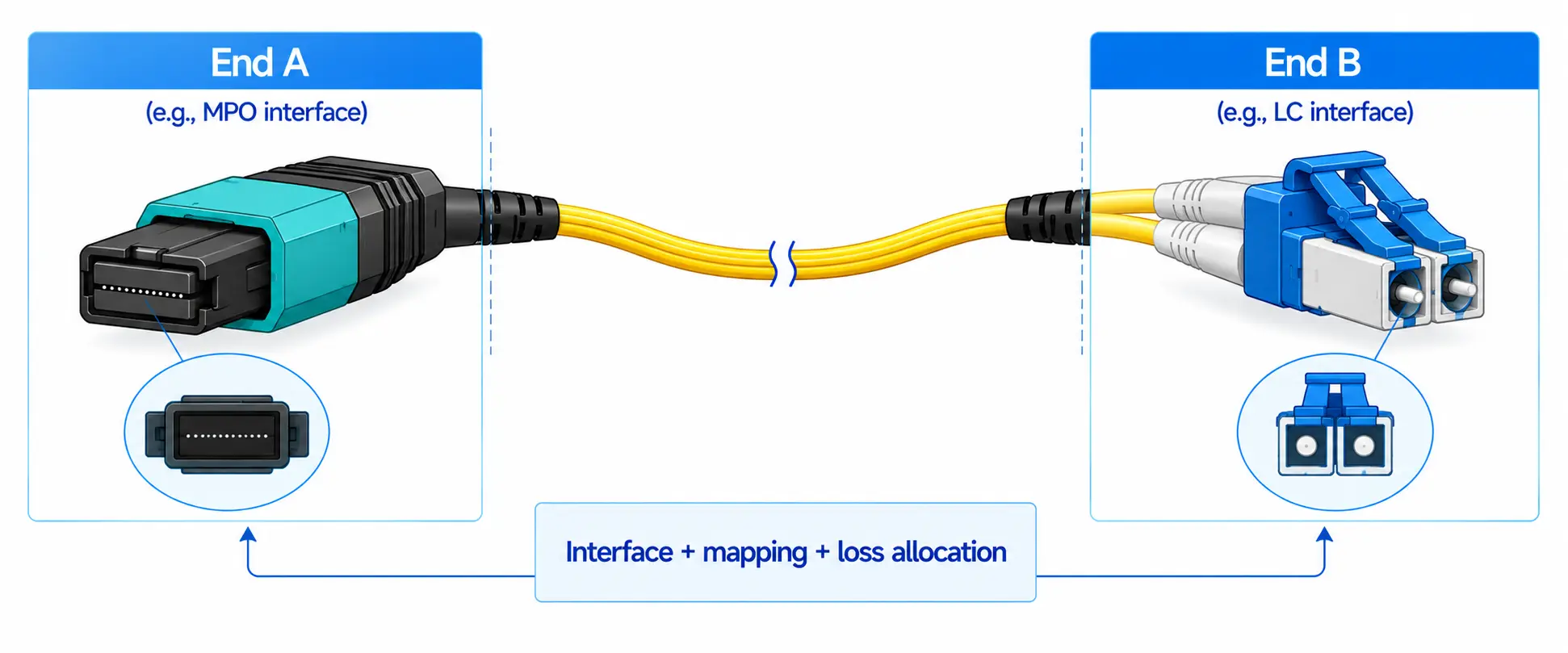
MPO/MTP Connector (Multi-Fiber for 40G/100G/400G+)
What it is: A multi-fiber connector using an MT-style ferrule to terminate many fibers in one interface.
Fiber counts: Commonly 12/16/24/32 (and more), depending on architecture and standards.
Common use cases: Data center backbone trunking, parallel optics, high-density patching for 40G/100G/400G+ migration.
Advantages:
Ultra-high density and fast deployment for large fiber counts
Enables trunk/harness designs that simplify cable pathways
Limitations:
Requires correct planning for polarity and method (A/B/C) to ensure Tx/Rx alignment
End-face cleanliness and inspection are especially critical due to multi-fiber contact area
What to emphasize (core SEO + engineering value):
- Polarity (Type A / Type B / Type C): how it maintains correct fiber mapping end-to-end
- Trunk vs Harness vs Cassette: when each architecture is the right choice
DIMI integration (natural manufacturer angle):
Pre-terminated MPO/MTP patch cords, trunks, harness/breakout assemblies, and patch panel/cassette components
Customization support for fiber count, polarity, length, jacket type, and insertion-loss grades (Standard / Low Loss)
Quality deliverables such as end-face inspection and test reports to align with project acceptance requirements
Other Connectors You May Encounter (Short Section)
These are less common than LC/SC/ST/FC/MPO, but you may see them in specific ecosystems:
MU: Small-form connector used in certain telecom platforms where density is prioritized.
MT-RJ: Legacy multi-fiber style used in older enterprise cabling; less common today.
E2000: Premium connector family often associated with high-performance/low-reflection requirements in some telecom environments.
CS / SN (VSSF connectors): Very small form factor connectors emerging for ultra-high density patching and next-generation transceiver modules in some high-density deployments.
If you want, I can turn this section into a "ready-to-publish" block with a mini comparison table (LC vs SC vs MPO) and a diagram-style explanation of MPO polarity (Type A/B/C) in plain English.
Fiber End Face Types Explained: PC vs UPC vs APC
End-face geometry and polishing style have a direct impact on insertion loss (IL) and especially return loss (RL)/reflectance. That's why PC, UPC, and APC matter just as much as choosing LC vs SC vs MPO-particularly in FTTH/PON and CATV networks where reflections can cause instability.

What's the Difference?
PC (Physical Contact)
A basic physical-contact polish where the ferrule end faces touch to reduce the air gap. It's a foundational style but is less commonly specified in modern projects compared to UPC/APC.
UPC (Ultra Physical Contact)
A higher-grade polish with a smoother end face than PC, designed to reduce back reflection. UPC connectors are commonly color-coded blue in many field environments.
APC (Angled Physical Contact)
An angled end face (typically 8°) that redirects reflected light into the cladding rather than back toward the source, delivering better return loss performance. APC connectors are commonly color-coded green.
When to Use UPC vs APC ?
Data centers / general enterprise links:
UPC is widely used for standard patching where extremely low reflectance is not the primary constraint, and where high-density LC environments dominate.
PON / FTTH / CATV networks:
APC is commonly specified because these architectures can be more sensitive to reflections, and APC helps maintain stable performance-especially through splitters and long distribution paths.
Important compatibility note:
Do not mate UPC with APC. Mixing polish types can cause higher loss, higher reflectance, and potential end-face damage, resulting in unstable links and failed acceptance tests.
DIMI FTTH Capability Tie-in
For FTTH and access networks, DIMI supports practical end-to-end configurations including SC/APC and SC/UPC termination options, matched to your ODN and customer standards. We also supply compatible patching components-patch cords and pigtails for ODF, fiber distribution boxes, and patch panels-so installers can maintain consistent polish types, manage reflections correctly, and simplify deployment and maintenance.
Connector Selection Guide:Pick the Right One in 60 Seconds
If you choose connectors based on where the link lives, what the equipment ports require, and how dense your rack/panel needs to be, you'll avoid most compatibility and performance problems. Use the quick rules below to narrow down the right connector family in under a minute.

By Application
Data Center: LC + MPO/MTP
LC is the default for switch/server patching, while MPO/MTP is widely used for high-density trunking and parallel optics migration (40G/100G/400G+).
Telecom / FTTH: SC/APC or SC/UPC
SC is common in distribution environments. Choose apc connector fiber optic when reflection control is required (common in many PON/FTTH/CATV builds), and UPC for general patching where APC is not specified.
Industrial / Vibration-Prone Sites: FC
The threaded coupling provides a more mechanically stable connection in environments where movement or vibration is a concern.
Legacy Networks: ST
Often required when maintaining or expanding older infrastructure where ST panels and cords are already installed.
By Port Type & Transceiver
SFP family (SFP / SFP+ / SFP28): LC is most common
Typical deployment: LC patch cords from switch ports to patch panels or cross-connects.
QSFP family (QSFP+ / QSFP28 / QSFP-DD and similar): MPO/MTP is common
Depending on the optics and architecture, you may use:
MPO/MTP trunks for parallel optics
MPO-to-2×LC (or MPO-to-LC) breakout/harness for duplex connectivity or migration scenarios
By Density & Cable Management
Rack/panel density target:
If you need maximum ports per RU, prioritize LC (duplex) and MPO/MTP (multi-fiber) solutions.
Bend radius & routing space:
High-density builds fail more from poor routing than from connector choice-ensure patch cords and trunks match your pathway constraints, maintain proper bend radius, and use structured cable management.
Panel format (1U/2U) and front-access workflow:
Select connector/panel systems that support clean labeling, accessible latch operation, and consistent patching practices-especially important when you're scaling to large fiber counts and frequent repatching.
Outdoor & Hardened Fiber Optic Connectors :FTTH Drop / ODN
Outdoor fiber connections are exposed to harsher conditions than indoor patching environments. That's why hardened (outdoor-rated) connector systems exist-to protect the optical interface, maintain stable performance over time, and reduce field failures caused by moisture, dust, and mechanical stress in FTTH drop and ODN deployments.

Why Outdoor Connectors Are Different?
Outdoor connectors must be engineered for:
- Water resistance (rain, standing water, humidity ingress)
- Dust and particulate protection (construction sites, roadside cabinets)
- UV resistance (sun exposure that can degrade plastics over time)
- Temperature cycling (daily and seasonal expansion/contraction)
- Tensile and strain protection (wind load, pull forces on drop cables, vibration)
In short, the connector for fiber optic cable is not just an optical interface-it's also part of the environmental sealing and mechanical load path for the outdoor segment.
Common Outdoor Connection Architectures
Typical FTTH drop path:
Drop cable → hardened connector → terminal / closure / distribution point
This approach enables faster field installation and reduces the need for on-site splicing in many last-mile scenarios.
ODN relationship (how it fits together):
In an ODN, outdoor connectivity usually sits between:
Splitter stage(s) (for PON distribution)
Distribution / patching stage (FDH/terminal/distribution box)
Subscriber drop segment (last span to the customer premises)
A well-planned architecture ensures the correct connector interface, proper sealing level, and maintainable patching layout from the feeder to the drop.
DIMI Outdoor Solutions
DIMI supports FTTH and ODN projects with outdoor protective connectivity concepts-including hardened connector and adapter approaches designed for field practicality-plus compatible aerial installation hardware and routing protection suggestions to reduce stress on the optical interface. For different deployment conditions such as coastal salt fog, extreme cold, or high-temperature regions, we can provide selection guidance on materials and structural design, helping you match sealing performance, durability, and installation workflow to your actual environment and network standards.
Installation, Cleaning & Testing Best Practices
Even the best connector design can fail in the field if handling, cleaning, and verification are not controlled. Most "mystery loss" cases come down to end-face contamination, poor mating discipline, or incomplete testing. The practices below are standard for maintaining consistent IL/RL performance from factory QC through project acceptance.

The #1 Issue: End-Face Contamination
Contamination is the most common root cause of unexpected insertion loss and degraded return loss. Dust, skin oils, and residue can block or scatter light, while particles trapped between mated connectors can scratch the end face-creating long-term performance issues.
Recommended cleaning workflow:
Inspect → Clean → Inspect
- Inspect: Use a fiber scope to check for dust, oils, or scratches before mating.
- Clean: Use approved cleaning tools (lint-free wipes, cleaning cassette, or one-click cleaners) matched to the connector type (LC/SC/MPO, etc.).
- Inspect again: Confirm the end face is clean before connecting-never "clean blindly" and assume it's fine.
- Why it matters: A "slightly dirty" end face can cause higher insertion loss (IL) and worse return loss (RL), leading to link instability, intermittent errors, and failed acceptance testing-especially in high-speed or reflection-sensitive networks.
Testing Checklist
A reliable acceptance process typically combines OLTS (for loss) and OTDR (for event/location analysis). They serve different purposes and work best together.
How OLTS and OTDR complement each other
OLTS (Optical Loss Test Set):
Measures end-to-end insertion loss across the link using a light source and power meter. Best for verifying the link meets the loss budget.
OTDR (Optical Time Domain Reflectometer):
- Shows a trace of events and reflections along the fiber (connectors, splices, bends) and helps locate where loss is occurring. Best for troubleshooting and documenting event locations.
- Factory test & project acceptance data (typical deliverables)
- Insertion Loss (IL) results (per link / per assembly)
- Return Loss (RL) / Reflectance results when required by the specification (often critical for APC/FTTH/CATV scenarios)
- End-face inspection records (pass/fail or images, especially for MPO/MTP where multi-fiber cleanliness is critical)
- Optional but common: polarity verification (for MPO/MTP trunk/harness), labeling and mapping documentation, and any customer-required sampling plan or traceability format.
If you want, I can also add a short "field checklist box" (copy-paste friendly) tailored to LC/SC vs MPO/MTP scenarios, since the cleaning tools and inspection steps differ slightly.
Comparison Table: Fiber Optic Connector Types at a Glance

fiber optic connector types chart
| Connector Type | Ferrule Size | Coupling Mechanism | Fiber Count | Typical Use Cases | Pros | Cons | Common Polish | Notes |
|---|---|---|---|---|---|---|---|---|
| LC connector | 1.25 mm | Push-pull latch | 1 (simplex) / 2 (duplex) | Data center patching, SFP/SFP+ switch ports | High density, widely supported | Smaller form factor can be harder to handle without good cable mgmt | UPC (common), APC (less common) | Strong ecosystem; keep end faces clean for stable IL/RL |
| SC connector | 2.5 mm | Push-pull | 1 / 2 | FTTH, ODF/patch panels, telecom rooms | Easy handling, common in telecom | Lower density vs LC | UPC / APC | Very common for FTTH; don't mix UPC and APC |
| ST connector | 2.5 mm | Bayonet (twist-lock) | 1 / 2 | Legacy networks, some industrial sites | Secure mechanical lock | Legacy footprint, less common in new builds | UPC (typical) | Often used to maintain existing infrastructure |
| FC connector | 2.5 mm | Threaded (screw-on) | 1 / 2 | Test instruments, vibration-prone environments | Very stable under vibration | Slower patching, bulky | UPC (typical), APC (sometimes) | Preferred where mechanical stability matters most |
| MPO/MTP connector | Multi-fiber MT ferrule | Keyed latch | 8 / 12 / 16 / 24 / 32… | DC trunking, parallel optics (40G/100G/400G+) | Ultra-high density, fast deployment | Polarity planning required; cleaning is critical | UPC (common for many DC uses), APC (special cases) | Confirm polarity (A/B/C) + fiber mapping; end-face inspection recommended |
| MU connector | 1.25 mm | Push-pull | 1 / 2 | Telecom platforms (region/system dependent) | High density | Less common globally than LC | UPC (common) | Often chosen for specific equipment ecosystems |
| MT-RJ connector | Multi-fiber (legacy) | Latch | 2 (duplex in one body) | Older enterprise cabling | Compact duplex format | Largely legacy; limited new adoption | UPC | Mostly encountered during upgrades of older installs |
| E2000 connector | 2.5 mm | Push-pull (often with shutter) | 1 / 2 | High-performance telecom environments | Strong performance focus, protective interface | Higher cost; ecosystem not as universal | UPC / APC | Used where reflectance control and protection are priorities |
| CS connector | VSSF (very small form factor) | Push-pull | 2 (duplex style) | High-density DC, next-gen transceiver ecosystems | Higher density than LC | Still emerging; compatibility depends on platform | UPC (common) | Adoption driven by very high port-density requirements |
| SN connector | VSSF | Push-pull | 2 (duplex style) | High-density DC patching | High density, compact | Emerging ecosystem; platform-specific | UPC (common) | Often discussed in next-gen high-density cabling designs |
FAQ
Q: What are the most common fiber optic connector types?
A: The most common fiber optic cable connector types are fiber optic connectors lc, SC, fiber optic st connector, fiber optic fc connector, and MPO/MTP. Optical fiber lc connector dominates high-density data center patching, SC is widely used in telecom/FTTH distribution, ST/FC appear more often in legacy or specialty environments, and mpo connectors optical fiber is popular for multi-fiber high-density trunking.
Q: Is LC better than SC for data centers?
A: In most modern data centers, Fiber optic connector lc is preferred because it supports higher port density and matches common transceiver interfaces (especially SFP-family). Fiber optic sc connector can still be used in some cross-connect or legacy panel setups, but it typically consumes more space.
Q: What is the difference between MPO and MTP?
A: MPO is the general multi-fiber connector interface standard. MTP is commonly used to describe an enhanced MPO-style system (often associated with tighter tolerances and performance-focused design details). In practice, people often say "MTP" when they mean a higher-grade MPO assembly ecosystem.
Q: Can I plug APC into UPC?
A: No-do not mate APC with UPC. They have different end-face geometries (APC is angled), and mixing them can cause higher insertion loss, higher reflectance, and possible end-face damage, leading to unstable links and failed testing.
Q: Which connector is used for FTTH?
A: SC/APC is very common in FTTH/PON deployments because APC helps control reflections. SC/UPC is also used in some distribution and patching scenarios depending on local standards and operator requirements.
Q: What does APC mean in fiber connectors?
A: APC stands for Angled Physical Contact. The end face is polished at an angle (commonly 8°) to direct reflected light away from the source, improving return loss (lower reflectance).
Q: How many fibers are in an MPO connector?
A: It depends on the system. Common MPO/MTP fiber counts include 8, 12, 16, 24, and 32 (and higher in some designs). The right choice depends on your network architecture, transceivers, and trunk/harness design.
Q: What causes high insertion loss in connectors?
A: The most common causes are dirty end faces, scratches or end-face damage, poor mating/alignment, using the wrong polish type (UPC vs APC), worn connectors from excessive cycles, or incorrect handling that introduces contamination.
Q: How do I clean fiber optic connectors correctly?
A: Use the standard workflow: Inspect → Clean → Inspect. Inspect with a fiber scope, clean with approved tools (one-click cleaners, lint-free wipes, cleaning cassettes), then inspect again before mating. Never assume a connector is clean just because it looks clean.
Q: Singlemode vs multimode connectors-are they different physically?
A: The connector style (LC/SC, etc.) can look the same, but the fiber inside is different (core size and optical performance). In the field, they are often differentiated by color coding and labeling on patch cords and components, not by the connector body alone.
Q: What connector type is used on SFP/QSFP modules?
A: SFP-family (SFP/SFP+/SFP28): commonly uses LC duplex interfaces.
QSFP-family: often uses MPO/MTP for parallel optics, or MPO-to-LC breakouts depending on the optics and migration design.
Q: What is return loss and why does it matter?
A: Return loss (RL) describes how much light is reflected back toward the transmitter. Higher RL (lower reflectance) reduces signal instability and is especially important in reflection-sensitive networks such as many telecom/FTTH/CATV scenarios and some high-performance optical links.