Most articles about multimode fiber stop at the OM grade - OM3, OM4, or OM5. But by the time you sit down to actually order cables, the grade is only one line on a long specification. What jacket rating? Tight-buffered or loose-tube? Simplex, duplex, or 24-fiber trunk? UPC or APC polish? What insertion loss limit will you accept on the test report? Which Telcordia or IEC standard should the supplier certify against?
This guide focuses on what the OM-comparison articles do not: the physical construction of a multimode fiber optic cable, the form factors you can actually buy, and the procurement specifications that separate a reliable cable from a cheap one. If you need to compare OM grades themselves or plan link distances, see our companion guides on OM1 vs OM2 vs OM3 vs OM4 vs OM5 and multimode fiber distance limits by Ethernet speed.
What Is Inside a Multimode Fiber Optic Cable?
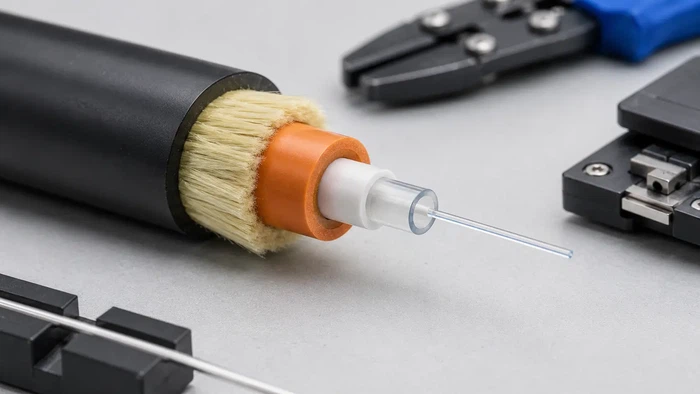
A "multimode fiber" is the 125 µm glass strand at the center of the cable. A "multimode fiber optic cable" is everything wrapped around that strand to make it survivable, installable, and connectable. The two terms are often used interchangeably, but at procurement time they are very different products.
From the inside out, a typical multimode patch cable consists of:
- Core (50 µm) - the light-carrying glass region, doped to produce a graded refractive-index profile.
- Cladding (125 µm) - outer glass layer with a lower refractive index that confines light to the core.
- Primary coating (typically 245 or 250 µm) - soft acrylate layer applied during draw, protecting the bare glass.
- Buffer (900 µm tight-buffered or gel-filled loose tube) - the first mechanical protection layer.
- Strength members - aramid yarn (Kevlar) for indoor patch cords, fiberglass rods or steel for outdoor cables.
- Jacket - the outermost layer, rated for the installation environment.
The choice between tight-buffered and loose-tube construction shapes nearly every downstream decision - flexibility, pulling tension, minimum bend radius, fiber count, and termination method. Our breakdown of loose tube vs tight-buffered fiber optic cable covers when each construction wins.
Multimode Fiber Optic Cable Form Factors You Can Buy
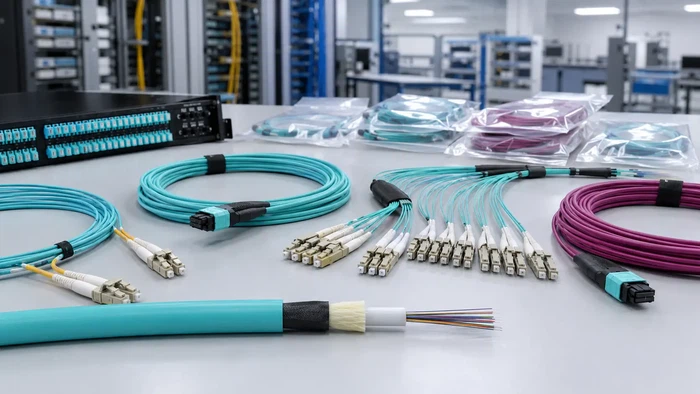
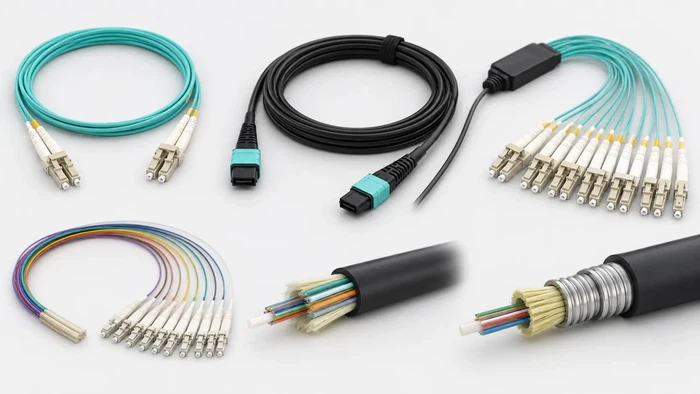
"Multimode fiber" comes in roughly seven distinct product families. Most procurement errors happen when a project specifies the wrong family entirely - buying duplex patch cords when the data center needs pre-terminated MPO trunks, or buying indoor cable for a path that crosses a building exterior.
Simplex and duplex patch cords
The smallest and most common product. One or two fibers in a 1.6–3.0 mm jacket, terminated with LC, SC, ST, or FC connectors. Standard lengths are 0.5 m to 10 m off-the-shelf, with longer cuts as custom orders. Almost every server-to-switch and switch-to-switch SR-optic link in a data center uses a duplex LC patch cord. Available configurations are on the multimode fiber patch cord page.
MPO/MTP trunk cables
Permanent or semi-permanent multi-fiber backbones, typically 12, 24, 48, or 72 fibers in a single jacket. Pre-terminated MPO/MTP connectors on both ends remove field termination entirely - you pull the trunk, plug both ends into cassettes, and you are done. Trunks are the backbone of structured cabling in modern data centers, and they dominate any environment running 40G or 100G parallel optics. See multimode MPO/MTP trunk cable configurations.
MPO breakout (harness) cables
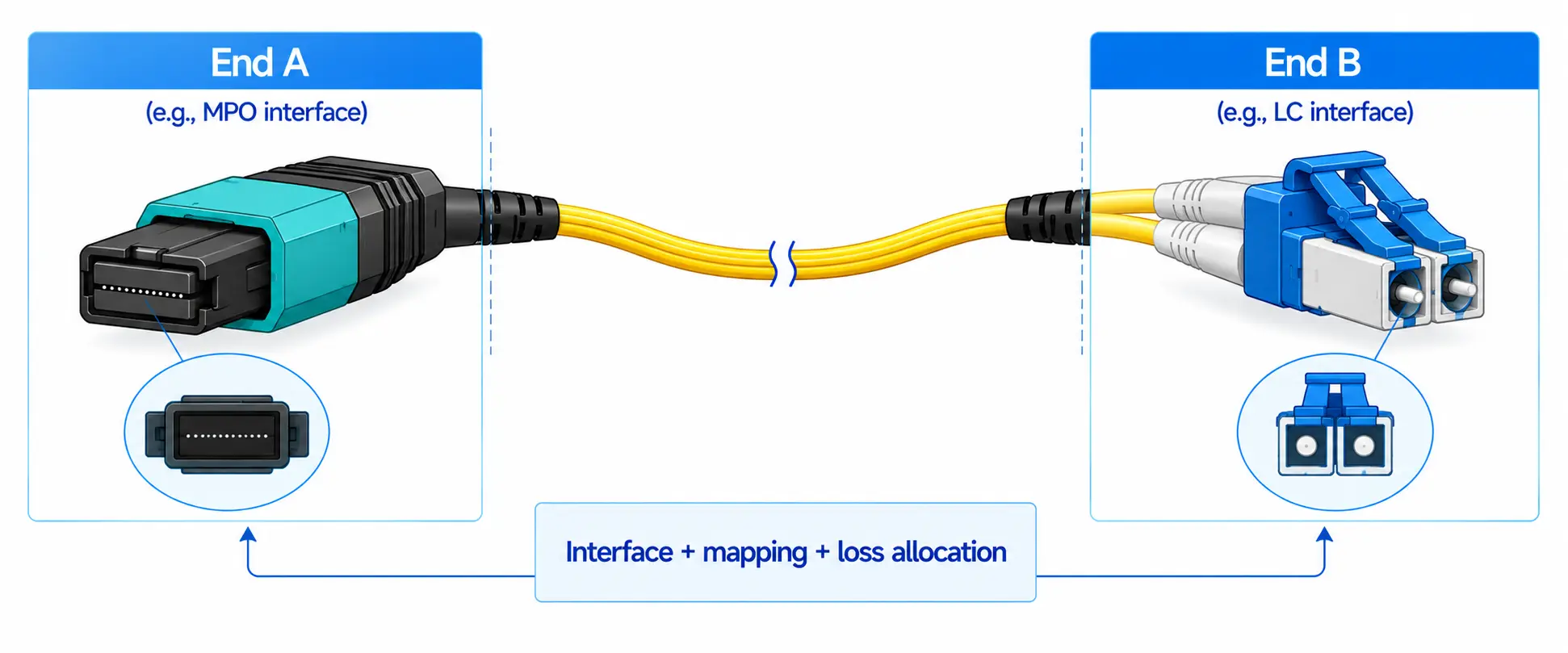
A single MPO/MTP at one end fans out into multiple duplex LC pairs at the other. The classic application is converting a 40G QSFP+ SR4 port into four 10G SFP+ SR links, or a 100G QSFP28 SR4 port into four 25G SFP28 ports. Polarity (Type A, B, or C) matters here - get the wrong polarity and the link will not pass light. The MPO breakout cable options include both 8-fiber and 12-fiber versions for different transceiver standards.
Pigtails
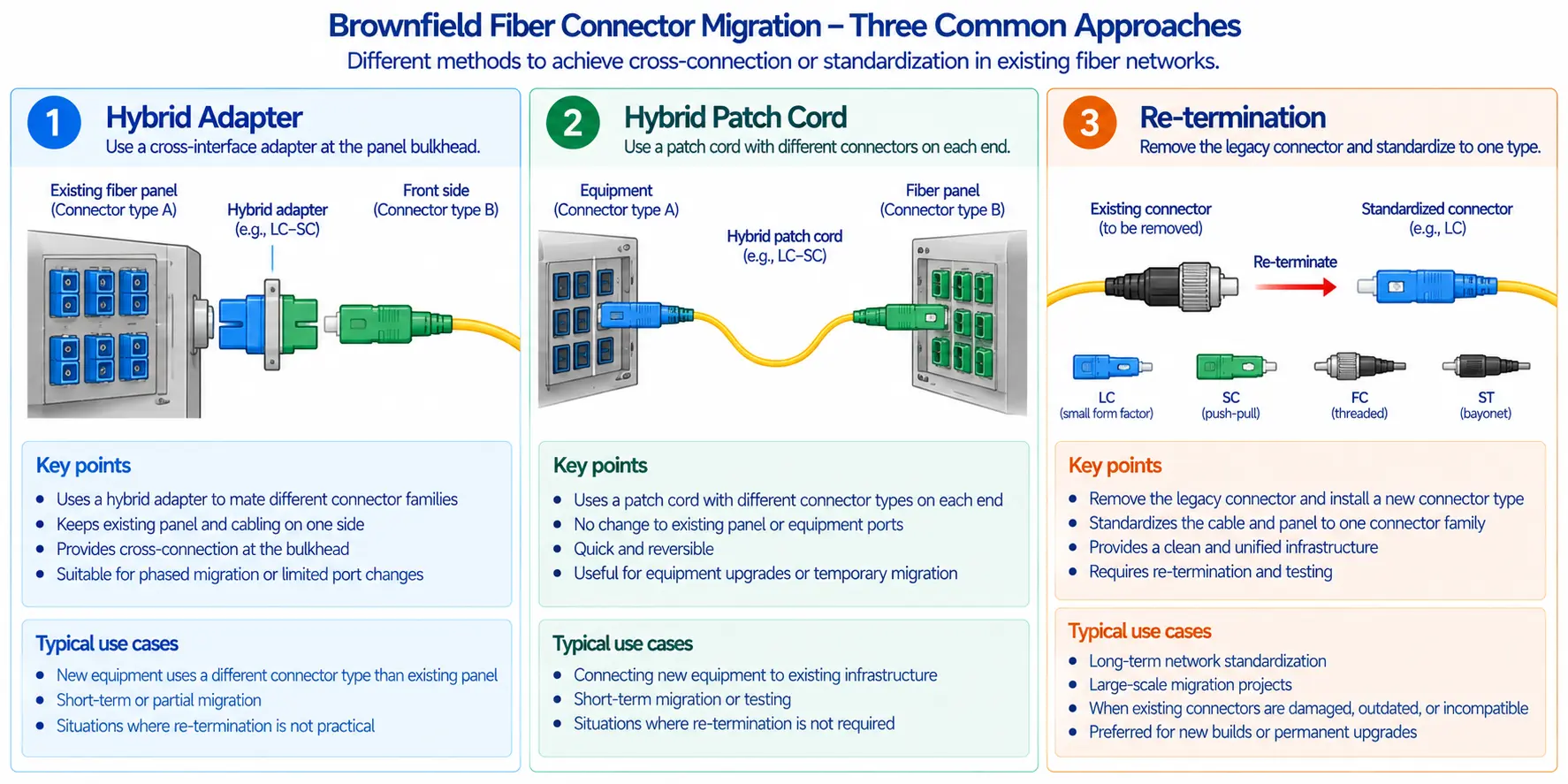
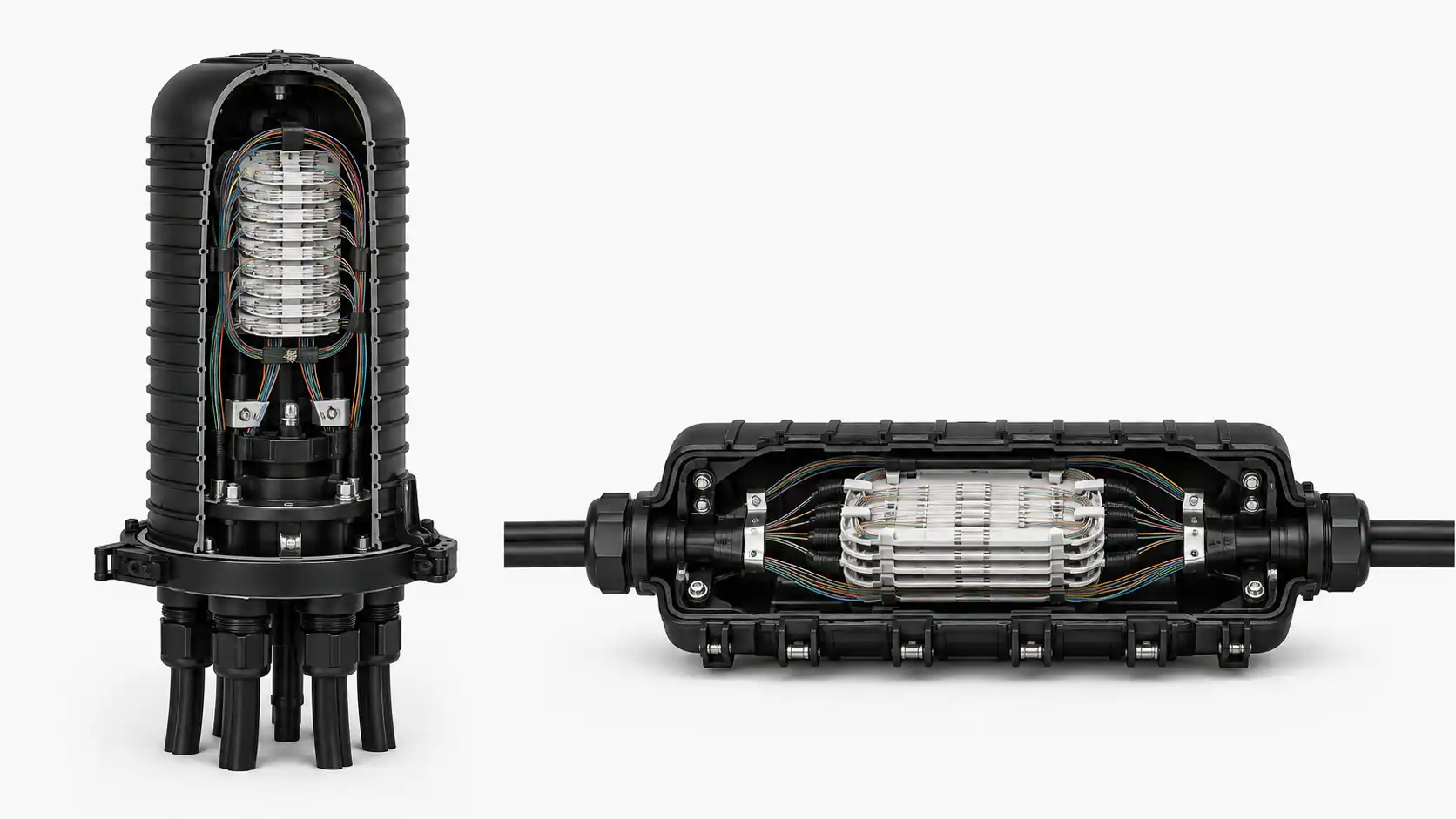
One end is factory-terminated with a connector; the other is bare fiber, intended to be fusion-spliced to an outdoor or distribution cable inside a splice tray. Pigtails dominate FTTH cabinet work and outdoor-to-indoor transitions where pulling a pre-terminated cable through conduit is impractical.
Distribution and breakout (indoor) cables
Multi-fiber cables - 6, 12, 24, 48, or more fibers in one jacket - designed for indoor riser, plenum, or general building distribution. Distribution cables are subunit-bundled and compact; breakout cables wrap each fiber in its own 2 mm subunit jacket so individual fibers can be terminated directly.
Indoor/outdoor and outdoor cables
Outdoor multimode runs are increasingly rare (campus backbones have largely shifted to single-mode), but they still exist for short inter-building links. Specifications to verify: water-blocking (gel-filled or water-blocking tape), UV-resistant jacket, operating temperature range (typically −40 °C to +70 °C), and rodent protection if direct-buried.
Armored cables
A spiral steel or aluminum-interlock armor wrapped around the cable core, used where mechanical protection trumps flexibility - under raised floors with heavy foot traffic, in industrial environments, or where rodents are a known problem. Armored cables are heavier and stiffer, with a larger minimum bend radius.
Jacket Ratings: What OFNR, OFNP, LSZH, and Friends Actually Mean
Jacket rating is one of the most common procurement mistakes because each rating is a code compliance requirement, not a quality choice. Buying the wrong rating can fail a building inspection and force a full re-pull.
| Rating | Standard | Used Where | Notes |
|---|---|---|---|
| OFNG / OFN | NFPA 70 (NEC) Article 770 | General-purpose indoor, single-floor runs | Cannot be used in risers or plenums |
| OFNR | NFPA 70 | Vertical between-floor (riser) runs | Must self-extinguish under UL 1666 test |
| OFNP | NFPA 70 | Air-handling plenum spaces | Must pass NFPA 262 (Steiner tunnel) test; required above drop ceilings in HVAC return paths |
| LSZH | IEC 60332-1, IEC 61034 | European installations, transit, marine, data centers with strict smoke requirements | Halogen-free; lower toxicity in a fire |
| OFCR / OFCP | NFPA 70 | Same as OFNR/OFNP but with conductive metallic members | Used for armored or messengered cables |
Check your local code before specifying. North American projects almost always require OFNR or OFNP. European and APAC projects usually require LSZH. Hyperscale data centers often specify both a North American flame rating and LSZH characteristics - this combination is a common custom-spec item, so confirm with the supplier early.
Endface Polish: Why PC and UPC Dominate Multimode, and APC Is Rare
The polished endface of a multimode connector ferrule directly determines back-reflection and insertion loss. Three polishing styles exist:
- PC (Physical Contact) - slightly domed, return loss around −40 dB. Largely superseded.
- UPC (Ultra Physical Contact) - more precise dome, return loss around −50 dB or better. The standard for multimode patch cords and connectors today.
- APC (Angled Physical Contact) - 8° angled endface, return loss of −60 dB or better. Standard for single-mode FTTH/CATV.
APC is rarely seen on multimode for one straightforward reason: multimode systems use intensity-modulated VCSEL transmitters that are far less sensitive to back-reflection than the narrow-linewidth lasers in single-mode CATV or coherent systems. The marginal return-loss improvement does not justify the higher cost and the strict polarity matching APC requires. Almost every multimode patch cord ships as UPC. The exception is some high-density MPO-APC assemblies used in specific architectures - see SC/APC fiber optic cable for the full PC vs UPC vs APC comparison.
Anatomy of a Multimode Fiber Optic Cable Part Number
Most cable suppliers encode the full specification in the part number. Learning to read the code saves hours of back-and-forth on RFQs. A typical part number looks like this:
Example: LC/UPC–LC/UPC–DX–OM4–2.0mm–LSZH–3M
- LC/UPC–LC/UPC - connectors on each end, with polish type.
- DX - duplex (two-fiber). Other codes: SX simplex, 8F or 12F for MPO assemblies.
- OM4 - fiber grade.
- 2.0mm - outer diameter of each subunit (common values: 0.9 mm pigtail, 1.6 mm slim patch, 2.0 mm and 3.0 mm standard patch).
- LSZH - jacket material/rating.
- 3M - length in meters.
For MPO assemblies, the code expands to include fiber count (8/12/16/24), polarity (Type A/B/C), pin presence (male/female), and ferrule polish (UPC or APC):
Example: MTP12-F/UPC–MTP12-F/UPC–TypeB–OM4–LSZH–10M
When writing a procurement spec, list each element explicitly. Ambiguity - for example, omitting polarity on an MPO trunk - is the single most common cause of return shipments.
Procurement Specification: What to Demand on the Datasheet and Test Report
Optical specifications
- Insertion loss per mated pair: typically ≤ 0.30 dB typical, ≤ 0.50 dB maximum for standard LC/UPC; ≤ 0.20 dB for low-loss and ≤ 0.12 dB for ultra-low-loss assemblies.
- Return loss: ≥ 35 dB for multimode UPC.
- Fiber grade certification: the OM3/OM4/OM5 rating and the underlying TIA-492 or IEC 60793-2-10 standard.
The difference between insertion loss and return loss matters because they fail differently in service - high insertion loss starves the receiver of power, while high return reflections destabilize the laser. The deeper treatment in insertion loss vs return loss is worth reading before writing an RFQ.
Mechanical specifications
- Minimum bend radius: typically 10× outer diameter under load, 6× unloaded. Bend-insensitive multimode fiber allows much tighter routing.
- Tensile load: short-term (during installation) and long-term (in service). Indoor patch cords are usually rated 50 N short-term; outdoor cables 600 N or more.
- Crush resistance: measured in N/cm. Critical for cables under raised floors or behind racks.
- Operating temperature: −20 °C to +70 °C for indoor; −40 °C to +70 °C for outdoor.
Connector specifications
- Ferrule material: zirconia ceramic is the industry standard for multimode LC, SC, ST, and FC.
- Endface geometry: apex offset, radius of curvature, fiber height - defined by IEC 61755-3.
- Mating durability: typically 500 to 1000 cycles before the connector ferrule needs replacement.
Quality certifications worth asking for
- Telcordia GR-326-CORE - single-fiber connector reliability (mostly applied to LC, SC, FC, ST).
- Telcordia GR-1435-CORE - multi-fiber connector reliability (MPO/MTP).
- IEC 61753-1 - passive fiber optic component performance.
- RoHS, REACH - material compliance for EU markets.
- UL listing - flame rating verification for North American markets.
Test report requirements
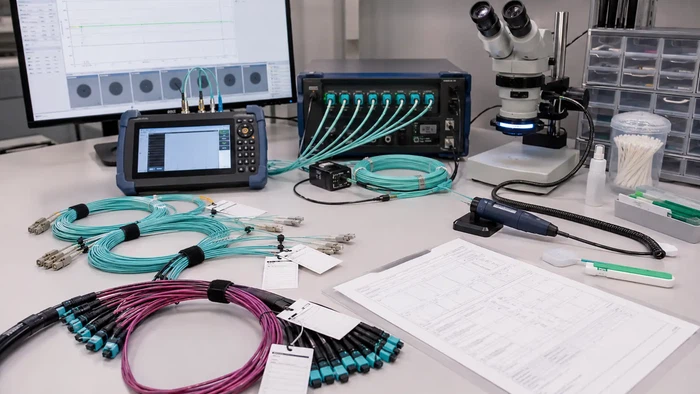
Demand a per-assembly test report - not a per-batch summary - for any link that will carry production traffic. The report should include:
- Insertion loss measured at 850 nm and 1300 nm (multimode).
- Return loss measured at the same wavelengths.
- Endface inspection images for each connector (per IEC 61300-3-35).
- Visual continuity verification.
- Operator and date stamp.
For inside the factory, a reputable supplier will follow a documented termination, polishing, and three-stage inspection workflow - what DIMI's own fiber optic cable assembly process outlines is typical of cable assembly best practice.
Tight-Buffered vs Loose-Tube: Choosing the Right Construction
Multimode cable construction divides cleanly into two families, and they are not interchangeable.
| Property | Tight-Buffered | Loose-Tube |
|---|---|---|
| Buffer | 900 µm thermoplastic, bonded to coating | 2–3 mm tube, fibers float in gel or dry water-block |
| Termination | Direct termination with connectors | Typically spliced to pigtails |
| Best environment | Indoor, patch panels, equipment rooms | Outdoor, direct buried, aerial, harsh temperature |
| Fiber count | Usually ≤ 24 fibers | Up to several hundred fibers |
| Crush/flex | Flexible, smaller bend radius | Stiffer, larger bend radius |
| Cost per meter | Higher | Lower for high fiber count |
Tight-buffered is the right answer for almost every indoor multimode application - every standard patch cord, riser, and plenum cable uses this construction. Loose-tube is the right answer for outdoor runs, aerial spans, and high-fiber-count backbones. Mixing them in one channel through a splice closure is normal practice for outdoor-to-indoor transitions; mixing them as a procurement substitution is not.
Pre-Terminated vs Field-Terminated: The Cost-vs-Flexibility Trade-Off
For modern data center cabling, the decision between pre-terminated factory assemblies and field-terminated cabling is essentially settled in favor of pre-terminated - but only for the right reasons.
Pre-terminated cables (factory-polished, factory-tested, shipped with a test report) deliver consistent insertion loss, eliminate field polishing skill variability, and dramatically cut installation time. The trade-off is length precision: the assembly is built to a fixed length, so the cable path must be measured accurately before ordering.
Field-terminated cabling (mechanical or fusion splicing of connectors onto bulk cable on site) retains length flexibility - useful for retrofits where exact routing is uncertain - but introduces operator skill as a variable, slows installation, and shifts the warranty burden onto the installer. For most modern multimode data center deployments, pre-terminated MPO trunks with cassettes at each end have become the default.
Multimode Cable Specification FAQ
Q: Is bend-insensitive multimode fiber worth specifying?
A: For high-density patch fields, raised-floor routing, and any installation where cables route over panel hinges or through tight corners, yes. Bend-insensitive multimode fiber (sometimes called BIMMF, marketed as OM3+ or OM4+ by some vendors) tolerates bend radii roughly half those of standard multimode without measurable loss increase. The cost premium is modest. For backbone trunks routed in straight conduit runs, the benefit is smaller.
Q: Should multimode patch cords be 2.0 mm or 3.0 mm jacket diameter?
A: 3.0 mm has been the historical default for indoor patch cords. 2.0 mm and even 1.6 mm "slim" patch cords have become popular in high-density data center patch fields because they pack more cleanly into LC-duplex cassettes and improve airflow. Mechanical robustness is slightly lower, so 3.0 mm remains common for cross-connects that get frequent reconfiguration.
Q: Do I need APC polish on multimode cables?
A: Almost never. Multimode systems use VCSEL transmitters that tolerate back-reflection well, and standard UPC polish gives more than enough return loss margin. APC adds cost and polarity-matching complexity without a measurable benefit. The only common exception is some niche MPO-APC assemblies for specific high-density architectures.
Q: How long can multimode patch cords be ordered as off-the-shelf?
A: Most suppliers stock standard duplex LC-LC OM3 and OM4 patch cords from 0.5 m up to 10 m in 0.5 m increments. Lengths above 10 m are typically made-to-order. For MPO trunks, the stocked range is narrower; almost everything above 5 m is custom.
Q: What does "low-loss" vs "ultra-low-loss" mean on a multimode connector?
A: Standard LC/UPC: ≤ 0.30 dB typical mated loss. Low-loss: ≤ 0.20 dB. Ultra-low-loss: ≤ 0.12 dB. The difference matters most in 40G/100G/400G channels with multiple connection points, where every 0.1 dB of saved loss directly extends the supported distance.
Q: Can I order custom-printed labels on multimode cables?
A: Yes - most cable assembly suppliers offer heat-shrink labeling with custom asset tags, port numbers, or project codes. Specify the label format, font size, and placement (typically 10 cm from each connector) when placing the order. Labeling at the factory is far cheaper and more durable than labeling at the cabinet.
Q: What is the typical warranty on a multimode patch cord?
A: Lifetime warranty against manufacturing defects is the industry norm for reputable suppliers. This excludes physical damage in the field, contamination, and over-bending. Read the warranty terms carefully - some suppliers cap their liability at replacement value of the cable, which may not cover the cost of a failed link in a production environment.
Q: How do I verify a supplier's cable quality before placing a large order?
A: Request a small sample order of the exact configuration you plan to buy in volume. Test it on the bench against a calibrated reference: measure insertion loss with an OLTS, return loss with an ORL meter, and inspect endfaces. Compare the field measurements against the supplier's test report. Significant deviations are a leading indicator that the volume order will have inconsistent quality. A walkthrough is in our fiber optic cable installation guide.
Conclusion
The fiber grade gets most of the attention in multimode cable discussions, but the construction and procurement specifications determine whether a cable actually performs the way the datasheet promises. The OM grade fixes the bandwidth-distance ceiling; the jacket rating decides whether you pass building inspection; the connector polish and per-pair insertion loss decide whether your 100G link has enough margin; the test report decides how much faith you can put in the assembly before plugging it into production.
A useful procurement spec lists every one of these elements explicitly. A useful supplier delivers a per-assembly test report that matches what the spec asked for. When both sides do their job, multimode fiber cabling becomes the kind of infrastructure component you install once and forget about - which is exactly what it should be.