


The right MTP cable depends on six specifications that must be confirmed together - fiber mode, fiber count, polarity method, connector gender, jacket rating, and insertion loss grade - and all six must match your transceiver and structured cabling plan. Choosing by connector type or length alone is the most common reason MTP links fail on commissioning day.
This guide explains how MTP cables work, how they differ from MPO, and how to specify the correct assembly for 40G, 100G, 400G and 800G environments. It is written for network engineers, data center planners, and procurement teams preparing an RFQ for high-density fiber cabling.
What Is an MTP Cable?
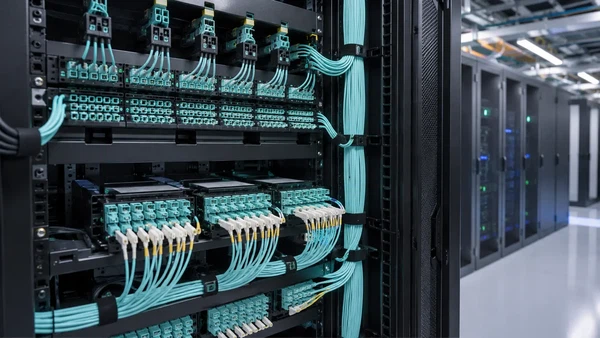
An MTP cable is a pre-terminated multi-fiber assembly that uses an MTP®-brand connector - a high-performance variant of the MPO connector family - to carry 8, 12, 16, 24 or more fibers in a single interface. It is the workhorse of modern data center backbones, switch-to-patch-panel runs, and parallel-optic transceiver links.
Typical deployments include:
- Backbone trunks between main and horizontal distribution areas
- Switch-to-patch-panel feeds for spine and leaf architectures
- Parallel-optic transceiver connections (40G-SR4, 100G-SR4, 400G-SR8, 800G-SR8)
- MTP-to-LC breakout cables that fan out a parallel trunk into duplex transceiver ports
- Cassette- and adapter-panel-based modular cabling systems
The advantage is density and deployment speed. A single 24-fiber MTP can replace twelve duplex LC patch cords, factory-tested as one unit. For a deeper comparison of MTP-style assemblies against duplex cabling, see our overview of fiber optic connector types.
MTP vs MPO: What Procurement Teams Need to Know
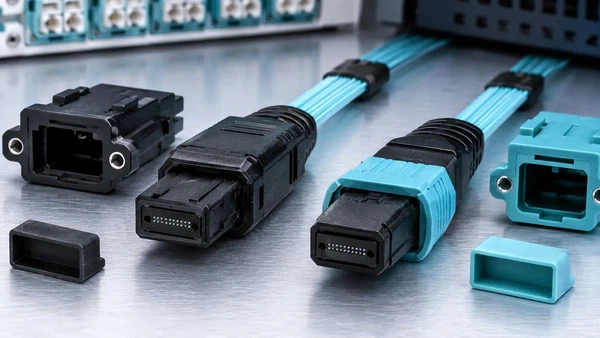
MPO (Multi-fiber Push-On) is the generic connector standard. MTP® is a registered trademark of US Conec for an MPO connector built with tighter mechanical tolerances, a removable housing for re-polishing, and an improved spring design. Every MTP is an MPO; not every MPO is an MTP.
| Item | MPO | MTP® |
|---|---|---|
| Type | Generic multi-fiber connector format | Branded MPO variant from US Conec |
| Intermateability | Mates with MTP and other MPO brands per IEC 61754-7 | Mates with any standards-compliant MPO |
| Typical insertion loss | Standard 0.35 – 0.75 dB | Often 0.20 – 0.35 dB (low loss) or ≤0.20 dB (elite) |
| When it matters | Acceptable for short, simple links | Required when tight optical budgets or multiple connection points exist |
Practical guidance: if a supplier quotes "MPO" but the project specification calls for MTP®, ask for the connector datasheet and the OEM name. Most well-known fiber assembly houses can supply genuine MTP®-brand connectors on request. A more detailed breakdown is available in our MTP vs MPO engineer's selection guide.
Main Types of MTP Fiber Cables
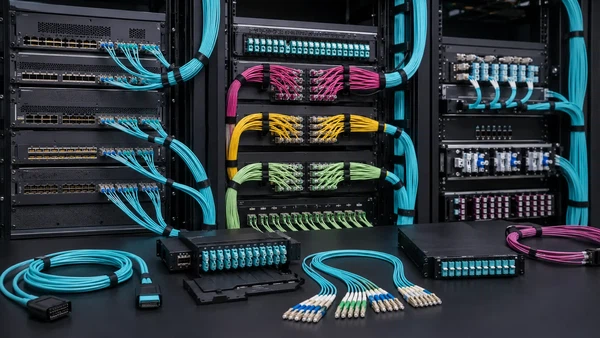
MTP Trunk Cable
An MTP trunk cable connects two high-density distribution points - typically patch panel to patch panel, or cabinet to cabinet. Both ends are MTP. Trunks are usually built in fixed factory lengths (3 m, 5 m, 10 m, 15 m, 20 m, 30 m and so on) with full optical and polarity test reports. They are the cleanest way to deploy backbone fiber, because the factory absorbs the splicing risk.
MTP-to-LC Breakout Cable
A breakout cable has one MTP end and several duplex LC legs. The most common configurations are:
- 12-fiber MTP to 6 × LC duplex - used in legacy 10G/40G LC-heavy environments
- 8-fiber MTP to 4 × LC duplex - used when only 4 duplex pairs are active
- 24-fiber MTP to 12 × LC duplex - used for high-density aggregation
MTP Patch Cable
Short MTP assemblies used inside a single cabinet, typically 1 – 3 m. Used to patch between cassettes, panels, or directly into parallel-optic transceivers.
Cassette-Based Cabling
An MTP trunk lands on a cassette that converts the parallel interface into 6 or 12 duplex LC ports on the front. This is the standard structured-cabling pattern for data centers that want to keep the backbone in MTP while allowing duplex LC at the equipment.
How to Choose the Right MTP Cable: Six Specifications That Must All Match
Three of these six are easy to fix after delivery (length, jacket, IL grade). Three are not (polarity, gender, fiber count). Prioritize the second group when reviewing a quote.
1. Fiber Mode
Match the fiber mode to the transceiver and the reach.
| Fiber Type | Typical Application | Common Reach Reference |
|---|---|---|
| OM3 | 10G/40G/100G short-reach multimode | Up to ~300 m at 10G, ~100 m at 40G/100G-SR4 |
| OM4 | 10G/40G/100G/400G short-reach multimode | Up to ~400 m at 10G, ~150 m at 40G/100G-SR4, ~100 m at 400G-SR8 |
| OM5 | Multimode with SWDM, 40G/100G/400G | Similar to OM4 with additional wavelength-multiplexing headroom |
| OS2 | Single-mode long-reach | Up to 10 km on 100G-LR4, longer with coherent optics |
Multimode and single-mode are not interchangeable - the fiber core size differs, and a mismatch will not light up. For deeper application limits, see our breakdown of OM1 to OM5 multimode fiber distance limits and the comparison of OS1 vs OS2 single-mode fiber.
2. Fiber Count
Fiber count is dictated by the transceiver, not by preference. The two most common mistakes are buying a 12-fiber MTP for an 8-fiber transceiver (4 fibers unused, polarity reversal headache) or buying 8-fiber when migration to 400G-SR8 needs 16.
| Transceiver | Active Fibers | Recommended MTP |
|---|---|---|
| 40G-SR4 / 100G-SR4 | 8 (4 TX + 4 RX) | 8-fiber MTP, or 12-fiber MTP with 4 unused fibers |
| 100G-SR10 (legacy) | 20 (10 + 10) | 24-fiber MTP |
| 200G-SR4 / 400G-DR4 | 8 | 8-fiber MTP single-mode (DR4) or multimode (SR4) |
| 400G-SR8 / 800G-SR8 | 16 | 16-fiber MTP (single-row or dual-row depending on transceiver) |
| 800G-DR8 | 16 | 16-fiber MTP single-mode |
Real example: a buyer specified a 12-fiber OM4 MTP trunk for a leaf-switch refresh that quietly moved from 100G-SR4 to 400G-SR8. The 12-fiber trunks could not carry the 16 fibers needed per port, and the entire backbone had to be re-pulled. Confirm the transceiver roadmap for the next 3 – 5 years before fixing fiber count.
3. Polarity
Polarity is the single biggest cause of failed MTP commissioning. The TIA-568 standard defines three polarity methods:
- Method A - straight-through mapping. Requires Type A trunks with a duplex LC patch cord flipped on one side.
- Method B - reversed (key-up to key-up) mapping. The most common choice for new data centers using identical patch cords on both ends.
- Method C - pair-flipped mapping. Less common; used in some legacy migrations.
The polarity decision must be made for the whole channel: trunk + cassette + patch cord. Mixing Method A trunks with Method B cassettes will fail every time. If you inherit a site, document the existing method before adding cables - do not assume.
4. Connector Gender (Pinned vs Unpinned)
A normal MTP mating uses one pinned (male) connector and one unpinned (female) connector. Two pinned ends will physically refuse to seat correctly; two unpinned ends lose fiber alignment.
The general rule:
- Cassettes and adapter panels are usually female on the back.
- Trunk cables terminating into those cassettes are usually male.
- Parallel-optic transceivers are usually male, so the patch cord into them must be female.
Confirm gender on every endpoint of your channel before placing the order. A mis-gendered cable cannot be fixed in the field without a re-termination kit.
5. Jacket Rating
Jacket choice follows the installation environment and local code, not price:
- LSZH - Europe and most international data centers; required where low-smoke and halogen-free behavior is mandated.
- OFNP / plenum - US plenum air-handling spaces under NFPA 70 (NEC).
- OFNR / riser - Vertical runs between floors.
- OFNG / general purpose - Within a single room, not in plenum or riser.
Specify the jacket per local code first, then confirm with the cabling contractor.
6. Insertion Loss Grade
Every connector in the channel costs you optical budget. Typical per-mated-pair budgets that suppliers publish:
| Grade | Typical IL per mated pair | When to specify |
|---|---|---|
| Standard loss | ≤ 0.50 – 0.75 dB | Short links with 1 – 2 connection points and generous budget |
| Low loss | ≤ 0.35 dB | Most data center 40G/100G channels with 3 – 4 connection points |
| Elite (ultra-low loss) | ≤ 0.20 dB | 400G/800G channels, channels with cassettes on both ends, or links near reach limits |
For a 100G-SR4 channel with two cassettes plus a trunk, you can burn 1.0 dB or more in connectors alone. Use the insertion loss budgeting reference to estimate the channel before specifying the grade. If you are uncertain whether the issue is insertion or return loss, the insertion loss vs return loss explainer clarifies how each contributes to link performance.
MTP Cable Quick Selection Matrix
| Application | Transceiver | Fiber Count | Polarity | Recommended Cable Type | IL Grade |
|---|---|---|---|---|---|
| 40G data center spine | 40G-SR4 | 8 or 12 | Method B | OM4 MTP trunk + cassettes | Low loss |
| 100G short-reach | 100G-SR4 | 8 or 12 | Method B | OM4 MTP trunk + LC breakout | Low loss |
| 100G long-reach | 100G-LR4 / DR1 | 2 (duplex) | n/a (use duplex) | OS2 LC duplex, MTP not required | Standard |
| 400G short-reach | 400G-SR8 | 16 | Method B | 16-fiber OM4 MTP trunk | Elite |
| 400G single-mode | 400G-DR4 | 8 | Method B | 8-fiber OS2 MTP trunk | Low loss / Elite |
| 800G migration-ready | 800G-SR8 / DR8 | 16 | Method B | 16-fiber MTP, OM4 or OS2 | Elite |
| Legacy 10G LC migration | 10G-SR | 12 → 6 × LC | Method B | MTP-to-LC breakout | Low loss |
Use this as the starting point for your RFQ - but always validate against the actual transceiver datasheet, because vendors occasionally deviate from the IEEE 802.3 reference port mapping.
Common Mistakes When Buying MTP Cables
Treating MTP and MPO as identical on the BOM
If the engineering team specifies MTP® and procurement substitutes a generic MPO to save 10 – 15%, performance grade and intermateability may still be fine - but the warranty and the optical budget often are not. Ask for the connector OEM and the IL data per the published IEEE 802.3 Ethernet standards for the relevant transceiver.
Ignoring polarity until installation day
This is the single most expensive mistake in MTP deployments. A 24-cable rack that fails polarity testing on commissioning night often means swapping every patch cord - or worse, every trunk. Define and document the polarity method during the design phase.
Choosing fiber count by today's transceiver only
If the site will see a 100G to 400G migration within the asset life of the cabling (typically 7 – 10 years), specify 16-fiber MTP today even if 8 fibers will sit dark. Re-pulling backbone fiber is far more expensive than the additional fiber count.
Pinned-to-pinned or unpinned-to-unpinned ends
A surprisingly common shipping error. Insist on a clear gender callout on every line of the BOM, and inspect a sample on receipt before bulk installation.
Skipping endface cleaning
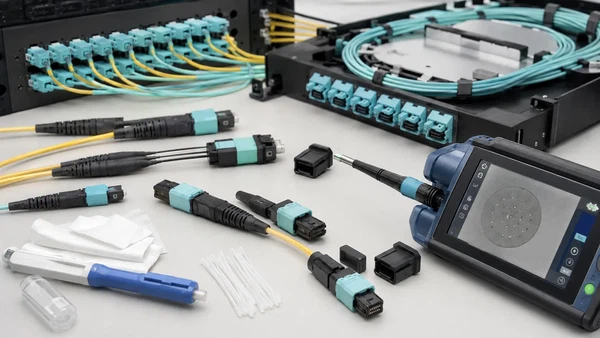
MTP connectors expose 8, 12, 16 or 24 polished fiber ends inside a single ferrule. A single contaminated fiber will degrade or kill the entire link. Fluke Networks' field guidance is unambiguous: inspect, clean, inspect again - every connection, every time. Use MPO-specific cleaning tools, not LC sticks.
Quoting on price alone
The cheapest MTP cable stops being the cheapest the moment a wrong-polarity trunk forces a rework crew back into a live data hall. Cost of failure dwarfs the unit-price delta on a fiber assembly.
Installation and Testing: What Actually Differs from LC Cabling
General fiber installation rules apply - bend radius, no pulling on the connector body, proper cable management. The MTP-specific considerations are:
- Pre-install paperwork. Before any trunk leaves a box, verify length, fiber count, mode, gender, polarity method, jacket and IL grade against the BOM.
- Dust caps stay on until the moment of mating. MTP ferrules are larger and harder to clean than LC.
- Polarity test first, IL test second. An IL failure on a mis-polarized channel sends you in the wrong troubleshooting direction.
- MPO-specific inspection scopes. A standard LC inspection scope will not work; you need an MPO tip that scans all fibers across the ferrule.
- Label both ends. Include polarity method, fiber count, gender, and trunk ID. The next engineer will thank you.
For physical handling, routing, and pulling best practices applicable to all fiber types, see our fiber optic cable installation guide.
FAQ
Q: Is MTP the same as MPO?
A: No. MPO is the generic connector standard defined by IEC 61754-7 and TIA-604-5. MTP® is a trademarked, higher-precision MPO connector made by US Conec. They are intermateable, but MTP typically has lower insertion loss and better repeatability.
Q: Can I connect MTP to MPO?
A: Yes, in almost all cases - the mechanical interface is the same. The combined channel performance, however, is limited by the lower-performance connector. If the design assumes elite-loss connectors, mixing standard MPO into the channel will likely break the IL budget.
Q: What is the difference between male and female MTP?
A: Male MTP connectors have two precision guide pins protruding from the ferrule; female connectors do not. Pins align the two ferrules when mated. A valid connection always pairs one male with one female.
Q: Which polarity should I choose for a new data center?
A: Method B is the most common for greenfield deployments because both ends use identical duplex LC patch cords and the channel is symmetric. Method A is still used in some 10G LC migrations. Method C is rare in new builds.
Q: Is 8-fiber or 12-fiber MTP better for 100G?
A: 100G-SR4 uses 8 fibers (4 TX + 4 RX). An 8-fiber MTP fits exactly. A 12-fiber MTP works but leaves 4 fibers unused, and unused fibers in a parallel optic context are a known source of polarity confusion. For 100G-only deployments, 8-fiber is cleaner; for mixed 40G/100G/legacy use, 12-fiber gives more flexibility.
Q: What MTP cable should I use for 400G?
A: For 400G-SR8 and 400G-DR8, use 16-fiber MTP. For 400G-DR4 single-mode, an 8-fiber single-mode MTP is correct. Always confirm against the transceiver vendor's port-pinout document.
Q: Can MTP connectors be cleaned in the field?
A: Yes, with MPO-specific cassette cleaners or stick cleaners. Do not use LC tools on MTP - the ferrule geometry is different and a wrong tool can damage the endface. Inspect with an MPO-compatible scope before and after each cleaning.
Q: Do I need MTP for short links between two switches?
A: No. For a single duplex 10G or 25G link between adjacent switches, a duplex LC patch cord is simpler, cheaper, and easier to troubleshoot. MTP is justified when fiber density, structured cabling, or parallel optics enter the picture.
Q: How long can an MTP fiber cable run?
A: The MTP connector does not limit reach; the fiber type and transceiver do. OM4 supports up to ~150 m at 100G-SR4 and ~100 m at 400G-SR8. OS2 single-mode MTP cables can run several kilometers depending on the optics. Always check the transceiver reach specification.
Key Takeaways
MTP cables are the backbone of modern high-density and high-speed data center networks. They are not, however, a single product - they are a specification that must be defined across six parameters. Get all six right and the link comes up the first time. Get one wrong and you are pulling cable on a Saturday night.
Before approving any MTP purchase, confirm:
- Fiber mode matches the transceiver and the reach
- Fiber count matches the transceiver lane count, plus a margin for the migration roadmap
- Polarity method is documented for the entire channel
- Connector gender is correct on every endpoint
- Jacket meets local building code
- Insertion loss grade fits the channel budget
If you would like a tailored configuration for a specific 100G, 400G or 800G deployment, you can send the project details to our engineering team and we will return a verified BOM with polarity diagrams and factory test plan.


