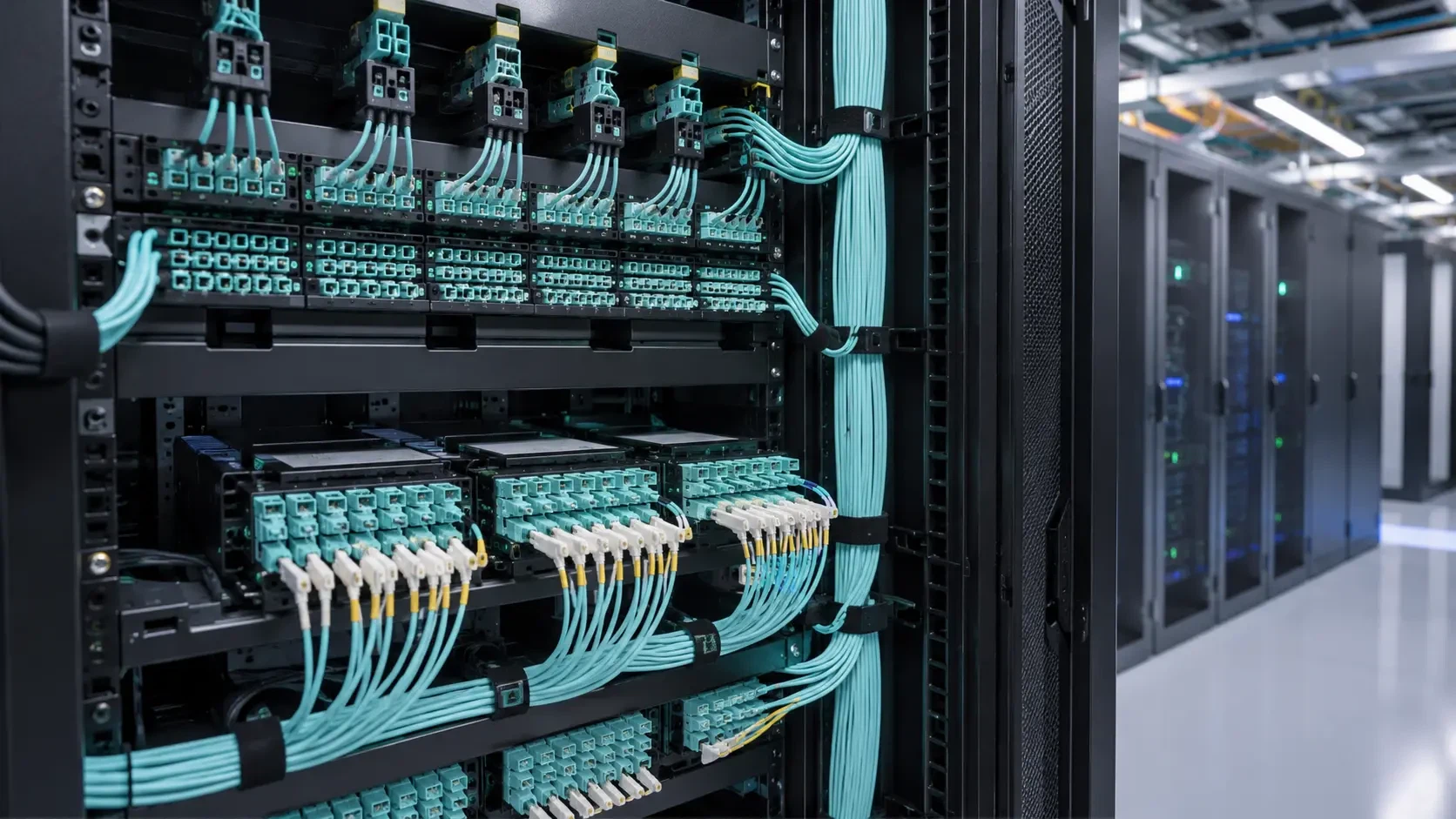
OM4 fiber has more than double the effective modal bandwidth of OM3 and supports longer reaches at 10G, 25G, 40G and 100G. OM3 is still a sound choice for short links and budget-sensitive 10G networks. For most new data center cabling, OM4 is the safer long-term decision.
OM3 and OM4 are both laser-optimized 50/125 µm multimode fibers, designed for short-wavelength VCSEL transceivers at 850 nm. They are the two most common multimode types in modern data centers, enterprise LANs, and storage networks. The right choice depends on your transceiver, link length, connector type, insertion loss budget, and how soon you plan to move to 25G, 40G, 100G, or higher.

OM3 vs OM4
Use OM3 fiber when your links are short, you are running 10G Ethernet or short 40G/100G applications, and you already have OM3 infrastructure or a tight budget.
Use OM4 fiber when you are installing new cabling, planning higher-speed upgrades, or need extra distance margin for parallel-optic 40G and 100G links.
If your link will exceed roughly 100 m at 40G/100G, or 400 m at 10G, neither OM3 nor OM4 is suitable - you should evaluate single-mode versus multimode transceivers instead.
What Are OM3 and OM4 Fiber?
OM3 and OM4 are both 50/125 µm laser-optimized multimode fibers (LOMMF) defined in ISO/IEC 11801 and TIA-492AAAC/AAAD. They share the same core size and outer diameter, and they can use the same connectors and patch panels. The difference is bandwidth performance, especially the laser-launch Effective Modal Bandwidth (EMB) at 850 nm.
- OM3: minimum EMB of 2,000 MHz·km at 850 nm
- OM4: minimum EMB of 4,700 MHz·km at 850 nm
That bandwidth gap is the entire reason OM4 supports longer reach at the same Ethernet speed. The core glass, connector geometry, and cleaning practices are otherwise identical - which is why OM3 and OM4 are physically interoperable but not equivalent in performance.
OM3 Fiber in Practice
OM3 is widely deployed in 10G Ethernet networks and short-reach data center links. It typically has an aqua-colored jacket, although the printed cable marking is the only reliable identifier. OM3 is a sensible choice when:
- Links run at 10G Ethernet over distances well under 300 m
- 40G or 100G links are short (under 70–100 m)
- The project budget is tight and the speed roadmap is stable
- OM3 infrastructure already exists and is performing reliably
OM4 Fiber in Practice
OM4 is the dominant multimode choice for new enterprise and data center cabling today. It supports the same applications as OM3, but with more reach margin. OM4 is the right pick when:
- You are pulling new fiber that will be hard to replace later
- The cabling will see 40G, 100G, or beyond within its lifetime
- Links are close to OM3's distance ceiling and you want headroom for patch panels and connectors
- You operate a high-density data center with structured cabling and many cross-connects

OM3 vs OM4 Comparison Table
| Specification | OM3 Fiber | OM4 Fiber |
|---|---|---|
| Fiber type | Laser-optimized multimode | Laser-optimized multimode |
| Core/cladding size | 50/125 µm | 50/125 µm |
| Operating wavelength | 850 nm (also 1310 nm) | 850 nm (also 1310 nm) |
| Minimum EMB at 850 nm | 2,000 MHz·km | 4,700 MHz·km |
| 10GBASE-SR reach | 300 m | 400 m |
| 25GBASE-SR reach | 70 m | 100 m |
| 40GBASE-SR4 reach | 100 m | 150 m |
| 100GBASE-SR4 reach | 70 m | 100 m |
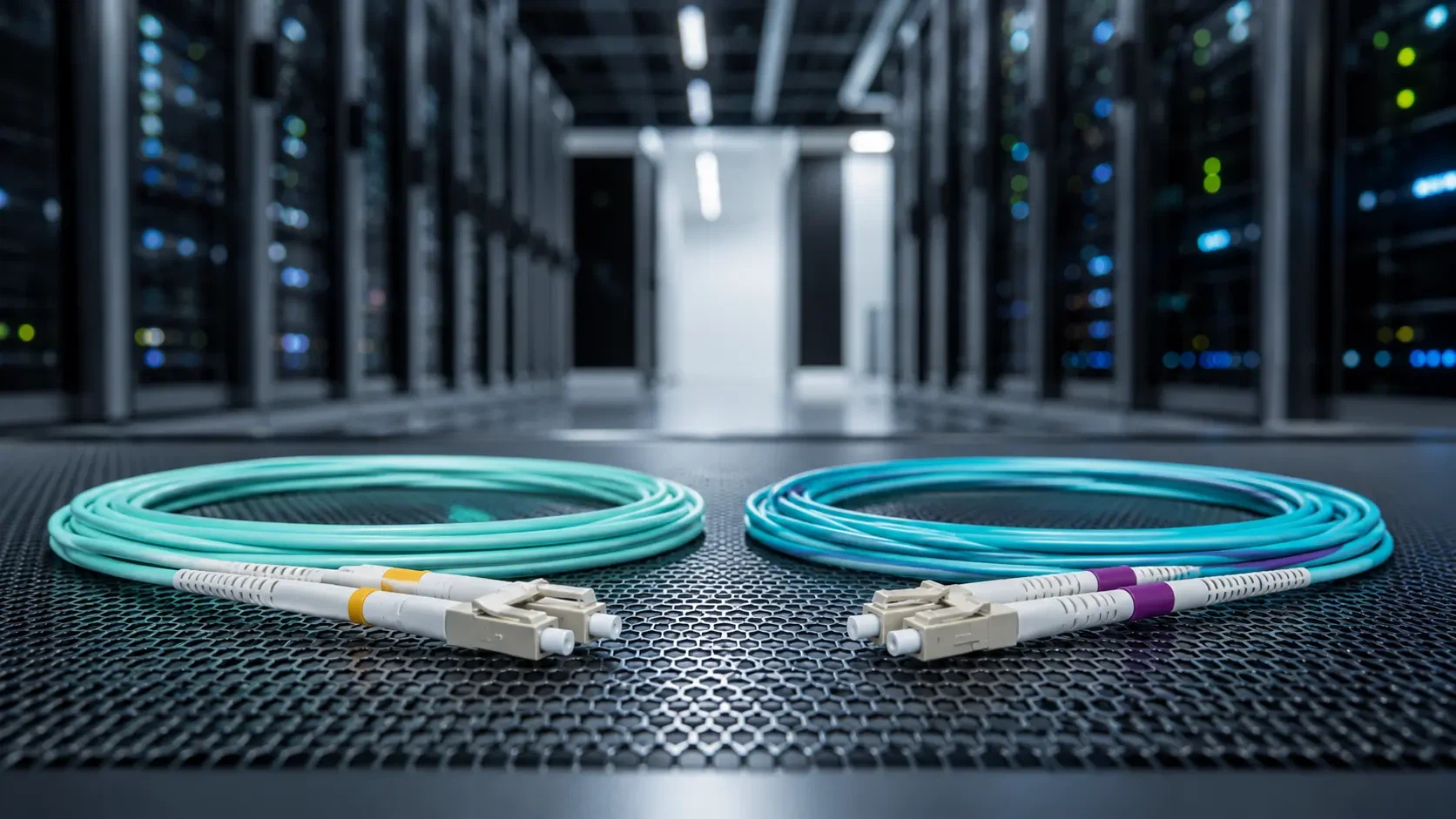
| Common jacket color | Aqua | Aqua (some vendors use erika violet) |
| Relative cable cost | Lower | 15–40% higher |
| Best suited for | 10G data center links, existing OM3 plants | New cabling, 40G/100G short-reach, upgrade flexibility |
The distance figures above follow the multimode reach values published by IEEE 802.3 Ethernet standards and the cabling guidance summarized by the TIA Fiber Optics Technical Consortium. Always confirm the supported distance against the data sheet of the specific transceiver you plan to use, since vendor-qualified reaches occasionally differ from the standard.
OM3 vs OM4 Distance: 10G, 25G, 40G, and 100G Reach
The single biggest reason engineers choose between OM3 and OM4 is distance. Higher EMB lets OM4 carry the same signal further before pulse spreading (modal dispersion) corrupts the bit pattern.
10GBASE-SR
OM3 supports up to 300 m and OM4 up to 400 m. For switch-to-server links inside a single row or building, both are comfortably within reach. A 30 m or 70 m switch-to-server link runs fine on OM3 with duplex LC connectors.
25GBASE-SR
OM3 reaches 70 m, OM4 reaches 100 m. The drop is steep - moving from 10G to 25G on the same OM3 cabling can suddenly leave you with no margin on links that used to work fine. If you are designing a top-of-rack to leaf 25G fabric, OM4 protects you against patch-panel insertion loss.
40GBASE-SR4
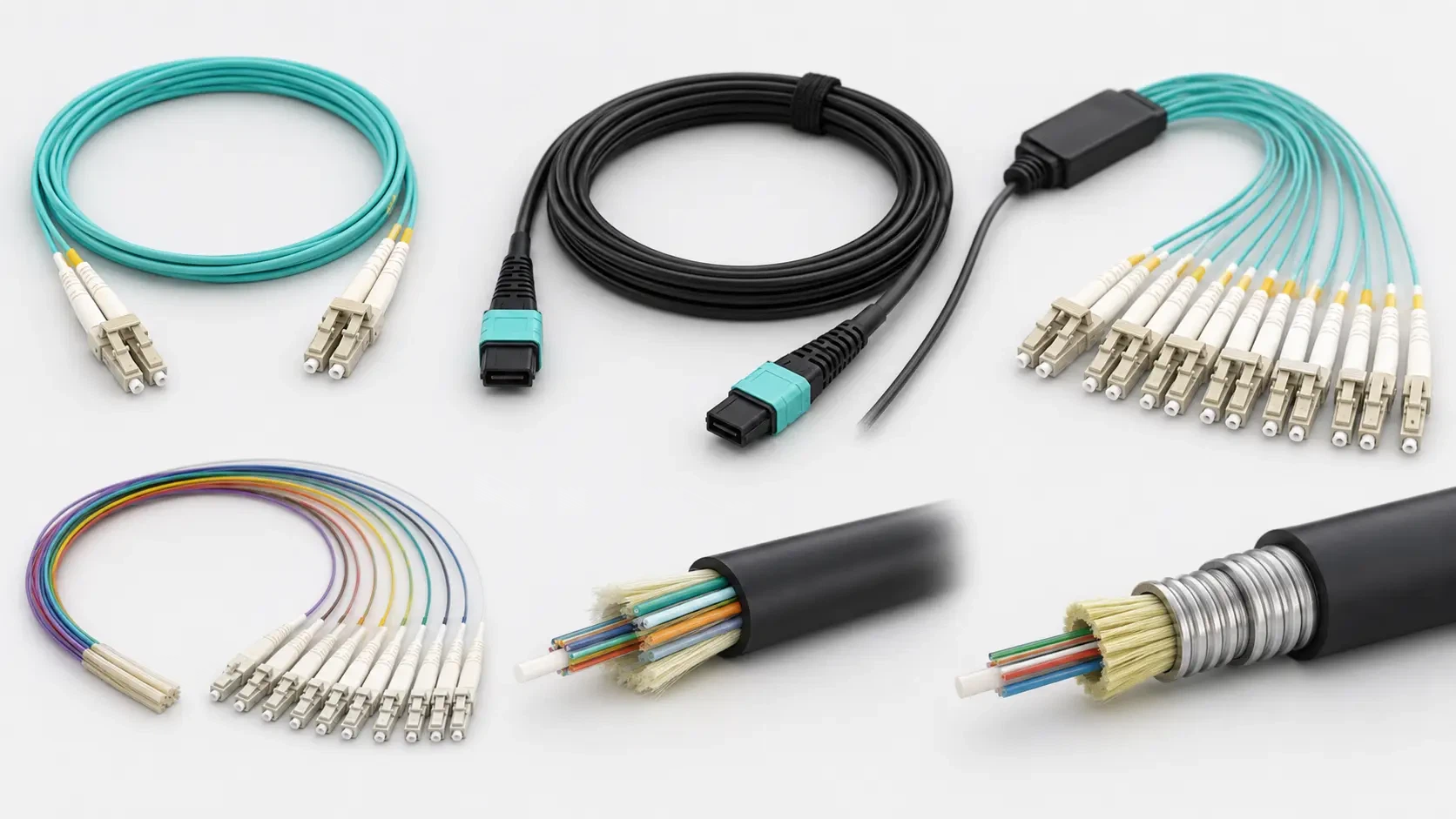
40G short-reach uses 4 parallel transmit lanes and 4 receive lanes over MPO-12 connectivity. OM3 supports 100 m, OM4 supports 150 m. If you are planning 40G across a data hall, you are looking at MPO/MTP patch cords and trunks - not duplex LC. Plan the connector format and breakout strategy before specifying the fiber.
100GBASE-SR4
100GBASE-SR4 also uses 8-fiber parallel optics: OM3 to 70 m, OM4 to 100 m. In a real link with two MPO connectors and a couple of patch panels, the insertion loss budget can erode that quickly. For 100G trunks above 70 m, default to OM4 unless you have a thoroughly tested OM3 plant.
For a wider view across all multimode grades, see our reference on OM1 to OM5 multimode fiber distance limits.
OM3 vs OM4 Bandwidth: Why EMB Matters
Effective Modal Bandwidth measures how well a multimode fiber preserves a laser pulse over distance. A higher EMB means less modal dispersion, which means the receiver still sees a clean "1" or "0" after the signal travels through the fiber.
The 2,000 vs 4,700 MHz·km difference is not a marketing number. It directly maps to the distance figures above. When IEEE writes a new high-speed Ethernet standard, the supported multimode reach is derived from EMB, the transceiver's transmit and receive characteristics, and a defined link power budget. Cable bandwidth is the input; reach is the output.
This is also why OM3 and OM4 are not "just multimode." Older OM1 (62.5/125 µm) and OM2 (50/125 µm) fibers were optimized for LED sources, not VCSELs, and they will not deliver these reaches at all. Mixing OM1 or OM2 into an OM3/OM4 path will fail.
OM3 vs OM4 Cost: When Is OM4 Worth It?
OM4 cable typically costs 15–40% more than OM3 of the same construction and connector type. Whether that premium is worth paying depends on three things.
How long will the cabling stay in place? Permanent cabling pulled through conduits, risers, or overhead trays is expensive to replace. The cable itself is often a minority of the total project cost - labor, downtime, and pathway access dominate. In that situation, OM4's extra cost is small insurance against future re-pulls.
What's the speed roadmap? If your network will sit at 10G for the foreseeable future and the links are short, OM3 is genuinely sufficient. If 25G or 40G are on the two-year roadmap, OM4 pays for itself the first time a link distance pushes against the OM3 limit.
How many connectors are in the link? Every MPO or LC connector adds 0.25–0.75 dB of insertion loss in a real installation. A 100 m 100G link on OM3 with two cross-connects can fail link verification while the same cable on OM4 passes with margin. If your structured cabling uses multiple patch panels, OM4 buys you that margin.
Real-World Scenarios: Picking OM3 or OM4 by Link Length
Distance tables are a starting point. Field engineers usually translate them into rules of thumb based on link length and speed.
- 30 m switch-to-server at 10G or 25G: OM3 is fine. Use a duplex LC patch cord, keep the connectors clean, and move on.
- 70 m row-to-row at 25G: OM3 is at the edge. Verify with an OTDR or link tester, or step up to OM4 for breathing room.
- 100 m 40G trunk between switch rows: Both work in theory. OM4 is the practical default, especially with MPO breakouts at each end.
- 150 m 40G campus link: OM3 won't reach. OM4 will, but only with a clean two-connector path. If your design has more connectors, jump to single-mode.
- Anything over 100 m at 100G: Move to single-mode 100GBASE-LR4 or DR-class optics. Don't try to stretch OM4 past its rated reach.
Engineer's Note
One field reality the datasheets don't emphasize: a poorly installed OM4 link with dirty MPO ferrules will lose more dB than a clean OM3 link of the same length. Fiber category does not rescue bad installation practice. Before blaming the cable, inspect every endface with a fiber scope, and review your insertion loss budget. In troubleshooting visits, dirty connectors and bend radius violations account for the majority of failed multimode links - not the choice of OM3 vs OM4.
OM3 vs OM4 vs OM5 vs Single-Mode: When to Consider Each
OM3 and OM4 are not the only options. A complete decision should at least glance at OM5 and single-mode.
- OM3: Cheapest LOMMF. Right for 10G short links and existing 10G plants.
- OM4: Best balance of cost and reach for 25G/40G/100G short links. The current default for new multimode cabling.
- OM5: Adds wideband performance from 850–953 nm to support SWDM optics. Pays off mainly where you want to run 40G or 100G over fewer fiber pairs using SWDM4. For most data centers, the OM4-to-OM5 jump is harder to justify than the OM3-to-OM4 jump.
- Single-mode (OS1/OS2): Necessary for longer links, campus or metro distances, and forward-looking 400G/800G deployments. Cable is cheap; the cost is in the transceivers.
If you are weighing single-mode for longer reaches, our comparison of OS1 vs OS2 single-mode fiber covers the practical differences.
Can You Mix OM3 and OM4?
OM3 and OM4 are mechanically interoperable. They share core size, connector geometry, and termination methods. You can patch an OM3 cord into an OM4 trunk and the light will pass through. The question is whether the resulting link still meets the standard's reach and loss requirements.
When a link contains both OM3 and OM4 segments, the overall performance is bounded by the lower-grade fiber. A 100 m 40GBASE-SR4 link built with 80 m of OM4 trunk and 20 m of OM3 patch cords behaves more like OM3 than OM4. For permanent links, keep one fiber grade end-to-end and document it. For temporary patching, mixing is acceptable as long as you re-verify the loss budget.
OM3 vs OM4 Decision
| Project Profile | Recommended Fiber | Why |
|---|---|---|
| Existing 10G data center, links under 300 m | OM3 | Already deployed and within reach; no benefit from re-pulling |
| New enterprise LAN, 10G today, possible 25G later | OM4 | Cheap insurance against future tight links |
| New data center trunk, 40G or 100G short-reach | OM4 | OM3 has little margin once connectors are added |
| Campus link over 150 m at 40G or 100G | Single-mode | Beyond multimode reach regardless of grade |
| High-density colocation with many cross-connects | OM4 (or OM5 for SWDM) | Loss budget matters more than raw cable cost |
| Storage network, sub-50 m, 16/32G FC | OM3 or OM4 | Both work; pick by budget and existing plant |
Common Mistakes When Comparing OM3 and OM4
Assuming OM4 is always required. For a 30 m 10G link, paying the OM4 premium adds no real benefit. Match the fiber to the speed and distance, not to a vague "future-proofing" instinct.
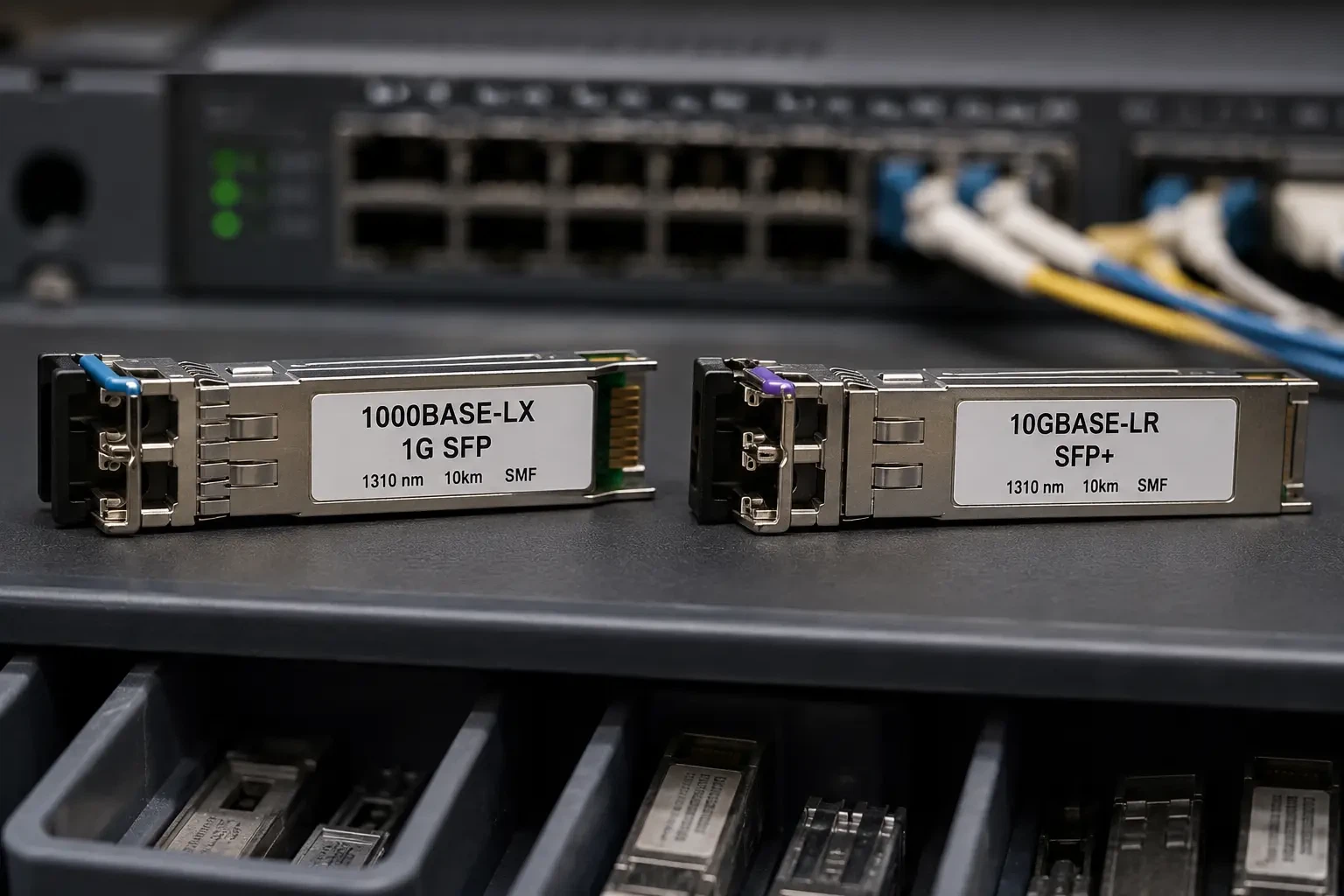
Ignoring the transceiver standard. The fiber is only half the link. A 100G-SR4 transceiver does not behave like a 100G-LR4 transceiver, and the supported distance reflects the optic, not just the cable.
Forgetting that 100G has many flavors. 100GBASE-SR4, SR2, SR1, DR1, FR1, and LR4 all carry 100G but use different lane counts, connectors, and reaches. The fiber that works for SR4 may be useless for LR4, and vice versa.
Overlooking connector type. Duplex LC and MPO/MTP have very different patching ecosystems. If you choose OM4 because of 100G-SR4, your patch panels and cassettes also need to support MPO. For deeper context, see our overview of fiber optic connector types.
Identifying fiber by jacket color alone. TIA-598 commonly assigns aqua to OM3 and OM4, with some vendors using erika violet for OM4 to distinguish the two. Color is a hint, not proof. Always read the cable print legend.
FAQ
Q: Is OM4 better than OM3?
A: OM4 has higher modal bandwidth (4,700 MHz·km vs 2,000 MHz·km) and longer supported reach at every multimode Ethernet speed. For new cabling, OM4 is the better technical choice. For short 10G links, OM3 is often equally good in practice and cheaper.
Q: Can OM3 support 100G?
A: Yes. 100GBASE-SR4 over OM3 is rated to 70 m. 100GBASE-SR2 and SWDM-based 100G also work on OM3 over short distances. For longer 100G links, OM4 or single-mode is required.
Q: Can OM3 and OM4 be mixed in the same link?
A: Mechanically, yes - they use the same 50 µm core and connector geometry. Practically, the link inherits the lower fiber grade's reach. Avoid mixing in permanent installations, and always re-test the loss budget if you do mix.
Q: Is OM4 backward compatible with OM3?
A: Yes. Any application that works on OM3 will work on OM4 with at least the same reach. Connectors, splicing techniques, and test equipment are identical.
Q: Are OM3 and OM4 the same color?
A: Both are usually aqua. Some vendors use erika violet for OM4 to make it visually distinct, but coloring is not standardized worldwide. The cable's printed marking is the authoritative identifier.
Q: Should I use OM3 or OM4 for a data center?
A: For a new data center build, OM4 is the default. The fiber cost premium is small compared to labor, pathway, and future re-pull costs. For an established data center with stable 10G traffic, expanding with OM3 is reasonable.
Q: Should I just skip multimode and go to single-mode?
A: Single-mode cable is cheaper than OM4, but single-mode transceivers cost significantly more, especially at higher speeds. For sub-100 m data center links at 10G–100G, multimode usually wins on total cost. For longer reaches or 400G/800G plans, single-mode is the right base.
Conclusion
The OM3 vs OM4 decision comes down to four levers: required speed, link distance, connector and loss budget, and how long the cable will stay in place. OM3 keeps cost down for short 10G links and existing plants. OM4 gives you the reach and margin needed for 25G, 40G, and 100G short-reach networks, and it has become the default choice for new data center cabling. For links that exceed multimode's distance limits, neither OM3 nor OM4 is the right answer - that is where single-mode fiber belongs.
Before you buy, confirm the supported reach against the exact transceiver data sheet, calculate the insertion loss including every connector and splice, and design the link with at least 1 dB of headroom. Choosing the cable category alone, without checking the rest of the link, is the most common reason a new fiber plant fails its first day of testing.