


In fiber optic networks, SFP (Small Form-factor Pluggable) transceivers are almost standard equipment for switches, routers, and media converters. However, when it comes to fiber optic ports, many people get stuck on one question: What's the difference between single mode and multimode SFP?
The differences between these two mainly stem from the types of fiber they're designed for, which in turn affects working wavelength, transmission distance, cost, and typical application scenarios.
Understanding SFP Transceivers
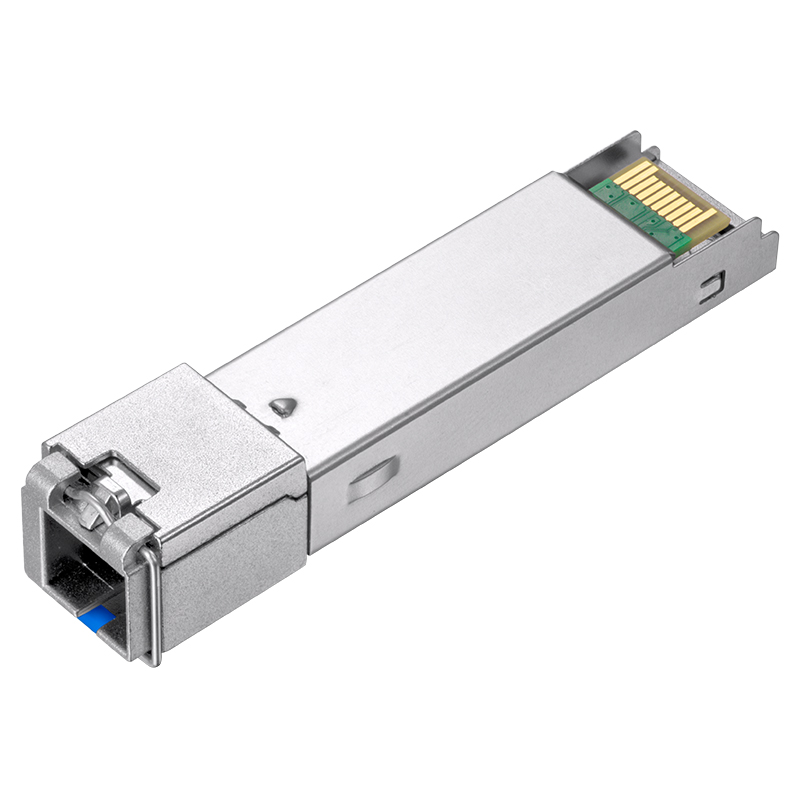
SFP transceivers can be understood as "pluggable miniature optical-electrical conversion modules." They are compact in size, support hot-swapping, and are installed in the SFP ports of network devices to complete data transmission and reception over fiber optic links.
In common deployments, SFP modules can be broadly divided into two categories: single mode SFP and multimode SFP, each designed for different cabling environments and distance requirements.

Single Mode SFP: Simplifying Long-Distance Communication
The positioning of single mode SFP modules is very clear: designed for long-distance transmission. They are typically paired with single mode fiber, which has a thinner core (typically around 9µm). Light travels more "concentrated" through the core, resulting in less dispersion, making it easier to maintain signal quality over long distances.
In engineering selection, you'll often see single mode SFP transceivers with these typical characteristics:
More suitable for inter-building, campus backbone, metropolitan extension, and other "kilometer-level or longer" links
Commonly use laser diodes for light emission to meet longer distance and higher stability requirements
Common working wavelengths are concentrated at 1310nm / 1550nm (varies by model)
If your link plan requires long distances, or may expand distances in the future, single mode fiber SFP usually fits the "less hassle, more sustainable" approach.
Multimode SFP: Optimizing Short to Medium Distance Connections
Multimode SFP modules are more commonly found in short to medium distance environments such as equipment rooms, buildings, and campuses. They are generally paired with multimode fiber, which has a thicker core (typically 50µm or 62.5µm), allowing multiple light propagation modes to exist simultaneously, enabling reliable connections in a more economical way over short distances.
From a deployment perspective, multimode SFP transceivers typically have these characteristics:
Commonly used for intra-building/equipment room/campus interconnections, with typical distances often in the range of several hundred meters (specifics still depend on speed and model)
Light emission technology commonly uses LED or VCSEL, with costs and implementation methods more suitable for short-distance scenarios
Common working wavelength is 850nm
If your requirement is "short-distance interconnection within the same building/campus," multimode SFP is often a more practical and cost-effective choice.

Distinguishing Factors: Single Mode vs Multimode SFP
The core comparison dimensions between single mode and multimode actually come down to four: distance, bandwidth, cost, and light source.
Transmission Distance
Single mode SFP is more oriented toward long distances; multimode SFP is more oriented toward short to medium distances. The specific "how many meters/kilometers" you see in materials are often typical examples or common specifications for certain models, but the directional conclusion is stable: single mode fiber goes farther, multimode fiber covers shorter ranges.
Bandwidth Capability and Application Positioning
Single mode is usually described as having stronger bandwidth capability, supporting higher data rates and stronger long-distance performance; multimode can also run at high speeds, but is more likely to encounter limitations in reachable distance and bandwidth, making it more suitable for short-distance interconnection.
Cost Trade-offs
Single mode SFP often has higher cost (due to higher technical and component requirements for long distances); multimode SFP is usually more economical, especially in short-distance scenarios like intra-building/equipment rooms.
Light Source and Wavelength
Single mode commonly uses 1310/1550nm with laser devices; multimode commonly uses 850nm with LED/VCSEL. The differences in wavelength and light source further affect link budget and compatibility risks.
Comparison Table
|
Comparison Dimension |
Single Mode SFP (SMF) |
Multimode SFP (MMF) |
|
Compatible Fiber |
Single mode fiber (OS1/OS2, etc.) |
Multimode fiber (OM1/OM2/OM3/OM4/OM5, etc.) |
|
Core Diameter (Typical) |
~9 µm |
50 µm / 62.5 µm |
|
Common Working Wavelength |
1310 nm, 1550 nm |
850 nm (most common), some also have 1300 nm series |
|
Common Light Source |
Laser Diode |
VCSEL/LED (common for short distances) |
|
Typical Transmission Distance |
Kilometer-level to tens of kilometers (varies greatly by model/standard) |
Mainly short distances within buildings: tens to hundreds of meters, some standards/models can reach kilometer-level |
|
Main Advantages |
Long distance, strong scalability, relatively smaller dispersion impact |
Relatively lower cost, mature short-distance deployment, common in equipment rooms/buildings |
|
Cost Tendency |
Modules/systems usually more expensive (but more economical for long distances) |
Usually cheaper (especially for short-distance scenarios) |
|
Common Application Scenarios |
Inter-building, campus backbone, metropolitan extension, long-distance uplinks |
Equipment room interconnection, short distances within buildings/campuses, data center short-distance links |
|
Common Ethernet Standard Examples |
1000BASE-LX / 10GBASE-LR (and higher speed LR/ER, etc.) |
1000BASE-SX / 10GBASE-SR (and higher speed SR, etc.) |
|
Compatibility Points |
Generally not recommended to mix "single mode module + multimode fiber"; short distances may need attention to excessive reception (attenuation) |
Need to match corresponding multimode fiber grade and distance; note different OM grades support different distances |
FAQ
Q: Can you use multimode fiber with single mode SFP?
A: Generally not recommended. Because single mode SFP is designed according to the core size and working wavelength system of single mode fiber, forced mixing may bring additional loss, performance degradation, or even instability.
Q: Is multimode always cheaper than single mode?
A: In many cases, multimode fiber and multimode solutions are indeed cheaper, but whether it's "more cost-effective" also depends on distance, bandwidth requirements, and overall deployment costs. Sometimes, for future expansion and reduced retrofitting, single mode has higher long-term benefits.
Q: Does single mode SFP have a "minimum distance" limitation?
A: Possibly. Even if the module can work at short distances, switches and other devices may have minimum distance/minimum receiving power requirements; when the link is very short, the receiving end may produce errors due to excessively strong signals, and in engineering practice, attenuators are used to reduce receiving power.
Q: Can single mode SFP and multimode SFP be used interchangeably?
A: Usually not recommended. They are optimized for different fibers and transmission mechanisms respectively, and interchangeable use can easily lead to compatibility issues and performance degradation.
Q: When upgrading from multimode to single mode, can you leave the existing infrastructure unchanged?
A: Not necessarily. Because the two have different core sizes and working wavelengths, upgrades may require evaluation of the compatibility of existing fiber and links, and may require replacement or modification of relevant parts when necessary.


