


What is Single Mode Fiber (SMF)
Single mode fiber is a type of optical fiber that allows only a single propagation mode to transmit through the fiber core. Compared to multimode fiber, it significantly reduces signal broadening and distortion caused by multipath propagation, making it more suitable for long-distance and high-bandwidth applications.
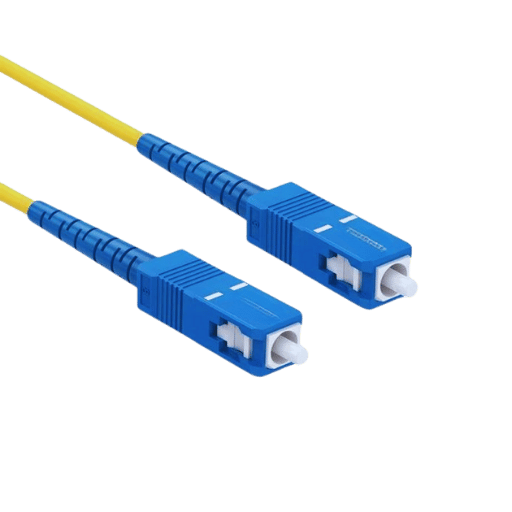
Key Parameters of Single Mode Fiber
The typical single mode fiber core size is approximately 8–10 microns in diameter. In engineering practice, two operating wavelength windows-1310 nm and 1550 nm-are commonly used, striking a balance between low loss, controllable dispersion, and compatibility with mainstream optical module ecosystems. These single mode fiber wavelengths are carefully selected to optimize transmission performance.
Why Single Mode is Suitable for Long Distance
Multimode fiber supports multiple propagation paths, which easily causes intermodal dispersion leading to pulse "spreading." Single-mode optical fiber, by maintaining only a single mode of propagation, minimizes intermodal dispersion effects. Combined with lower attenuation levels, this allows links to maintain clear signal boundaries and greater upgrade potential over much longer distances. The single mode fiber range far exceeds that of multimode solutions.
Types of Single Mode Fiber: OS1 vs OS2
Single mode fiber types are commonly categorized as OS1 and OS2. OS1 is more oriented toward indoor cabling applications, while OS2 single mode fiber is more suited for outdoor and longer-distance applications. This classification primarily serves to facilitate selection discussions around "deployment environment and cable structure/specifications" rather than making fixed distance commitments.

Cable Structure Differences
OS1 is commonly associated with tight-buffered structures, making it more convenient for indoor routing, management, and termination. OS2 is typically associated with loose-tube structures, emphasizing adaptability to moisture, temperature variations, and external force environments, making it more suitable for complex scenarios such as outdoor conduits, aerial installations, or inter-building connections. The single mode fiber cable structure directly impacts deployment feasibility.
Performance
OS2 typically has lower maximum attenuation specifications, making it more commonly used for long-distance links. However, what truly determines "how far you can go" in engineering is the link budget, which includes fiber attenuation, connector and splice losses, the number of patch panels and distribution frames, end-face cleanliness, as well as optical module transmit power and receiver sensitivity. Therefore, selection should focus on budget and margin rather than memorizing specific single mode distance numbers.
|
Parameter |
OS1 |
OS2 |
|
Standard |
ITU-T G.652 |
ITU-T G.652 |
|
Construction |
Tight buffer |
Loose tube |
|
Primary Use |
Indoor backbone |
Outdoor plant |
|
Attenuation @1310nm |
≤1.0 dB/km |
≤0.4 dB/km |
|
Attenuation @1550nm |
≤1.0 dB/km |
≤0.4 dB/km |
|
Typical Distance |
2-10km |
10-200km |
|
Environmental Rating |
-10°C to +60°C |
-40°C to +70°C |
|
Price Range |
$0.50-1.50/m |
$2-5/m |
When to Prioritize OS1
When the route is primarily indoors (equipment rooms, building risers, telecommunications rooms, data center cabling, etc.) and the distance has sufficient margin within the link budget, OS1 fiber optic cable often better aligns with construction and management practices, with more straightforward termination and maintenance.
When to Prioritize OS2
When the route involves outdoor environments, inter-building connections, campus backbones, metro aggregation, or clearly longer distance requirements, OS2 is more common and more reliable. Its low attenuation specifications and outdoor-friendly structure enhance link margin and preserve headroom for future higher-rate optical module upgrades.
Advantages of Single Mode
The core advantage of single-mode fiber optic cable is its long service life: with fiber conduit and routing unchanged, you can more easily expand capacity by replacing optical modules or introducing wavelength division multiplexing, making it suitable for long-term bandwidth growth and stable cross-regional transmission.
Disadvantages of Single Mode
Due to its finer core, single mode fiber optic is more sensitive to connection alignment and end-face cleanliness-construction quality and testing standards directly affect stability. Additionally, single mode optical modules (especially higher-rate, longer-distance specifications) are often more expensive than many multimode solutions, with cost differences reflected at the system level rather than in the cable itself.
What is the difference between single-mode and multi-mode optical fibers?
Single-mode fiber (SMF) features a narrow core, typically around 8–10 μm, which makes it suitable for long-distance, high-capacity transmission. It usually works with laser light sources and is widely used in metropolitan links, backbone infrastructure, and ISP networks.
Multimode fiber (MMF), in contrast, has a wider core of about 50–62.5 μm, allowing multiple light modes to travel simultaneously. It commonly uses LED or VCSEL light sources and is best suited for short-distance communication, generally under 500 meters, such as in data centers and internal building networks.
Application Scenarios
Single mode optical fiber is commonly used in access networks (such as fiber-to-the-home/campus access), campus interconnection and enterprise backbones, metro aggregation links, and long-haul/backbone transmission. The common thread across these applications is longer distance, higher stability requirements, and expectations for continuous capacity expansion.
In building interconnection and campus backbones, single mode is often the default choice, but stable operation depends on whether the number of terminations is controllable, connector end-faces remain clean, bend radius complies with specifications, and whether link budget and acceptance testing are performed in advance.
Typical Role of Single Mode in High-Capacity Transport
In long-haul and backbone scenarios, single mode is virtually the default transmission medium because it better accommodates high power budgets, long-distance transmission, and more complex transmission system evolution paths, providing greater headroom in both stability and scalability.


