Choosing the right multimode fiber type affects more than cable price. OM1, OM2, OM3, OM4 and OM5 differ in core diameter, effective modal bandwidth, light source compatibility, maximum supported distance and long-term upgrade potential. A wrong choice can limit link reach, force premature recabling or leave performance on the table.
For most new enterprise and data center installations, the decision comes down to OM3, OM4 or OM5. OM1 and OM2 still appear in older networks, but both are classified as obsolete in ISO/IEC 11801 and TIA-568, and the TIA Fiber Optics Technology Consortium (FOTC) recommends new installations use OM3, OM4 or OM5.
This guide compares all five multimode fiber types side by side and explains which one makes sense for different network speeds, link distances and upgrade plans.

What Is Multimode Fiber?
Multimode fiber (MMF) is an optical fiber designed to carry multiple light paths - called modes - through a relatively large core. It is the standard choice for short-distance links inside data centers, enterprise buildings, equipment rooms and campus backbones where runs rarely exceed a few hundred meters.
Compared with single-mode fiber, multimode fiber supports shorter maximum distances. However, multimode links often cost less at the system level because the wider glass core relaxes connector alignment tolerances and because VCSEL (vertical-cavity surface-emitting laser) light sources consume less power and cost less than the lasers used in single-mode optics. TIA FOTC notes that for many short-reach Ethernet speeds, a multimode channel - fiber plus optics - can be more cost-effective than the equivalent single-mode channel.
The five standardized multimode fiber types are OM1, OM2, OM3, OM4 and OM5. The "OM" prefix stands for optical multimode.
Quick Comparison: OM1 vs OM2 vs OM3 vs OM4 vs OM5

| Fiber Type | Core Size | Jacket Color | Primary Light Source | Key Bandwidth | Best Fit |
|---|---|---|---|---|---|
| OM1 | 62.5/125 µm | Orange | LED | 200 MHz·km OFL at 850 nm | Legacy 100M / 1G networks |
| OM2 | 50/125 µm | Orange | LED | 500 MHz·km OFL at 850 nm | Legacy 1G links |
| OM3 | 50/125 µm | Aqua | VCSEL (850 nm) | 2000 MHz·km EMB at 850 nm | 10G and short-reach 40G / 100G |
| OM4 | 50/125 µm | Aqua (some vendors use violet) | VCSEL (850 nm) | 4700 MHz·km EMB at 850 nm | Modern 10G / 25G / 40G / 100G data centers |
| OM5 | 50/125 µm | Lime green | VCSEL / SWDM (850–953 nm) | 4700 MHz·km at 850 nm; 2470 MHz·km at 953 nm | SWDM and multi-wavelength applications |
Cisco's OM4 vs OM5 technical paper identifies OM3, OM4 and OM5 as 50 µm multimode fiber classes and specifies that OM5 carries effective modal bandwidth requirements at both 850 nm and 953 nm.
OM1 Fiber: Legacy 62.5 µm Multimode
OM1 uses a 62.5 µm core - larger than every other OM type - and is identified by an orange jacket. It was the dominant LAN fiber during the 1990s and early 2000s, when 100 Mbps and 1 Gbps Ethernet were the fastest speeds most buildings needed.
Today, OM1 is not recommended for new cabling. Its lower modal bandwidth and 62.5 µm core severely limit reach at 10G and above. If OM1 is already installed, it may still carry legacy 100M or 1G traffic, but any speed upgrade should begin with a link audit: measure the actual cable length, check the insertion loss budget and confirm the transceiver specification before assuming the existing plant can be reused.
OM2 Fiber: Older 50/125 µm Multimode
OM2 moved to a 50 µm core, which improved bandwidth over OM1, but it is still considered a legacy fiber class. Like OM1, it typically has an orange jacket and was designed primarily for LED-based transmitters.
Many existing 1G links run on OM2 without issues. However, OM2 lacks the laser-optimized core profile that OM3, OM4 and OM5 provide, so its upgrade headroom at 10G and above is limited. For new cabling, OM2 is generally not the right choice unless a very specific compatibility requirement with existing LED-based equipment makes it necessary.
OM3 Fiber: Laser-Optimized Multimode for 10G
OM3 represents a significant step forward: it is the first multimode fiber type designed and optimized for 850 nm VCSEL laser sources. It uses a 50 µm core and is commonly identified by an aqua jacket.
For enterprise 10G links, OM3 remains a practical and cost-effective option. TIA FOTC lists the operating range of 10GBASE-SR over OM3 as 2 m to 300 m, while OM4 and OM5 extend that planning range to 400 m. OM3 can also support short-reach 40G and 100G multimode applications such as 40GBASE-SR4 and 100GBASE-SR4, but the supported distance drops compared with 10G - typically to around 100 m.
In practice, OM3 works well for 10G runs under 300 m in office LANs, campus buildings and smaller equipment rooms where the planned link distances comfortably fit within its limits. If your longest run is 150 m and you are deploying 10G with LC duplex connectors, OM3 can save meaningful cost over OM4 without sacrificing reliability.
OM4 Fiber: The Mainstream Choice for Modern Data Centers
OM4 is an enhanced laser-optimized 50/125 µm multimode fiber with an effective modal bandwidth of 4700 MHz·km at 850 nm - more than twice that of OM3. The jacket is usually aqua, although some manufacturers use violet to distinguish OM4 from OM3 visually.
For many new enterprise and data center projects, OM4 is the practical default. It provides more reach than OM3 for every major 850 nm Ethernet application, and it avoids the additional cost of OM5 unless the network specifically requires SWDM or multi-wavelength optics. For example, Cisco's 10GBASE-SR SFP+ module data sheet lists a maximum reach of 300 m over 2000 MHz·km OM3 and 400 m over 4700 MHz·km OM4.
Consider a data center deploying 100GBASE-SR4 over MPO/MTP trunk cables. With OM4, the planning range extends to 150 m - enough for most structured cabling topologies within a building. OM3 would cap the same application at 100 m, which may be tight once patch panels, cross-connects and end-of-row transitions are factored in.
OM5 Fiber: Wideband Multimode for SWDM Applications

OM5 - also called wideband multimode fiber (WBMMF) - shares the same 50 µm core as OM3 and OM4, but adds bandwidth characterization at a second wavelength: 953 nm. Fluke Networks explains that OM5 is essentially an OM4-class fiber with additional effective modal bandwidth specification across the 846 nm to 953 nm range, enabling VCSEL-based shortwave wavelength division multiplexing (SWDM) transceivers.
This is where OM5 is frequently misunderstood. OM5 is not automatically better than OM4 for every multimode link. Cisco states explicitly that OM5 delivers a meaningful performance improvement mainly for multi-wavelength transceivers that operate across the 850 nm to 940 nm waveband. For the many multimode transceivers that operate only at 850 nm - including 10GBASE-SR, 25GBASE-SR, 40GBASE-SR4 and 100GBASE-SR4 - OM4 provides the same practical reach at a lower cost.
OM5 makes financial sense when your optical module roadmap specifically includes SWDM4 or other multi-wavelength technologies. The 400GBASE-SR4.2 standard, for instance, uses two wavelengths and benefits from OM5's wideband characterization: OM5 supports up to 150 m for that application, while OM4 reaches 100 m. If your network does not plan to use multi-wavelength optics, OM5 may not justify the premium over OM4 fiber cables.
Multimode Fiber Distance by Ethernet Speed
The table below summarizes IEEE 802.3 multimode application ranges based on data published by TIA FOTC. Actual reach in any installation depends on the transceiver standard, connector count, splice loss, cable quality and total channel loss budget. Always verify the optical module data sheet and calculate the loss budget before final design.
| Ethernet Application | Fiber Count | OM3 Range | OM4 Range | OM5 Range |
|---|---|---|---|---|
| 10GBASE-SR | 2 fibers (duplex LC) | 2–300 m | 2–400 m | 2–400 m |
| 25GBASE-SR | 2 fibers (duplex LC) | 0.5–70 m | 0.5–100 m | 0.5–100 m |
| 40GBASE-SR4 | 8 fibers (MPO-12) | 0.5–100 m | 0.5–150 m | 0.5–150 m |
| 100GBASE-SR4 | 8 fibers (MPO-12) | 0.5–100 m | 0.5–150 m | 0.5–150 m |
| 200GBASE-SR4 | 8 fibers (MPO-12) | 0.5–70 m | 0.5–100 m | 0.5–100 m |
| 400GBASE-SR4.2 | 8 fibers (MPO-12) | 0.5–70 m | 0.5–100 m | 0.5–150 m |
The pattern is straightforward: OM4 generally provides more reach than OM3 for all 850 nm applications, while OM5 adds further distance only when the transceiver uses multiple wavelengths (as in 400GBASE-SR4.2). For a deeper look at distance planning across all five OM grades, see our multimode fiber distance limits guide.
Connector and Transceiver Compatibility

Multimode fiber selection does not end with the cable. The connector type, optical module standard and fiber count all interact with the fiber grade to determine whether a link will work reliably.
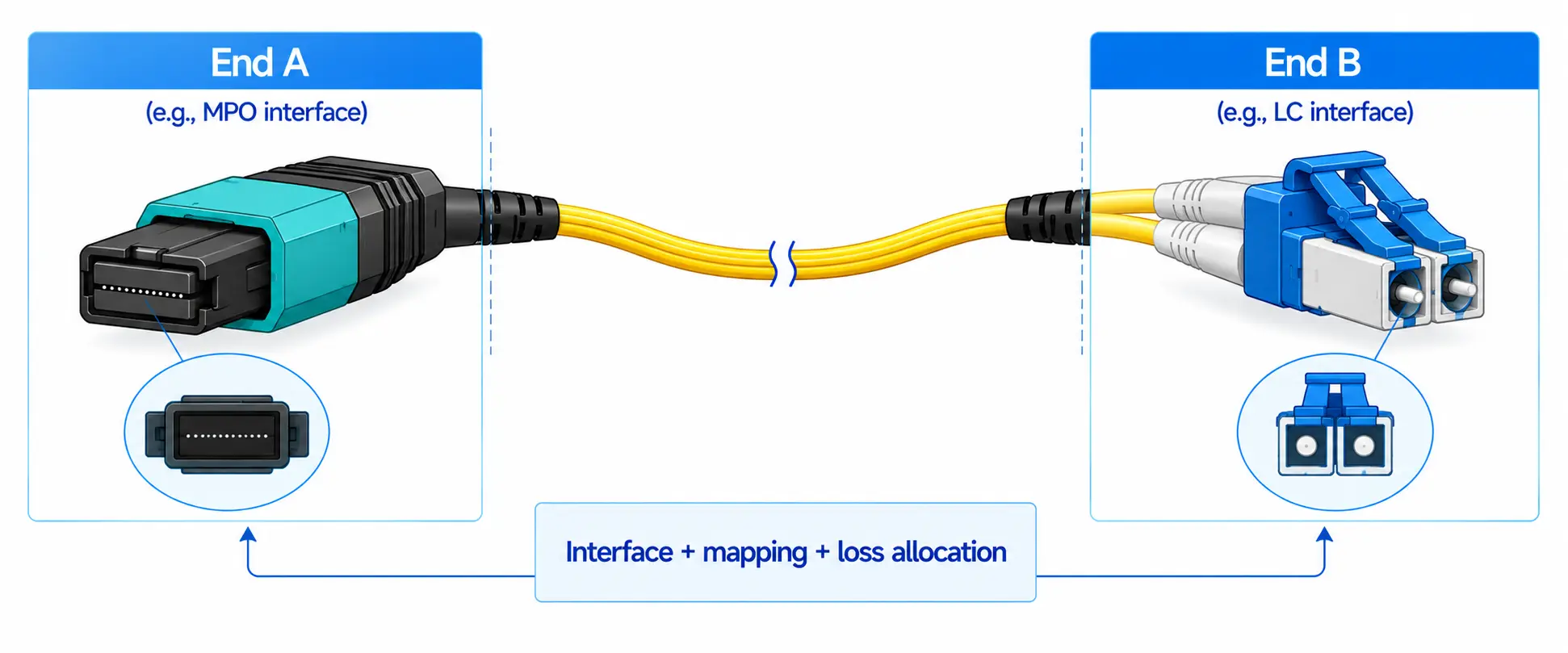
Duplex applications such as 10GBASE-SR and 25GBASE-SR use two fibers and typically terminate with LC duplex connectors. Parallel applications such as 40GBASE-SR4 and 100GBASE-SR4 use eight fibers and rely on MPO/MTP connectors. Some higher-speed applications like 400GBASE-SR4.2 may also use MPO-12 connectors with eight active fibers.
When specifying fiber, always confirm: the Ethernet standard the link will carry, the transceiver type (SFP+, SFP28, QSFP+, QSFP28, QSFP-DD), the required connector interface, the fiber count, and the total channel loss budget including every mated connector pair and splice in the path. A 100G SR4 link, a 100G SR1 link and a 100G SWDM4 link may look similar on paper but require different fiber counts, different connectors and different minimum fiber grades.
How to Choose the Right Multimode Fiber Type
Selecting the right fiber grade involves matching five variables: the target data rate, the maximum link distance, the transceiver standard, the fiber count and the anticipated upgrade path. Here is a practical decision framework.

Keep OM1 or OM2 Only for Legacy Maintenance
If your building already has OM1 or OM2 installed, you may continue using it for existing 100M or 1G links. But for any new cabling - even short patch runs - these fiber types offer almost no high-speed upgrade potential. Before reusing legacy fiber at higher speeds, identify whether the existing plant is OM1 (62.5 µm) or OM2 (50 µm), then verify the link length and test the channel loss against the transceiver's published budget.
Choose OM3 for Budget-Friendly 10G Links Under 300 m
OM3 is a sound choice when your longest 10G run stays well under 300 m and your near-term roadmap does not call for 25G, 40G or 100G over the same cabling. It is commonly used in enterprise LANs, campus distribution and small equipment rooms where link lengths are moderate and 10G is the target speed.
Choose OM4 for Most New Multimode Deployments
For new enterprise and data center projects where multimode fiber is appropriate, OM4 is the practical default for most teams. It extends 10GBASE-SR reach to 400 m, supports 100GBASE-SR4 up to 150 m, and provides headroom for 25G and 200G short-reach applications - all without the cost premium of OM5. If you are building structured cabling trunks for a data center or planning a campus backbone that will carry 10G today and 100G in a few years, OM4 balances cost and future-proofing well.
Choose OM5 When SWDM or Multi-Wavelength Optics Are on Your Roadmap
OM5 is worth the premium when your optical module plan specifically includes SWDM4, 400GBASE-SR4.2 or other multi-wavelength technologies that operate across the 850–953 nm range. If your network uses - and will continue to use - standard 850 nm SR optics, OM5 cable may not deliver a measurable advantage over OM4 for the same link.
Choose Single-Mode Fiber When Distance or Long-Term Scalability Matters More
If the link distance exceeds multimode limits - roughly 400 m at 10G and much shorter at 100G - or if you are building a long-term campus backbone, metro ring or high-speed interconnect, single-mode fiber (OS1 or OS2) is typically the better infrastructure investment. Single-mode optics cost more per port, but the fiber itself supports virtually unlimited bandwidth over distances that multimode cannot reach. For help comparing optics, see our guide on single-mode SFP vs multimode SFP.
Application Scenario: Upgrading a 1G Enterprise LAN to 10G

Suppose your office building currently runs 1000BASE-SX over OM2 cabling and you need to upgrade to 10GBASE-SR. Your longest horizontal run is 180 m.
First, check the existing fiber: OM2 is not laser-optimized for 10G VCSELs, and 10GBASE-SR over OM2 is limited to only 82 m according to IEEE 802.3. Since your longest run is 180 m, the existing OM2 plant cannot support the upgrade. You will need to pull new fiber.
OM3 supports 10GBASE-SR to 300 m, which covers the 180 m run with comfortable margin. OM4 extends the range to 400 m and would provide even more headroom if you anticipate future 25G or 40G needs on the same cabling. In this scenario, OM3 saves money if 10G is the endpoint; OM4 is the safer choice if the network might scale further. Check your fiber optic cable installation plan to confirm routing paths, connector counts and splice points before ordering.
Common Mistakes When Selecting Multimode Fiber
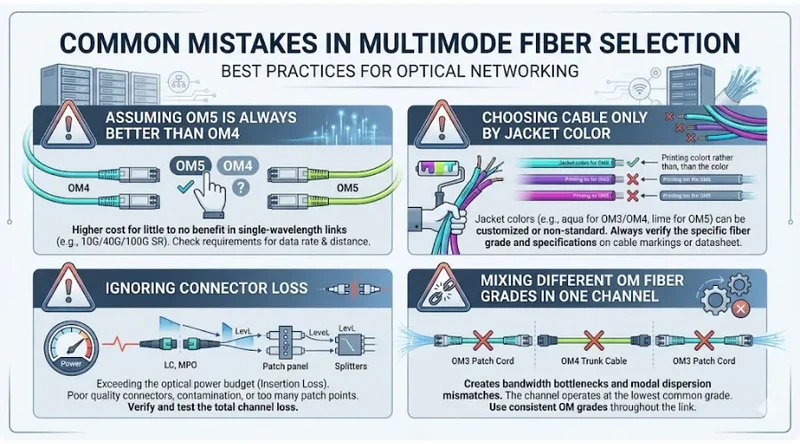
Assuming OM5 Is Always Better Than OM4
OM5 is newer, but its advantage is specific to multi-wavelength optics. For single-wavelength 850 nm applications - which still represent the majority of deployed multimode transceivers - OM4 provides the same reach at lower cost.
Choosing Fiber Only by Jacket Color
Aqua jackets appear on both OM3 and OM4 cables from many manufacturers. Lime green identifies OM5. Orange covers both OM1 and OM2. Color is a useful visual cue, but it is not a substitute for checking the printed cable marking, the manufacturer's test report and the actual OM grade specification.
Ignoring Fiber Count and Connector Type
A 100GBASE-SR4 link uses eight fibers and an MPO-12 connector. A 100GBASE-SR1 link uses two fibers and an LC duplex connector. A 100G SWDM4 link also uses two fibers but requires OM5. Selecting the fiber grade without confirming fiber count and connector configuration can lead to expensive rework.
Forgetting About Connector Loss
Every mated connector pair, cassette adapter and splice in the channel adds insertion loss. A link with multiple patch panels may fail its loss budget even if the fiber grade is nominally correct. Always calculate the total channel loss - including every connection point - and compare it against the transceiver's specified power budget. For more on this topic, see insertion loss in fiber networks.
Mixing Different OM Grades in One Channel
Connecting OM3 and OM4 segments in a single link is physically possible - both have 50 µm cores - but the entire channel must be rated at the lowest-grade fiber in the path. A mixed OM3/OM4 channel effectively becomes an OM3 channel for distance planning. Mixing 62.5 µm fiber (OM1) with 50 µm fiber (OM2/OM3/OM4/OM5) causes a core mismatch that introduces significant additional loss and is not recommended.
Frequently Asked Questions
What is the difference between OM3 and OM4 fiber?
OM4 has a higher effective modal bandwidth (4700 MHz·km vs 2000 MHz·km at 850 nm) and supports longer reach for most multimode Ethernet applications. For example, 10GBASE-SR reaches up to 300 m on OM3 and up to 400 m on OM4. Both use a 50 µm core and work with the same VCSEL-based transceivers and fiber patch cables.
Is OM5 better than OM4?
Not necessarily. OM5 is designed for wideband, multi-wavelength applications such as SWDM4. For standard 850 nm transceivers - including 10GBASE-SR, 40GBASE-SR4 and 100GBASE-SR4 - OM4 delivers the same practical distance at a lower cost. OM5 only adds measurable value when the optical modules operate across multiple wavelengths in the 850–953 nm range.
What color is OM5 fiber?
OM5 fiber has a lime green jacket. TIA specified lime green as the official jacket color for OM5 to distinguish it visually from aqua OM3/OM4 cables.
Can I use OM4 transceivers with OM3 fiber?
The transceiver itself does not change - a 10GBASE-SR SFP+ module works with both OM3 and OM4 fiber. However, the maximum supported distance depends on the fiber grade. Using OM3 instead of OM4 means the link must be planned at OM3 distances, which are shorter. Always check the module data sheet and calculate the full channel loss budget.
Can OM3 and OM4 fiber be mixed in the same link?
It is physically possible because both use a 50 µm core, but the entire channel should be planned at the OM3 distance limit. In high-speed links (40G and above), mixing grades is generally discouraged because it reduces the already-tight distance margin and complicates troubleshooting.
Is OM4 enough for 400G?
It depends on the 400G optical standard. 400GBASE-SR4.2 supports OM4 up to 100 m and OM5 up to 150 m. Other 400G multimode variants may have different fiber requirements. Always confirm the specific transceiver standard and its published distance on your fiber grade before committing to a design.
What is laser-optimized multimode fiber?
Laser-optimized multimode fiber refers to OM3, OM4 and OM5 - fiber classes whose core refractive index profiles are specifically engineered to minimize differential mode delay (DMD) when excited by 850 nm VCSEL lasers. This optimization dramatically increases usable bandwidth compared with legacy OM1 and OM2 fiber, which were designed for LED sources.
Should I install multimode or single-mode fiber?
Use multimode fiber for short-reach, cost-sensitive enterprise and data center links where distances stay within the limits shown in the distance table above. Use single-mode fiber for longer distances, campus backbones, metro links or any infrastructure where long-term bandwidth scalability is the primary concern. For a detailed comparison, see our article on glass vs plastic optical fiber and our guide to loose tube vs tight buffered cable.
Conclusion
For new multimode fiber installations, OM3, OM4 and OM5 are the only grades worth considering. OM1 and OM2 remain relevant only for maintaining existing legacy networks.
Choose OM3 when you need a cost-effective, laser-optimized fiber for 10G links that stay well within 300 m. Choose OM4 - the most widely deployed grade in new builds today - when you want stronger distance headroom and broad compatibility with 10G, 25G, 40G and 100G short-reach optics. Choose OM5 only when your transceiver roadmap specifically includes SWDM or other multi-wavelength applications that benefit from wideband characterization at 953 nm.
Before purchasing, confirm your required data rate, maximum link distance, connector type, fiber count, optical module standard and future upgrade path. A well-planned fiber plant should serve reliably for a decade or more - taking the time to match the fiber grade to the application pays off over the full life of the cabling.