Choosing the right fiber optic cable hardware is often where projects go wrong: cables are good, but lines sag, closures leak, and networks keep breaking after a few years.
In this article you'll quickly see:
- What counts as fiber optic cable hardware (the main types of clamps, brackets, closures, boxes, etc.)
- How hardware directly affects outages, maintenance cost and service life
- Where each type is used in ADSS lines, FTTH, backbone and industrial projects
- Real project-style configurations & FAQs you can copy or use as a reference for your own designs
So you can avoid rework and after-sales trouble, and choose hardware that actually matches your cable and environment.
What Is Fiber Optic Cable Hardware?

Basic Definition of Fiber Optic Cable Hardware
Fiber optic cable hardware is the group of mechanical components that hold, support and protect fiber optic cables along their route. It does not carry the optical signal itself, but it decides whether the cable can operate safely and reliably for many years. In a typical project you will see suspension clamps carrying the cable in mid-span, tension or dead-end clamps anchoring the cable at poles or building corners, brackets and hooks fixing the hardware to poles or walls, and closures or distribution boxes protecting spliced fibers. In simple terms, everything made of metal or plastic that keeps the cable in the correct position and under safe mechanical stress can be considered fiber optic cable hardware.
Cable + Hardware + Accessories: The Complete Optical Link
Three Elements of a Fiber Link
In real installations, a fiber link is never just a cable. It is always a combination of cable, hardware and accessories working together. The cable transmits data, the hardware provides mechanical support and environmental protection, and the accessories keep individual fibers organized, spliced and clearly managed.
Practical Examples Along the Route
On an ADSS backbone line, suspension hardware between poles carries the cable along the span, while tension hardware at terminations or angle points secures it and controls the mechanical load. Splice closures protect the fusion joints between cable sections and keep water and dust away from the fibers.
On an FTTH drop to a home, small anchor clamps, wall hooks and compact distribution boxes guide and protect the drop cable when it enters the building, turns around corners and reaches the user terminal. Only when cable, hardware and accessories are correctly matched does the optical link achieve both good mechanical performance and stable optical performance over its full lifetime.
Key Technical Parameters to Consider
Mechanical Performance
The first question is not "can I install this hardware", but "will it stay safe here for many years". Mechanical performance is the starting point. The rated load of clamps and brackets must match the cable weight, span length and additional wind or ice load. The choice between suspension and tension hardware must fit the span, angle and position in the route so that the cable always works inside its safe mechanical window.
Protection and Sealing
For closures and boxes, protection level and sealing performance are critical. Outdoor products face rain, dust, insects and sometimes underground moisture. If the sealing is poor, water can slowly enter, increase attenuation and finally cause fiber failure. A properly designed closure keeps the splice area dry and stable over many years, even under repeated temperature cycles.
Material Selection
Material choice directly affects corrosion resistance and long-term strength. Aluminum alloy and hot-dip galvanized steel are widely used for strong load-bearing parts. Stainless steel is preferred in coastal or highly corrosive environments. UV-resistant engineering plastics are common for FTTH and light-duty hardware where weight and appearance matter. Selecting the right material avoids early rust, deformation, cracking or aging.
Environmental Conditions
Finally, the real environment of the project must be considered: wind speed, icing conditions, salt fog, strong sunlight, temperature range and pollution level. These factors all influence how long the hardware can keep its original performance. When mechanical rating, protection level, materials and environmental conditions are evaluated together and correctly matched, the fiber cable remains well protected, and network failures and maintenance costs are significantly reduced.
Main Types of Fiber Optic Cable Hardware

ADSS Fiber Optic Cable Hardware
ADSS (All-Dielectric Self-Supporting) fiber optic cable hardware is designed to carry the full weight and mechanical load of the cable without a messenger wire, typically on power or telecom poles. Because ADSS is installed close to live power lines and exposed to wind, ice and vibration, the matching hardware must provide strong, stable support while keeping the cable within its allowed tension and bending limits.
In a standard ADSS line, suspension clamps or suspension sets are used at intermediate poles to cradle the cable and allow a small amount of controlled movement under wind. Tension or dead-end clamps are installed at line ends, angle points and major elevation changes to firmly anchor the cable and transfer the tensile load to the structure. These clamps are fixed to the pole through pole brackets and hooks, which are usually banded or bolted to concrete, steel or wooden poles. For long spans or heavy environmental loads, armor rods and reinforcing fittings are added around the cable at hardware locations to distribute stress, protect the sheath from abrasion, and extend service life.
Figure-8 & Messenger Fiber Optic Cable Hardware
Figure-8 and messenger fiber cables include a built-in steel or FRP messenger that carries most of the mechanical load. The hardware for these cables is therefore optimized to grip and support the messenger part while keeping the fiber section safely aligned. This type of hardware is widely used in aerial access networks for telecom operators, CATV and some utility communication lines.
On straight sections, suspension clamps are used to hang the cable from the messenger and allow limited swing without damaging the sheath. At terminations or angles, tension clamps grip the messenger to transfer the tensile load back to the pole or building structure. These clamps are installed using stainless steel bandings and pole brackets, which make it easy to fix hardware on different kinds of supports (concrete poles, steel poles, walls, cross-arms) with consistent mechanical performance.
FTTH / Drop Fiber Optic Cable Hardware
FTTH and drop cable hardware focuses on small-diameter, light-weight cables running from distribution points into buildings and homes. Here, appearance, ease of installation and protection of delicate drop cables are just as important as basic mechanical strength.
The main working parts are anchor clamps or wedge clamps, which grip the drop cable and create an anchor point at building facades, poles or tension points. For lighter service drops and indoor/outdoor transitions, drop wire clamps are commonly used to gently hold the cable without crushing it. Along the route into the building, installers rely on various wall hooks, drive hooks and small brackets to keep the cable neat, close to the surface and safely away from sharp edges or moving parts like doors and windows. With a properly selected combination of these components, FTTH lines remain tidy, safe and easy to maintain.
Splicing & Sealing Hardware
Splicing and sealing hardware protects fiber joints and branch points, which are the most sensitive locations in any optical network. Once fibers are fusion-spliced, those joints must be kept clean, dry and mechanically stable for the full life of the network.
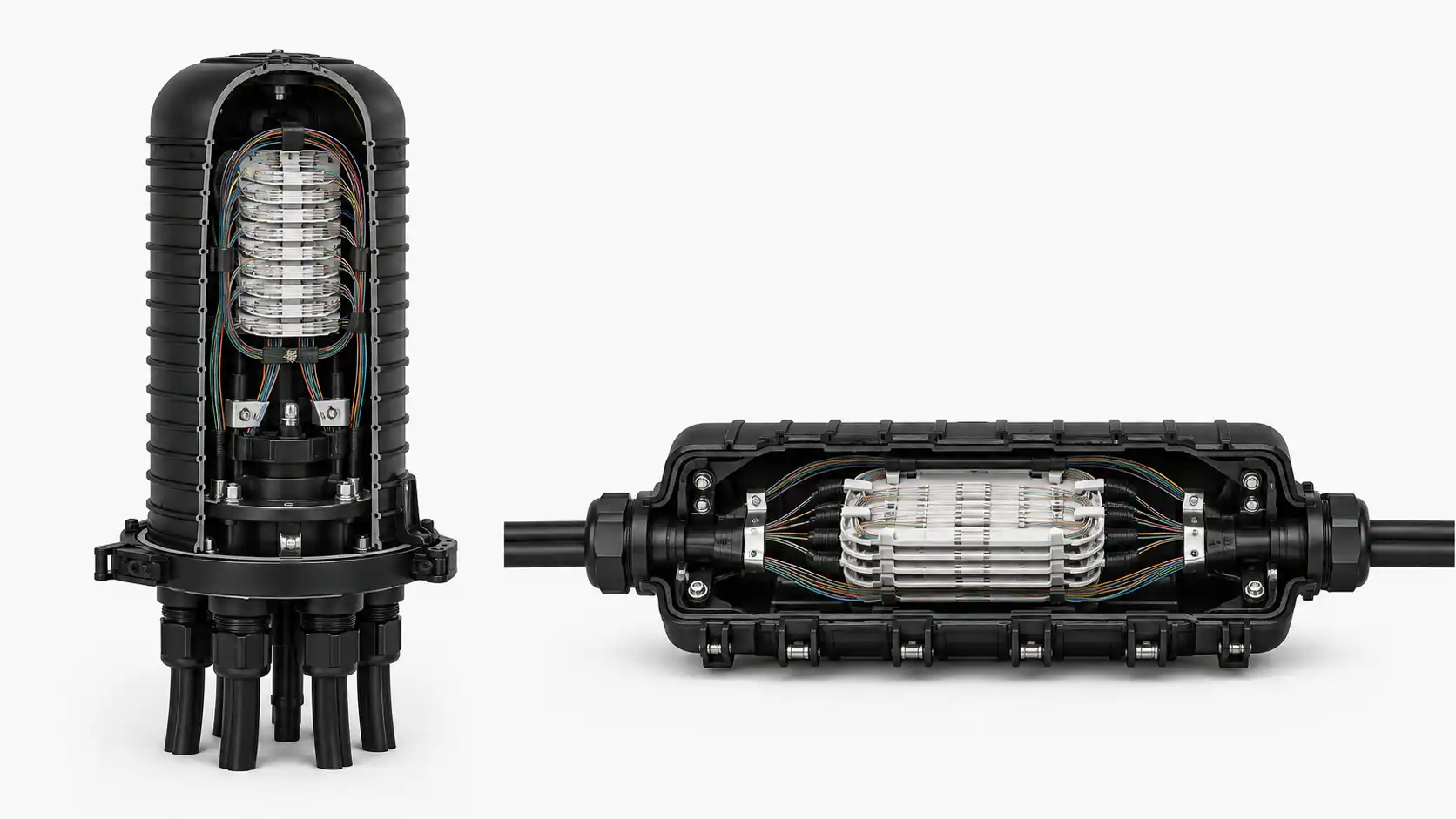
The core products in this group are fiber optic splice closures, available in dome and horizontal styles. They house splice trays, organize fibers and provide reliable sealing against water, dust and insects in aerial, wall-mount or underground applications. In distribution and branching scenarios, joint boxes and inline closures are used to split or divert fibers from backbone cables to distribution or drop cables, while still keeping joints protected. To maintain sealing performance, a range of sealing accessories-such as cable entry grommets, tapes, gels and heat-shrink tubes-is used to adapt closures to different cable diameters and ensure long-term IP protection.
Distribution & Management Hardware
Distribution and management hardware is responsible for organizing fibers, connectors and pigtails at central offices, data centers, campus buildings and floor distribution points. Good management hardware makes it easy to identify fibers, perform patching, and carry out moves, adds and changes without disturbing existing services.
Typical products include fiber distribution boxes (FDB) installed on walls or poles for outdoor/indoor access distribution. In larger facilities, optical distribution frames (ODF) and patch panels provide high-density termination, splicing and patching for backbone and horizontal cabling. These are often mounted inside wall-mount or rack-mount cabinets, which protect the equipment, provide cable routing paths and improve overall appearance. Together, these components form the structured "interface layer" between external cable routes and active network equipment such as OLTs, switches and routers.
Protection & Support Accessories
Protection and support accessories are the smaller components that complete the hardware system and directly affect installation quality and long-term reliability. Although each piece is simple, missing or choosing the wrong accessory can easily lead to fiber damage or poor sealing.
Inside closures and boxes, splice trays and splice sleeves hold and protect individual fusion joints, keeping bend radius under control and preventing micro-bending. Along exposed sections, protection tubes are used to shield loose fibers or pigtails from mechanical contact and sharp edges. For fixing hardware to poles and structures, stainless steel bands, buckles, bolts and related mounting accessories provide secure, corrosion-resistant attachment points. When properly combined with the main hardware, these accessories ensure that every fiber, joint and cable section is mechanically supported and protected from the moment of installation through the entire lifetime of the network.
Key Functions of Fiber Optic Cable Hardware

Mechanical Support and Tension Management
The first and most basic function of fiber optic cable hardware is to carry the mechanical load of the cable safely. Suspension clamps, tension clamps/dead-end clamps, brackets and bands work together to control cable sag, tension and bending so the fibers inside are never overstressed. When the hardware is correctly selected and positioned, the cable stays within its designed tension window, even under wind, ice or temperature changes. This prevents fiber micro-bending, sheath damage and, eventually, unexpected fiber breaks that cause service outages.
Protection Against Water, Dust, UV, and Corrosion
Fiber optic networks often run through very harsh environments: direct sunlight, heavy rain, dust, pollution, salt fog or underground moisture. Hardware such as splice closures, joint boxes, distribution boxes and pole fittings provides the physical barrier between these conditions and the delicate glass fibers and splices. Proper sealing keeps water and dust out of the splice area, while UV-resistant plastics and anti-corrosion metals (like aluminum alloy, galvanized steel or stainless steel) ensure that the hardware itself does not crack, rust or deform. This environmental protection is essential to keep attenuation low and avoid hidden faults that only show up years after installation.
Organizing, Routing and Managing Fiber Cores
Another key role of fiber optic cable hardware is fiber management. Inside closures, distribution boxes, ODFs and patch panels, hardware such as splice trays, holders, guides and protection tubes organizes individual fibers and pigtails. It maintains correct bend radius, separates different routes and keeps labeling clear so technicians can quickly identify and operate the right fibers. Along the route, hooks, brackets and protection tubes guide cables through corners, building entries and cabinets without sharp bends or mechanical interference. Good hardware design here directly reduces the risk of accidental damage during installation or later maintenance.
Ensuring Long-Term Stability in Harsh Environments
Fiber projects are usually designed for 10–25 years or more of service. Over such a long period, repeated wind, vibration, temperature cycling and pollution can slowly damage poorly chosen hardware. High-quality fiber optic cable hardware is engineered to absorb and distribute these stresses over time: suspension sets allow controlled movement without chafing the sheath, armor rods spread the load at key points, and rigid brackets keep anchor points stable. When the hardware system is well matched to the environment, the entire line remains mechanically stable year after year, minimizing unexpected failures and emergency repairs.
Enabling Fast Deployment and Easy Maintenance
Finally, modern fiber optic cable hardware is designed to speed up installation and future maintenance. Pre-engineered clamps, standardized brackets, quick-open closures and well-designed distribution boxes help installers work faster with fewer special tools, which is critical on large roll-outs or tight project schedules. For maintenance teams, clear routing, accessible splice trays and logical layout inside boxes and ODFs make it easier to locate faults, add new services or reconfigure connections without disturbing existing customers. In practice, the right hardware not only protects the network, but also reduces labor time, truck rolls and overall operating cost throughout the entire life of the project.
Typical Applications of Fiber Optic Cable Hardware

Overhead ADSS Fiber Networks on Power Utility Poles
On ADSS lines, hardware is used to carry the cable and control tension on power or telecom poles. Suspension clamps support mid-spans, tension clamps anchor ends and angles, while brackets, hooks and bands safely transfer load to the pole and protect the cable sheath in wind and ice.
FTTx / FTTH Access Networks in Urban and Rural Areas
In FTTx/FTTH, hardware ensures clean, safe routing of thousands of drop cables to homes and shops. Anchor/wedge clamps, wall hooks and small boxes fix and guide the cable along poles and façades, keeping the line tidy and reducing damage from wind or daily activities.
Data Center and Campus Backbone Cabling
For data centers and campuses, hardware focuses on fiber organization and patching rather than heavy load. ODFs, patch panels and cabinets terminate and manage fibers, while splice trays and guides keep bend radius under control and make MAC (moves, adds, changes) faster.
Industrial, Mining, Oil & Gas, and Transportation Projects
In industrial and transport environments, fiber hardware must withstand vibration, dust, moisture and corrosion. Robust clamps, brackets and high-IP closures protect cables and splices on pipelines, tracks, tunnels and production lines, helping avoid costly downtime.
Smart City, CCTV and 5G Backhaul Fiber Networks
Smart city, CCTV and 5G backhaul projects use hardware to mount and branch fibers on poles and building façades. Compact suspension/tension clamps, pole-mounted closures and distribution boxes feed cameras and small cells while keeping the installation neat and easy to upgrade.
Case Studies: Fiber Optic Cable Hardware in Real Projects

ADSS Fiber Optic Cable Hardware Solution for Power Line Project
Project snapshot (2024, Eastern Europe)
110 kV power line communication upgrade
~120 km ADSS route, 420 poles
~3,600 sets of ADSS suspension and tension hardware
In 2024, a power utility in Eastern Europe upgraded its grid communication using a 120 km ADSS line along a 110 kV corridor. The challenge was to control tension and sheath stress on long spans with strong wind and seasonal icing. DimiFiber supplied matched ADSS suspension sets for straight poles, dead-end/tension sets with preformed armor rods for ends and angles, plus pole brackets, hooks and stainless-steel bands for 420 concrete and steel poles. After one winter season, the line maintained stable sag and tension with no ADSS-related outages or rework reported.
FTTH Drop Cable Hardware for a Residential Deployment
Project snapshot (2024–2025, Southeast Asia)
Urban & suburban FTTH roll-out
~8,000 homes passed, 2,500 MDU units
~12,000 drop clamps and 4,000+ small FDBs
From late 2024 to early 2025, an ISP in Southeast Asia rolled out FTTH across a mixed low-rise and apartment area. Existing façades were crowded, and property owners demanded a much cleaner look. The operator adopted a unified hardware package from DimiFiber: compact anchor/wedge clamps for each drop, wall and drive hooks for routing along façades and corridors, plus small fiber distribution boxes per staircase or floor. With roughly 12,000 drop clamps and over 4,000 FDBs installed, the project delivered neat building exteriors, stable drop protection and faster activations, while significantly reducing trouble tickets related to cable damage.
Custom Fiber Optic Cable Hardware for an OEM/ODM Partner
Project snapshot (2025, Middle East & Africa markets)
Branded aerial fiber solution for a system integrator
5 customized hardware families (suspension, tension, brackets, bands, closures)
First batch ~20,000 hardware sets for carrier projects in 6 countries
In 2025, a system integrator serving carriers in the Middle East and Africa wanted a fully branded aerial fiber kit matched to its own ADSS and figure-8 cables. Standard catalog hardware didn't perfectly fit its cable diameters or corrosion requirements, and there was no consistent branding. DimiFiber co-developed customized suspension and tension clamps, matching pole brackets, stainless-steel banding and splice closures, all tuned to the integrator's cable specs, climate conditions and packaging design. The first shipment of about 20,000 sets supported multi-country deployments and helped the partner win projects with a differentiated, one-stop "own-brand" solution.
How to Select the Right Fiber Optic Cable Hardware?

Match Hardware to Cable Type (ADSS, figure-8, drop, etc.)
The starting point is always the cable type. ADSS, figure-8/messenger and flat drop cables all need different clamp and fitting designs. ADSS hardware grips the cable body and manages high tension; figure-8 hardware usually grips the messenger; FTTH/drop hardware is optimized for small, light cables and building façades. If the hardware is not designed for your specific cable structure and outer diameter range, you risk slippage, crushing or premature sheath damage.
Mechanical and Environmental Conditions (span, load, wind, ice, UV, salt fog)
Next, check the mechanical and environmental conditions of the route. Key points include span length, maximum tension, wind and ice load, plus local climate factors such as strong UV or salt fog. Long spans and harsh weather require stronger suspension and tension sets, often with armor rods or reinforcing fittings. In coastal or industrial areas, corrosion-resistant materials (stainless steel, hot-dip galvanized steel, UV-stable plastics) are essential to avoid early failure. Always compare the hardware's rated load and test data with your project's design values.
Installation Scenario (pole, wall, tower, underground, aerial)
The installation scenario will guide the choice of brackets, hooks, bands and boxes. Aerial lines on concrete poles, building façades in dense urban streets, steel towers, tunnels and underground handholes all require different fixing and sealing solutions. For example, stainless steel bands are ideal for round poles and masts, while screw-type brackets or expansion anchors may be better for walls. Underground or manhole applications need closures and glands designed specifically for buried environments and water pressure.
Standards, Testing and Certification Requirements
Many operators and utilities follow specific standards and testing requirements for fiber hardware, especially on power lines and long-haul routes. When evaluating products, look for evidence of mechanical load tests, slip tests, temperature cycling, UV and salt spray tests, and for closures, IP and sealing tests. In some regions or projects, utility or telecom approvals and type test reports are mandatory. Choosing hardware with documented performance reduces risk in technical audits and project acceptance.
Considering Total Project Cost and Long-Term Maintenance
Lowest purchase price is not always lowest project cost. Cheap, underspecified hardware can lead to more truck rolls, line repairs and customer complaints over 10–20 years. It is usually better to choose reliable, standardized hardware that installers already know how to use, even if unit price is slightly higher. A consistent hardware platform across projects also simplifies training, spare parts management and long-term maintenance planning.
When to Choose Custom-Designed Hardware?
Custom-designed or ODM/OEM hardware makes sense when your cable design, environment or branding needs are not well covered by catalog items. Typical triggers include special cable diameters, extreme spans or loads, unusual structures, or the need for a fully branded kit for system integration projects. In these cases, working with a manufacturer like DimiFiber to co-develop clamps, brackets and closures matched to your cable and specification can reduce on-site adjustments, improve installation speed and create a more competitive, unified solution.
Advantages of High-Quality Fiber Optic Cable Hardware

Reduced Fiber Breakage and Network Outages
High-quality hardware keeps the cable operating inside safe tension and bending limits, even under wind, ice and temperature changes. This directly reduces fiber breaks, sheath damage and unplanned outages, especially at anchor points, angles and splicing locations.
Longer Service Life in Harsh Outdoor Environments
Using the right materials and coatings, good hardware maintains its mechanical strength and sealing performance for many years in sun, rain, salt fog and polluted air. That means fewer corroded brackets, cracked plastics and leaky closures, and a longer overall service life for the entire line.
Lower Maintenance Cost and Fewer Site Visits
When cable and hardware are correctly matched and properly installed, routine inspections find fewer issues, and fault rates drop. Operators spend less time sending teams to re-tighten clamps, replace boxes or repair damaged drops. Over the life of a project, this reduction in truck rolls and emergency work adds up to significant OPEX savings.
Better Overall Performance of the Optical Network
Stable mechanical conditions and dry, clean splices help keep optical loss low and predictable. High-quality hardware supports consistent link performance, easier troubleshooting and smoother capacity upgrades. In short, good hardware protects both the physical and optical performance of the network.
FAQ about Fiber Optic Cable Hardware

What Is the Difference Between ADSS Hardware and Standard Pole Line Hardware?
ADSS hardware is designed specifically for all-dielectric self-supporting cables. It grips the cable in a way that controls tension and limits bending without damaging the sheath, often using preformed rods and specially shaped saddles. Standard pole line hardware for metal conductors or generic wires usually does not match ADSS cable diameter, mechanical behavior or electrical clearance requirements, and can easily overstress or abrade the fiber cable.
How Do I Choose the Right Clamp for My Fiber Optic Cable?
Start with the cable type and outer diameter, then look at the function and location: suspension vs. tension, straight span vs. angle, main line vs. drop. For ADSS, choose clamps that are specified for your cable diameter and span/tension level. For figure-8 cables, use hardware that grips the messenger section. For FTTH drops, pick anchor or wedge clamps designed for flat or round drop cables within your size range. When in doubt, use the manufacturer's cable–hardware matching table or consult their engineering team.
Can I Reuse Fiber Optic Cable Hardware After Disassembly?
Some parts, such as pole brackets, hooks and steel bands, can sometimes be reused if they are not deformed or corroded and still meet mechanical requirements. However, many critical components-especially tension/dead-end clamps and preformed rods-are designed for one installation only. Reusing them can reduce grip strength and increase the risk of cable slippage or damage. As a rule, reuse only after careful inspection, and always follow the hardware manufacturer's recommendation.
What Tests Should Fiber Optic Cable Hardware Pass Before Use?
For clamps and fittings, important tests include mechanical load and slip tests, tension and vibration tests, temperature cycling, UV and salt spray to verify long-term behavior. For closures and boxes, sealing and IP tests (e.g. water immersion, dust ingress) plus mechanical impact tests are key indicators. On power utility projects, additional tests may be required to confirm performance near high-voltage lines and under specific utility standards.
How Long Can Outdoor Fiber Optic Cable Hardware Last?
Design lifetime for outdoor fiber hardware is typically 10–25 years, depending on material, coating and environment. In moderate climates with proper selection and installation, hardware often reaches the upper end of that range. In very aggressive environments (coastal, chemical, desert with strong UV), lifetime can be shorter if materials are not chosen carefully. Regular inspections help identify parts that need replacement before they cause network issues.
Do You Support Custom Design or OEM Branding for Hardware Kits?
Yes. Manufacturers like DimiFiber can support custom design and OEM/ODM branding for fiber optic cable hardware, including clamps, brackets, closures and complete hardware kits. This can cover special cable sizes, unique environmental requirements, private labels, customized packaging and documentation, helping system integrators and operators deliver a differentiated, one-stop solution under their own brand.