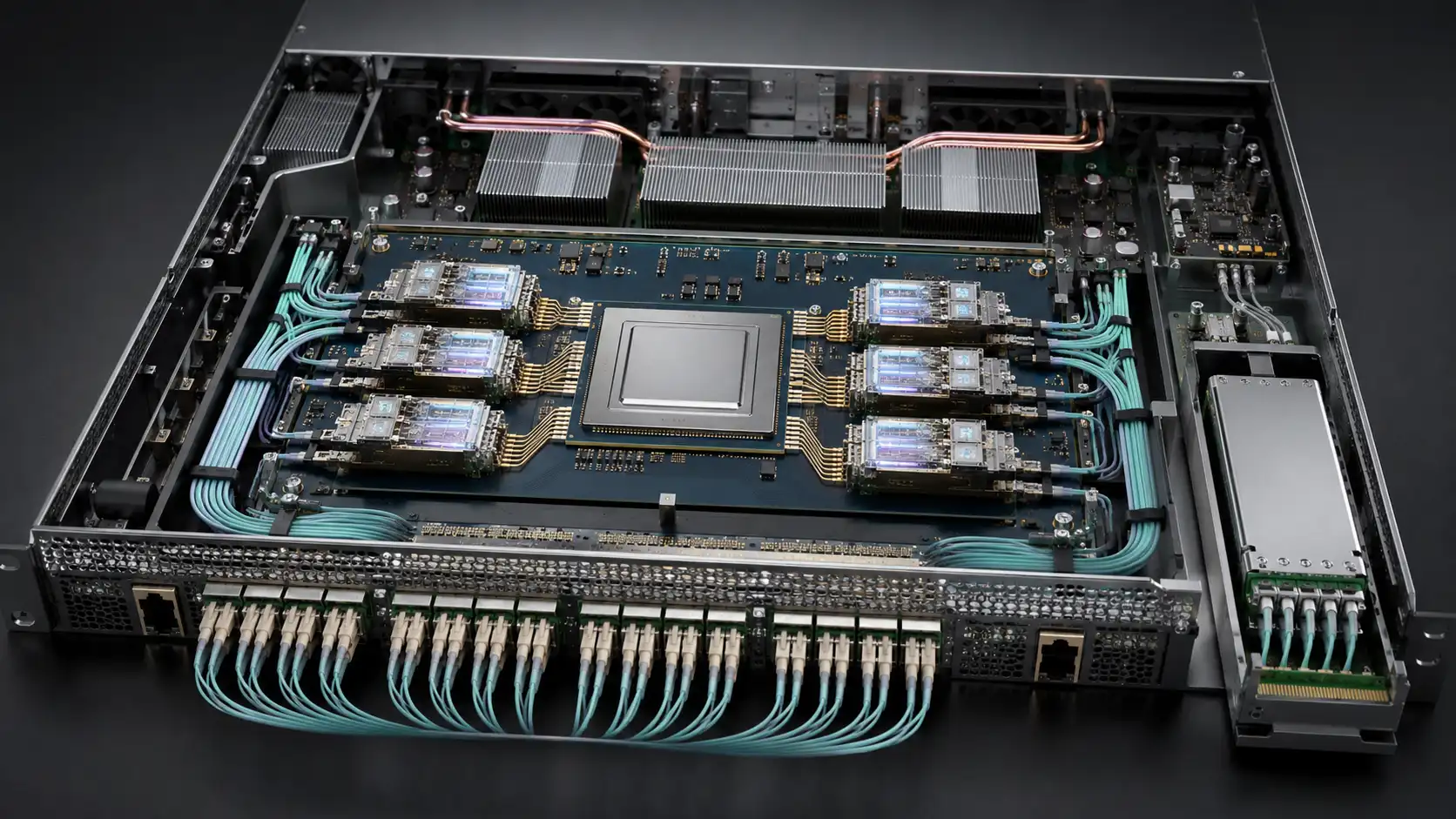
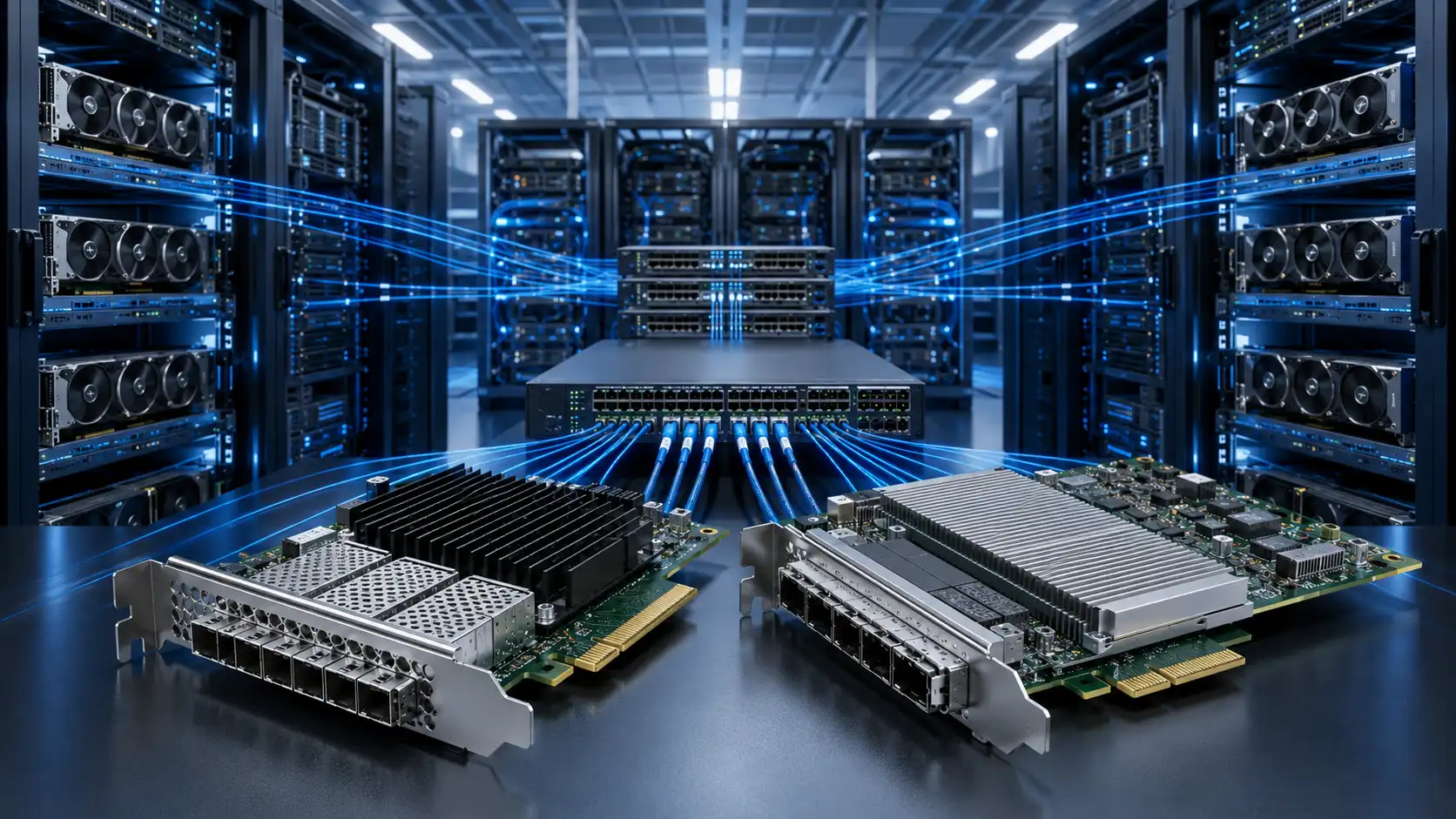
Co-Packaged Optics (CPO) is an interconnect architecture that places the optical engine directly next to the switch ASIC or processor, instead of routing high-speed electrical signals across the board to front-panel pluggable modules. For AI data centers, CPO matters because it attacks the three constraints that conventional optics hit first at high speed: power per bit, bandwidth density, and electrical signal integrity. This is not a new module form factor. It is a system-level change in how electrical and optical functions are integrated inside a switch.
The shift is no longer theoretical. At GTC 2025, NVIDIA demonstrated its Quantum-X and Spectrum-X photonic switches with silicon-photonics engines integrated into the package, and at OFC 2025 a wide range of vendors showed optical engines embedded inside ASIC packages. The question for most teams is no longer whether CPO is real, but where and when it fits.
What Is Co-Packaged Optics?
Co-Packaged Optics moves the optical engine - sometimes called a photonic chiplet - from the faceplate to the switch substrate, close to the ASIC. The goal is to shorten the electrical path between the chip and the point where signals convert to light.
In a traditional pluggable architecture, the switch ASIC drives high-speed electrical signals across centimeters of PCB trace to transceivers mounted at the front panel. That model is mature, flexible, and easy to service. But as per-lane rates climb to 200G and beyond, those electrical paths consume an increasing share of total system power and become harder to design cleanly.
CPO changes the geometry. The signal travels only a few millimeters electrically before converting to optical, rather than 15 to 30 cm across a board. The practical effect, in one sentence: optical I/O moves close enough to the chip that a switch can push far more bandwidth with far less electrical strain.
Is CPO the Same as Silicon Photonics?
No, and the distinction matters. Silicon photonics is a fabrication platform used to build photonic integrated circuits. CPO is a system architecture that uses silicon photonics as one enabling technology. NVIDIA's photonic engines, for example, are built on TSMC's COUPE process, which stacks an electronic die on top of a photonic die - silicon photonics is the building block, CPO is how it gets assembled into a switch.
Why AI Data Centers Are Pushing Optics Closer to the Chip
AI clusters generate intense east-west traffic between GPUs, accelerators, storage, and switches. Training and inference workloads move enormous volumes of data with tight latency and consistency requirements, and the network roadmap is outrunning what front-panel optics can comfortably deliver.
Three pressures drive the shift, and they compound on each other.
Bandwidth is scaling faster than electrical reach. Networks are moving from 400G to 800G, and 1.6T optical modules are expected to enter early commercial deployment around 2025 to 2026. As switch ASIC bandwidth roughly doubles every 18 to 24 months while the usable electrical reach of copper shrinks at higher SerDes rates, the front-panel pluggable model runs into a wall somewhere around the 102.4 Tbps switch generation.
Power per bit is now a facility-level number. This is the metric that actually moves procurement decisions. A traditional 800G pluggable module runs roughly 15 to 20 picojoules per bit; CPO implementations target around 5 pJ/bit, with a credible path below that. Independent demonstrations back this up - Intel's optical I/O chiplet consumes about 5 pJ/bit versus roughly 15 pJ/bit for pluggable modules. Across hundreds of thousands of ports in a large training cluster, saving 10 to 15 watts per port adds up to megawatts at the building level. With a single high-end rack projected to draw hundreds of kilowatts, every watt not spent on the network is a watt available for compute.
Front-panel density is a hard ceiling. More bandwidth means more ports, more cabling, more heat, and harder airflow. There is only so much faceplate, and pluggable cages compete for it. Moving conversion onto the substrate removes that geometric limit.
This is why CPO is most relevant to large AI, HPC, cloud, and hyperscale environments - the places where these three pressures arrive first. It is not designed to replace every module in every data center.
CPO Architecture at a Glance
It helps to see CPO as a set of building blocks rather than a single thing. Each one shifts a problem somewhere new.
| Building block | What it does | Why it matters in CPO |
|---|---|---|
| Switch ASIC | Switches traffic; hosts the high-speed I/O lanes | As capacity rises, lane count and lane speed both climb, straining electrical reach |
| Optical engine (photonic chiplet) | Converts electrical to optical and back | Sits on or beside the ASIC substrate, collapsing the electrical path to millimeters |
| External laser source | Supplies the light the engine modulates | Kept off the hottest part of the package for reliability; often field-replaceable to address the most failure-prone component |
| Fiber-to-chip coupling | Aligns fiber arrays and connectors to the engine | Inside-the-box fiber routing and alignment tolerance become first-order design concerns |
| Management and monitoring | Diagnostics, fault isolation, thermal telemetry | Far more critical than with pluggables, since the engine is integrated rather than swappable |
The laser strategy is worth dwelling on, because it is where vendors quietly solve the serviceability problem. Since the laser is the most failure-prone part of an optical link, many designs use a pluggable external laser. NVIDIA's photonic switches, for instance, feed eight 1.6 Tbps engines from a single replaceable laser module, which also cuts the number of lasers needed per unit of bandwidth. In operational terms, the leading indicator of laser death is a steady rise in laser bias current while optical output stays flat - telemetry that monitoring systems need to watch rather than relying on receive power alone.
What Exactly Changes When Optics Move Closer to the ASIC?
"What CPO changes" is the part most overviews leave vague. Concretely, it changes five things at once, and a team evaluating CPO should reason about each separately rather than as a single trade.

Switch design. Optics stop being a replaceable module the operator stocks and start being part of the board the OEM designs. The DSP retimer that conditions signals for a long PCB trace can often be eliminated entirely, which is where much of the power saving comes from.
Thermal management. The optical engine now sits beside a high-power ASIC. Lasers, modulators, and especially ring resonators are temperature-sensitive - ring-based designs need constant small-heater control to hold the photonic IC at temperature. Thermal zones inside the switch become a design problem, not an afterthought.
Fiber management. Conversion happening on the substrate means fiber has to be routed, secured, and aligned inside the box. Connector reliability, bend performance, and alignment tolerance move from "cabling concern" to "system yield concern."
Maintenance. A technician can pull and replace a front-panel transceiver in seconds. A co-packaged engine cannot be swapped that way. Sparing, repair, fault isolation, and what operators call "blast radius" - how much goes down when one element fails - all change.
Procurement and lifecycle. Pluggables give operators leverage: multiple interoperable vendors, easy spares, incremental upgrades. A more integrated optical system narrows that field and ties the optics to the switch lifecycle. This is a real cost that has nothing to do with optical performance.
The honest summary is that CPO does not simply lower power. It moves complexity - out of the electrical path and into packaging, thermal design, yield, and field operations.
CPO vs Pluggable Optics vs LPO: Which Should You Choose?
CPO is usually weighed against two alternatives: conventional pluggable optics and Linear Pluggable Optics (LPO). They are related but solve different problems, and for many teams the realistic near-term choice is between pluggable and LPO, with CPO tracked for the next platform generation.

| Architecture | Where the optics sit | Main advantage | Main limitation | Best fit |
|---|---|---|---|---|
| Pluggable optics | Front-panel module cage | Mature, multi-vendor, hot-swappable, standards-based | Higher power per bit (~15–20 pJ/bit at 800G) and electrical-reach limits at high speed | Broad data center, enterprise, and telecom deployments |
| LPO | Front-panel pluggable form factor, simplified signal path | Removes onboard DSP; typically 30–50% lower power than DSP-based pluggables, keeps the pluggable operational model | Requires tighter system-level signal-integrity control; shorter reach | Short-reach, power-sensitive AI links |
| CPO | Optical engine on the switch ASIC substrate | Highest bandwidth density and lowest power per bit (~5 pJ/bit target); removes front-panel density ceiling | Harder serviceability, packaging, thermal design, and ecosystem maturity | High-scale AI/HPC switching, especially scale-up fabrics |
A practical decision framework:
- Choose pluggable optics when operational flexibility, multi-vendor sparing, and fast field replacement matter most - which is still most networks.
- Consider LPO when you need lower power and latency on short reaches but want to keep the familiar pluggable model. LPO is the lower-risk bridge, and it has prominent advocates - at OFC 2025, Arista co-founder Andy Bechtolsheim continued to argue for LPO as the better near-term alternative.
- Track CPO when bandwidth density, power per bit, and long-term scaling past 800G outweigh module-level serviceability - and especially for scale-up fabrics inside AI clusters.
The framing that helps most: CPO is not a module purchasing decision, it is a switch-system architecture decision. Treat it that way and most of the confusion clears up.
Benefits of Co-Packaged Optics for AI Networks
The headline benefit is power efficiency at scale. Broadcom claims roughly 30% power savings and 40% lower optics cost per bit from its CPO platform, alongside bandwidth density on the order of 1 Tbps per millimeter. The energy-per-bit gap - about 15 pJ/bit for pluggables versus a 5 pJ/bit target for CPO - is what turns into facility-level megawatts across a large cluster.
Bandwidth density is the second benefit, and it is structural rather than incremental. By escaping the faceplate, CPO removes the front-panel ceiling that constrains pluggable designs once switch capacity passes roughly 102.4 Tbps. Latency can also improve where the signal path simplifies, though latency should always be judged at the full system level, not just at the optical engine.
Reliability data is starting to arrive too, which matters for a technology long stuck at "promising." In October 2025, Broadcom reported that Meta tested its CPO solution for one million link-hours without a single link flap in high-temperature lab characterization - the kind of evidence operators need before trusting non-serviceable optics in production.
CPO Challenges and Deployment Barriers
The challenges are real, and they are mostly not optical. They are packaging, thermal, operational, and ecosystem problems.

Thermal management is the hardest. The engine sits next to a hot ASIC, and ring resonators in particular require active heating to stay on-wavelength - so the design has to manage heat the engine both generates and depends on. Temperature drift directly threatens long-term reliability.
Packaging and yield come next. Co-integrating electronic and photonic dies demands advanced packaging, tight alignment, and test methods that are still maturing. Yield and manufacturability, not raw optical performance, often gate volume production.
Serviceability and blast radius change the operational model. Pluggable laser sources mitigate the worst case, but operators still lose the simple "pull and replace" workflow and the comfort of multiple interchangeable vendors.
Ecosystem readiness ties it together. CPO depends on coordination across switch-silicon vendors, optical-engine suppliers, laser makers, fiber-connectivity providers, packaging partners, and cloud operators, aligned to specifications from bodies such as the Optical Internetworking Forum (OIF) and IEEE. That coordination is forming but not finished.
The market consensus reflects this. Even analysts bullish on the technology - SemiAnalysis expects no rapid adoption curve for scale-out CPO among hyperscalers in the near term, even as those same operators commit to suppliers for scale-up. CPO grows first where the benefits clearly justify the complexity: very large AI factories, hyperscale fabrics, and HPC clusters.
When Should AI Data Centers Consider Co-Packaged Optics?
Pay close attention to CPO if your roadmap includes very high-radix switches, 800G or 1.6T links, large GPU clusters, or strict power-per-bit targets - and especially if your current design is already constrained by power, cooling, signal integrity, or faceplate density. When the cost and difficulty of scaling pluggable architectures keep rising, CPO's trade-offs start to look favorable.
CPO is probably not the right immediate move if your priorities are operational flexibility, fast replacement, broad supplier choice, and incremental upgrades. For most enterprise and general-purpose data centers, mature pluggable optics remain the better fit today, with LPO as a lower-power option for short-reach, power-sensitive links.
Will CPO Replace Pluggable Optics?
Not in the near term. Pluggable transceivers have a mature supply chain, broad standards support, multi-vendor interoperability, and a proven operational model, and they will keep serving most data center, enterprise, telecom, and cloud applications. Deployment-ready CPO products only arrived in 2025, with first hyperscale scale-out deployments expected in 2026 on next-generation switch platforms.
The clearer picture is a layered ecosystem. Pluggable optics stay mainstream. LPO serves as a lower-power bridge that keeps the pluggable model. And CPO becomes central where bandwidth, power, and density push past what front-panel optics can do - most decisively in scale-up AI fabrics, where it is positioned to be the main driver of bandwidth growth for the latter part of this decade. The future is not one architecture winning; it is each one matched to a different performance, cost, and operational requirement.
FAQ
Q: What does CPO stand for?
A: CPO stands for Co-Packaged Optics, an architecture that places optical engines close to the switch ASIC or processor package instead of at the front panel.
Q: Is CPO the same as silicon photonics?
A: No. Silicon photonics is a fabrication platform for building photonic integrated circuits. CPO is a system architecture that can use silicon photonics as an enabling technology.
Q: What is the difference between CPO and LPO?
A: LPO keeps the pluggable module format but removes the onboard DSP to cut power and latency, typically saving 30 to 50% versus DSP-based pluggables. CPO moves the optical engine onto the ASIC substrate and changes the system architecture more fundamentally.
Q: Does CPO actually reduce power consumption?
A: It reduces energy per bit substantially - from roughly 15 pJ/bit for pluggables toward a 5 pJ/bit target - by eliminating long electrical traces and DSP retimers. Note the nuance: CPO is efficient per bit, but it is not inherently a low-power component, since lasers and ring resonators still draw power, including for thermal control.
Q: What role does silicon photonics play in CPO?
A: Silicon photonics provides the integrated optical engines at the heart of most CPO designs. Stacking an electronic die on a photonic die - as in TSMC's COUPE process - is what lets the optical engine sit on the switch substrate.
Q: What are the main barriers to CPO adoption?
A: Thermal management next to a hot ASIC, packaging and yield complexity, reduced field serviceability and larger blast radius, and ecosystem and standards maturity. None of these are primarily about optical performance.
Q: Is CPO commercially available yet?
A: Deployment-ready products arrived in 2025, with reliability milestones such as Broadcom's one-million-link-hour test with Meta. First hyperscale scale-out deployments are expected in 2026, but broad adoption will be gradual and uneven.
Q: Should enterprise data centers care about CPO now?
A: For most enterprises, not as an immediate purchase. It is worth understanding as a roadmap input, but pluggable optics - and LPO for power-sensitive short reaches - remain the better fit until bandwidth, power, or density genuinely force the change.
Conclusion
Co-Packaged Optics is one of the most consequential architectural shifts in high-speed data center networking. By moving optical conversion onto the switch substrate, it cuts energy per bit toward 5 pJ/bit, lifts bandwidth density past the front-panel ceiling, and gives AI and HPC networks a path to scale beyond 800G and 1.6T. The evidence has moved from slideware to shipping products and real reliability data.
But CPO is not a drop-in replacement for pluggable optics. It trades electrical-reach problems for packaging, thermal, fiber-management, and operational ones - and it narrows the procurement leverage operators are used to. For most teams the right posture is layered: keep mature pluggable optics where they fit, use LPO for lower-power short reaches, and track CPO for next-generation high-density AI and HPC fabrics, especially scale-up. The key mental shift is simple: CPO is not a module purchasing decision, it is a switch-system architecture decision - and on that basis, it already belongs in any serious AI network roadmap conversation.