800G Ethernet is a high-speed Ethernet interface that moves 800 gigabits per second across a single port, built from eight electrical or optical lanes running at roughly 100 Gb/s each. It doubles the per-port bandwidth of 400G Ethernet, which lets a network carry the same capacity over fewer links between switches, GPUs, and storage - or far more capacity over the same number of racks.
But the part that matters in real deployments is not the headline number. 800G changes the optics you buy, the fiber and connectors you pull, the power and cooling each rack has to absorb, and the way you validate links before they go live. Treat it as a port-speed bump and you will hit avoidable problems; treat it as an architecture decision and it becomes one of the cleanest ways to scale an AI or cloud fabric.
What Is 800G Ethernet?
800G Ethernet, also written 800GbE, transmits Ethernet frames at an aggregate rate of 800 Gb/s. No single physical signal carries that whole rate. Instead, the interface stripes data across eight parallel lanes - eight electrical lanes from the switch ASIC to the module, and eight optical lanes (or wavelengths) out to the fiber - and presents them to the rest of the network as one logical link.
Each lane uses PAM4 signaling at about 100 Gb/s (106.25 Gb/s on the wire). Eight of those lanes give you 800 Gb/s. This 8×100G structure is the defining characteristic of today's 800G generation, and it is why a single 800G port can step in for two 400G ports or eight 100G ports - provided the switch, the optics, the cabling, and the device on the far end all agree on how that capacity is split.

800G Ethernet vs 400G Ethernet: What Actually Changes
The obvious difference is that 800G carries twice the aggregate bandwidth of 400G. The practical differences are what drive the project plan:
| Factor | 400G Ethernet | 800G Ethernet |
|---|---|---|
| Aggregate bandwidth | 400 Gb/s | 800 Gb/s (8 lanes × ~100 Gb/s) |
| Typical role | Cloud spine, DCI, high-speed aggregation | AI back-end fabric, hyperscale spine, dense aggregation, 51.2T-class switching |
| Switch ASIC requirement | 50G-PAM4 SerDes | 100G-PAM4 SerDes - a 400G switch cannot simply run 800G modules |
| Power per port | Lower | Roughly 12–17 W for a typical DSP optic; up to ~30 W for coherent |
| Cabling for equal capacity | More ports and fiber pairs | Fewer ports, but denser connectors (MPO-16) and stricter loss budgets |
| Ecosystem maturity | Mature, widely interoperable | Maturing fast; interoperability still needs validation |
| Best fit | Today's high-speed networks with headroom | Networks hitting 400G capacity, density, or scaling limits |
The single most overlooked row is the ASIC requirement. An 800G QSFP-DD800 module is mechanically compatible with a 400G QSFP-DD cage, so it physically fits - but it needs a host ASIC that supports 100G-per-lane signaling. Drop one into a 50G-per-lane 400G switch and it will not deliver 800G. Capacity planning starts there, not at the faceplate.
Why 800G Ethernet Matters Now
Enterprise traffic used to flow mostly north-south, between users and applications. AI training, large-scale inference, and distributed storage have flipped that: the heavy traffic is now east-west, between accelerators and between storage nodes inside the fabric. When thousands of GPUs synchronize gradients or exchange parameters, the network - not the compute - becomes the bottleneck.
Adoption reflects that pressure. According to Dell'Oro Group's data center switch forecast, 800G port shipments crossed 20 million units within about three years of first shipment - a milestone 400G took six to seven years to reach - pulled almost entirely by AI back-end networks. The ramp is steep precisely because the workloads are bandwidth-hungry in a way general-purpose computing never was.
AI and Machine Learning Fabrics
In an AI back-end network, the real question is not whether 800G is faster, but whether it reduces oversubscription between GPUs without creating a new thermal or cabling bottleneck. Collective operations such as all-reduce are sensitive to the slowest path, so a fabric that halves link count while holding latency and congestion in check directly improves job completion time. That is why 800G shows up first on spine-to-leaf uplinks and GPU-to-leaf links in clusters running RoCEv2, where lossless behavior and load balancing matter as much as raw throughput.
Cloud and Hyperscale
Hyperscale operators use higher port speeds to grow bandwidth without growing rack complexity at the same rate. One 800G uplink replaces two 400G uplinks, which means fewer cables, fewer optics to manage, and more headroom per rack unit. At scale, that translates into fewer failure points and simpler cable plant - operational savings that often outweigh the per-port cost difference.
Bandwidth Density and Power
As fabrics scale, bandwidth per rack becomes a hard design constraint. Building 800 Gb/s out of many slower ports burns faceplate space, multiplies cabling, and adds operational overhead. Consolidating that into 800G ports can lower the energy spent per bit moved - but only sometimes. Actual power per bit depends on the switch ASIC, the optic type (a linear-drive LPO module can draw 4–10 W where a DSP module draws 14–17 W), the reach, and the cooling design. Treat "more efficient" as a claim to verify against your own ASIC and optics, not a guarantee.
800G Ethernet Standards: IEEE 802.3df, 800GBASE-R, and the Lane Architecture
This is where many 800G overviews stop short. "800G" is not a single specification - it is a stack of related standards that define how the rate is encoded, corrected, and carried over copper and fiber.
From 800GBASE-R to IEEE 802.3df
The first formal 800G specification came from the Ethernet Technology Consortium in 2020 as 800GBASE-R. Rather than invent a new architecture, it repurposed two sets of the existing 400G logic from IEEE 802.3bs, modified to distribute data across eight 106-Gb/s physical lanes, and kept the standard RS(544,514) forward error correction so the new rate stayed compatible with existing physical-layer thinking. That reuse is the reason 800G arrived so quickly: most of the hard logic already existed at 400G.
The IEEE then ratified the formal standard. IEEE 802.3df-2024 was published in March 2024 as Amendment 9 to IEEE Std 802.3-2022, adding MAC parameters, physical layers, and management parameters for 800 Gb/s (and additional 400 Gb/s physical layers) based on 100 Gb/s-per-lane signaling over copper, multimode fiber, and single-mode fiber. The electrical interface between the ASIC and the module follows IEEE 802.3ck for 100G-per-lane signaling. Work on the next step - 200 Gb/s per lane, enabling four-lane 800G and eight-lane 1.6T - is progressing in IEEE 802.3dj.
What the Layers Actually Do
A high-speed Ethernet link is more than a cable. Four layers do the real work, and understanding them is what lets you read a transceiver datasheet correctly:
- MAC handles Ethernet frame formatting and access to the medium.
- PCS (Physical Coding Sublayer) encodes the data and stripes it across the eight lanes. In 800GBASE-R, two 400G PCS instances are adapted to feed one 800G MAC.
- FEC (Forward Error Correction) detects and repairs bit errors. At PAM4 speeds the raw error rate is high enough that FEC is not optional - it is what makes the link usable, and the FEC type affects latency.
- PAM4 sends two bits per symbol using four amplitude levels instead of the two levels of older NRZ signaling, doubling the data rate per lane at the same baud rate - at the cost of much tighter signal-to-noise margins.
The PMD Types That Define 800G
The physical medium dependent (PMD) sublayer is where "800G" turns into a specific module you can order. IEEE 802.3df-2024 defines a family of eight-lane, 100G-per-lane PMDs:
- 800GBASE-CR8 - eight lanes over copper (direct attach).
- 800GBASE-KR8 - eight lanes over a backplane.
- 800GBASE-VR8 / 800GBASE-SR8 - eight lanes over multimode fiber, very short and short reach.
- 800GBASE-DR8 and 800GBASE-DR8-2 - eight parallel single-mode lanes for roughly 500 m and 2 km.
One common point of confusion is worth correcting: the popular 800G "FR4" and "LR4" modules are not 802.3df eight-lane PMDs. In practice they are delivered as 2×FR4 and 2×LR4 - two independent 400G-FR4/LR4 optical engines using CWDM4 wavelengths over duplex single-mode fiber - or, in the newest generation, as true four-lane optics built on 200 Gb/s-per-lane signaling under IEEE 802.3dj. When a vendor lists "800G FR4," confirm whether it is a 2×400G group or a 200G-per-lane part, because the two interoperate with different things.
800G Optics and Form Factors: OSFP vs QSFP-DD800
Two pluggable form factors dominate 800G: OSFP and QSFP-DD800. Both carry eight lanes at 100G PAM4. The difference is in thermals, density, and backward compatibility - and the right answer depends on what you are building.

OSFP
OSFP (Octal Small Form-factor Pluggable) was designed from the start for eight high-speed lanes and high power dissipation. Per the OSFP MSA, the form factor supports 400G (8×50G), 800G (8×100G), and 1.6T (8×200G), fits up to 36 ports in a 1U faceplate, and the standard variant ships with an integrated heatsink for thermal headroom. That headroom is why OSFP is the default in new NVIDIA-class AI clusters, where modules can run 12–17 W and beyond.
One deployment detail that trips teams up: OSFP comes in an integrated-heatsink (IHS) flavor and a riding-heatsink (RHS) flavor. NIC and some server ports require RHS; order IHS modules for those slots and they physically will not seat. Confirm the heatsink type against the host before purchasing.
QSFP-DD800
QSFP-DD800 extends the proven QSFP-DD family to 800G while keeping the same compact footprint. Its headline advantage is backward compatibility: as the QSFP-DD800 MSA describes, a QSFP-DD800 port also accepts QSFP+, QSFP28, QSFP56, and 400G QSFP-DD modules, which lets operators reuse modules the industry has already spent roughly $9 billion on. If you are upgrading an installed QSFP estate rather than building greenfield, that continuity is valuable. QSFP-DD800 builds directly on the broader QSFP-DD form factor, so the cages, panels, and operational tooling carry forward. DSP-based QSFP-DD800 modules typically draw 14–17 W, with LPO variants in the 4–10 W range.
800G OSFP vs QSFP-DD800: Which Should You Choose?
The honest split is: build for thermals and the 1.6T roadmap, or build for density and reuse.
- Choose OSFP for new AI training fabrics where every port runs hot, thermal margin matters, and you want a clean path to 1.6T (OSFP-XD / OSFP1600).
- Choose QSFP-DD800 when you are extending an existing QSFP-DD switching estate, need front-panel density, and want to protect prior optics and cabling investments.
Do not pick on popularity. The decision is driven by the switch platform you have selected, the optics actually available for it, the link distances you need to cover, your fiber type, and your cooling design.
800G Optics Types by Reach and Fiber
Once the form factor is set, the optic is chosen by distance and fiber, not by port speed. This is the single most useful selection table for an 800G project - it is the difference between ordering a module that lights up and one that cannot reach the far end. Reaches below are typical industry values; always confirm against the specific datasheet.
| Optic | Architecture | Fiber | Typical reach | Connector | Where it fits |
|---|---|---|---|---|---|
| 800G SR8 / VR8 | 8×100G, 850 nm VCSEL | OM4 / OM5 multimode | ~30–100 m (VR8 shortest) | MPO-16 or 2×MPO-12 | GPU server to ToR, intra-rack AI links |
| 800G DR8 | 8×100G parallel single-mode | OS2 single-mode | 500 m | MPO-16 | Spine-leaf; breakout to 2×400G or 8×100G |
| 800G DR8-2 (DR8+) | 8×100G parallel single-mode | OS2 single-mode | 2 km | MPO-16 | Longer single-mode, campus spans |
| 800G 2×FR4 (FR8) | 2×400G-FR4, CWDM4 | OS2 single-mode | 2 km | Dual LC / Dual CS | Fiber-efficient DCI; links two 400G-FR4 ends |
| 800G 2×LR4 | 2×400G-LR4, CWDM4 | OS2 single-mode | 10 km | Dual LC / Dual CS | Metro and longer DCI |
| 800G ZR / ZR+ | Coherent | OS2 single-mode | 80 km+ | Duplex LC | Long-haul data center interconnect |
A few practical rules fall straight out of this table. SR8 and VR8 are the only multimode options, and the OM3/OM4/OM5 grade you have installed caps how far they reach. Every single-mode optic above runs over OS2, and the exact single-mode fiber type influences loss and distance. Below the optical options, copper and active cables cover the very short reaches: passive DAC for runs up to a few meters, active electrical cable (AEC) for the roughly 3–7 m range inside and between adjacent racks, and AOC where a fixed module-plus-fiber assembly is convenient.
800G Breakout: 2×400G, 4×200G, and 8×100G
One of the most useful properties of 800G platforms is breakout. Because the port is eight lanes, it can be split. Depending on the switch, optic, and cable assembly, an 800G port may run as 1×800G, 2×400G, 4×200G, or 8×100G.
This matters because almost no network moves to 800G everywhere at once. A realistic deployment puts 800G in the spine or the AI back-end while leaf, storage, and server ports stay at 100G, 200G, or 400G. An 800G DR8 port, for example, commonly breaks out to 2×400G-DR4 or 8×100G to feed those lower-speed devices, while a 2×FR4 module connects two existing 400G-FR4 endpoints with no breakout cable at all.
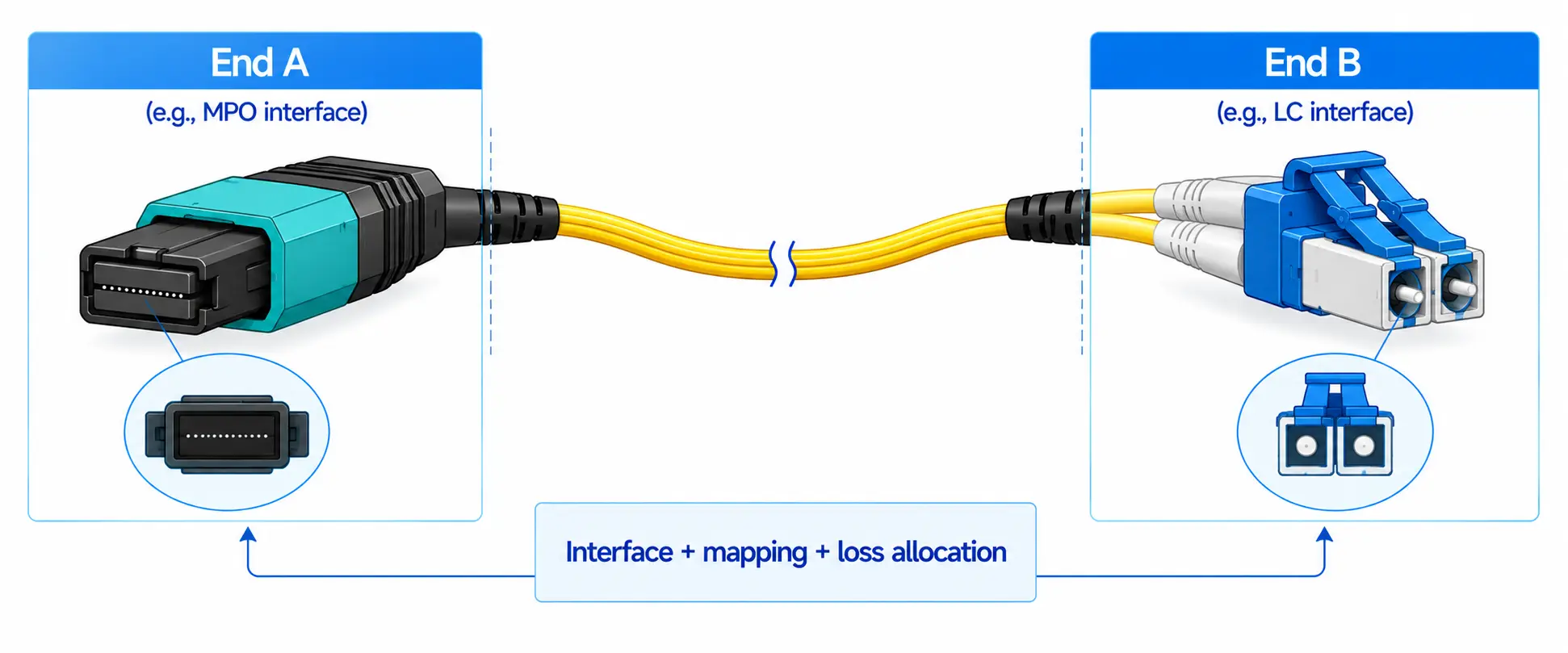
Breakout is also where assumptions go wrong. The connector, fiber polarity, lane mapping, switch NOS version, optic type, and supported speeds all have to line up - and not every 800G port supports every breakout mode in every software release. Plan the physical side early: choosing the right MPO breakout cable for the split you intend is as important as the module itself, and the broader MTP versus MPO connector decision affects density and serviceability across the whole fabric.
Where 800G Ethernet Is Used - and What Each Case Demands
The use cases overlap, but the requirements behind them differ. Matching the optic and topology to the workload is what separates a working 800G fabric from an expensive one.
- AI training and inference fabrics. The priority is low, predictable latency under heavy synchronization, lossless transport (RoCEv2), and clean load balancing (ECMP) across the fabric. Reach is usually short, so SR8 inside the rack and DR8 across spine-leaf dominate; thermals push these toward OSFP.
- Cloud and hyperscale. The priority is scalable, repeatable fabric capacity. 800G consolidates spine-leaf uplinks and inter-pod bandwidth; backward compatibility and operational simplicity often steer these toward QSFP-DD800.
- High-performance computing. The priority is predictable data movement between compute and storage nodes, which means congestion control and low-latency switching matter more than peak throughput.
- Storage and analytics. The priority is sustained throughput for large dataset movement and checkpointing; the constraint is usually how fast storage and the fabric can stay fed, not the port rate.
- Data center interconnect. The priority shifts to reach, fiber availability, and power budget. Here 2×FR4 (2 km), 2×LR4 (10 km), and coherent ZR/ZR+ (80 km+) are the relevant choices, often carried over high-fiber-count MPO/MTP trunk cabling in the spine.
When Should You Upgrade From 400G to 800G?
800G earns its place when there is a measurable bottleneck - not when it is simply available. Look for concrete signals before committing:
- 400G uplinks running consistently above roughly 50–70% utilization, judged on the 95th percentile rather than peaks.
- Fabric oversubscription you cannot resolve by rebalancing traffic or adding a few links.
- A GPU cluster scaling to a point where per-accelerator bandwidth demand outpaces what 400G provides without heavy oversubscription.
- Spine port count or fiber paths approaching exhaustion.
- A new build around 51.2T-class switching, where 800G is simply the native port speed.
400G is still the right answer when links are underutilized, applications are not network-bound, current switches lack 100G-PAM4-capable ASICs (so 800G would force a forklift upgrade), or power and cooling are not ready for 12–17 W per port at high density.
Example migration scenario. A team runs a 400G spine-leaf fabric that has been comfortable for two years. A new GPU cluster comes online, east-west traffic climbs, and 95th-percentile utilization on the spine uplinks settles around 80%. Rather than re-cabling more 400G links, they introduce 800G on the spine only: 800G DR8 over single-mode for the 500 m spine-to-leaf runs, with each 800G port broken out to 2×400G where it lands on existing 400G leaf switches. Server access stays at 200G. The wins are real - link count on the spine roughly halves and headroom returns - but the project surfaces three things to handle first: the new switch needs 100G-PAM4 SerDes, each port adds ~15 W of heat the racks must absorb, and the DR8 links require single-mode fiber, so any multimode runs left over from an earlier era have to be replaced, not reused.
How to Plan an 800G Ethernet Upgrade
An 800G upgrade is a network architecture project, not a hardware refresh. These steps move in order from "why" to "validate."
Step 1: Define the Traffic Problem
Start with the bottleneck, not the port. Are 400G uplinks congested on a sustained basis? Is east-west traffic outgrowing the fabric? Are AI or storage workloads bursty? Is the fabric oversubscribed, or are you running out of ports or fiber? If you cannot point to a specific capacity or congestion problem with data behind it, 800G is premature.
Step 2: Map the Topology
Decide where 800G goes first. The usual entry points are spine-to-leaf uplinks, AI back-end fabrics, high-capacity aggregation, DCI links, and storage aggregation. Most teams introduce 800G in the spine or AI fabric while keeping server access at 100G, 200G, or 400G, with breakout bridging the two.
Step 3: Check Switch and ASIC Capabilities
Two switches with 800G ports are not equal. Confirm the number of 800G ports, supported form factors, switching capacity, latency and buffer behavior, breakout support, RoCEv2 / lossless features, telemetry and automation hooks, NOS maturity, and the vendor's interoperability testing. For AI and HPC, congestion behavior under load is as decisive as raw throughput.
Step 4: Select the Right Optics
Use the reach-and-fiber table above. Match the optic to distance, fiber type, connector, power budget, temperature range, breakout needs, and verified switch compatibility - then check lead time, which has been a real constraint for 800G optics and DSPs. Always confirm the transceiver datasheet against the switch compatibility matrix before ordering.
Step 5: Validate Fiber and Cabling
800G exposes weaknesses a slower link tolerated. Before upgrading, check fiber type and grade, connector condition and cleanliness, polarity, patch-panel capacity, bend radius, and the airflow impact of denser cabling. Above all, confirm the link stays within its insertion-loss budget - at PAM4, a marginal connector or a dirty endface that passed at lower speeds can push a link into errors. A fast port is worthless if the physical layer is not clean and stable.
Step 6: Plan Power and Cooling
800G optics and switches push harder on power and thermals. A dense 800G switch can draw on the order of 700–1,000 W, and each port adds roughly 12–17 W of heat. Review rack power capacity, front-to-back airflow, module temperature monitoring, fan behavior, cable obstruction, hot/cold aisle design, and whether liquid or advanced cooling is needed. Ignoring this leads to throttling, link instability, or shortened hardware life.
Step 7: Test Before Scaling
Validate in a controlled pilot before rollout: link bring-up, FEC behavior, latency, packet loss, congestion handling, breakout behavior, telemetry visibility, optics temperature, multi-vendor interoperability, and failover. A pilot surfaces problems that are far harder to fix once the fabric is in production.
Common 800G Mistakes to Avoid
- Treating 800G as a drop-in. It can require new optics, fiber, cooling, switch configuration, and monitoring - and a switch ASIC that supports 100G per lane.
- Ignoring breakout details. Confirm switch software, optics, cables, far-end devices, and lane mapping before ordering. An 800G port that "supports breakout" may not support the exact mode you need on the exact NOS you run.
- Choosing optics by reach alone. Power, thermals, connector type, interoperability, and availability all matter - and mixing fiber types is a classic failure, since DR8/FR4/LR4 need single-mode and will not work over multimode plant.
- Overlooking congestion control. For AI and HPC, bandwidth alone does not guarantee performance; lossless transport, congestion management, and load balancing decide it.
- Forgetting operations. High-speed links need strong telemetry - optical power, module temperature, FEC errors, packet drops, queue depth, and link stability all need eyes on them.
FAQ: 800G Ethernet
Q: What is 800G Ethernet?
A: 800G Ethernet is an Ethernet interface that carries 800 Gb/s of aggregate throughput across eight lanes of roughly 100 Gb/s each. It is used mainly in AI clusters, hyperscale and cloud fabrics, HPC, and other bandwidth-intensive data center environments.
Q: Is 800G Ethernet faster than 400G Ethernet?
A: Yes - it carries twice the aggregate bandwidth. Real-world benefit depends on the network design, optics, traffic pattern, and whether the endpoints and switch ASIC support 100G-per-lane signaling.
Q: How much power does an 800G module consume?
A: A typical DSP-based 800G optical module draws roughly 12–17 W. Linear-drive LPO variants can run in the 4–10 W range, while coherent ZR/ZR+ modules for long-distance DCI can reach 20–25 W. At rack scale this heat is a primary design constraint, not a footnote.
Q: Which 800G optic should I choose for 500 m, 2 km, or 10 km?
A: For up to ~100 m use SR8/VR8 on multimode (or copper/AOC for in-rack). For 500 m over single-mode, DR8 is the workhorse. For about 2 km, use DR8-2 or 2×FR4. For 10 km, use 2×LR4, and for 80 km+ use coherent ZR/ZR+.
Q: Can 800G run on my existing fiber?
A: Sometimes. SR8 needs OM4/OM5 multimode; DR8, 2×FR4, 2×LR4, and ZR all need OS2 single-mode. Parallel optics such as SR8 and DR8 use MPO-16, which may differ from installed MPO-12 plant, while 2×FR4/2×LR4 use duplex LC. Even where fiber type matches, confirm the link stays within its insertion-loss budget - connectors and endfaces that passed at lower speeds can fail at PAM4.
Q: What is the difference between OSFP and QSFP-DD800?
A: Both are eight-lane 100G-PAM4 form factors. OSFP offers more thermal headroom and a clean path to 1.6T, which suits new AI clusters; QSFP-DD800 is more compact and backward compatible with the QSFP family, which suits upgrades of existing QSFP estates. The right choice depends on switch support, optics availability, thermal design, and reach.
Q: Can 800G ports connect to 400G or 100G devices?
A: On many platforms, yes, via breakout such as 2×400G, 4×200G, or 8×100G. It depends on the switch, optics, cables, and software, so verify the specific breakout mode is supported before deployment.
Q: Is 800G Ethernet only for hyperscale data centers?
A: No. Hyperscale and AI operators are the early adopters, but service providers, large enterprises, HPC sites, and DCI deployments can all justify 800G where traffic growth warrants it.
Key Takeaways
800G Ethernet has become foundational infrastructure for AI-era data centers, defined by the eight-lane, 100G-per-lane architecture of IEEE 802.3df-2024 and 800GBASE-R. It delivers higher bandwidth per port and a practical scaling path for AI, cloud, HPC, and dense fabrics - and a clear runway toward 1.6T.
But a successful 800G upgrade depends on more than faster switches. It means matching the form factor (OSFP or QSFP-DD800) to the workload, selecting optics by reach and fiber, confirming the switch ASIC supports 100G per lane, validating the fiber plant against tighter loss budgets, and planning for 12–17 W of heat per port. If your network is approaching 400G limits or you are building for AI and high-performance workloads, start with traffic analysis, validate the physical layer, pilot a limited deployment, and then scale on a clear migration roadmap.