QSFP-DD Definition
QSFP-DD (Quad Small Form-factor Pluggable Double Density) is a pluggable optical module form factor within the QSFP family that supports higher data rates, primarily targeting high-speed interconnect requirements in data centers, high-performance computing, and telecommunications networks. The core meaning of "Double Density" lies in the electrical interface design expanding from the traditional QSFP's 4 electrical lanes (4-lane) to 8 lanes (8-lane), doubling the bandwidth density within the same physical footprint and providing the hardware foundation for 200G/400G and even 800G rates.
At the modulation technology level, QSFP-DD transceivers support traditional NRZ (Non-Return-to-Zero) encoding and higher-order PAM4 (4-Level Pulse Amplitude Modulation). PAM4 transmits 2 bits of information per symbol, achieving double the data rate at the same baud rate, becoming the mainstream technical path for 400G and above rates. Single lane QSFP speed can increase from 25G NRZ to 50G PAM4 or higher. In terms of specification framework, QSFP-DD's mechanical, electrical, and management interfaces are defined by the QSFP-DD MSA (Multi-Source Agreement) organization, while Ethernet applications follow IEEE 802.3 series standards, such as 802.3bs (200G/400G) and 802.3ck (800G).
QSFP-DD Packaging Advantages
QSFP-DD inherits the physical dimensions of the QSFP series (approximately 18.35mm wide), allowing a single RU switch panel to accommodate 36 QSFP ports, providing higher total bandwidth throughput in the same rack space and reducing the space cost per unit bandwidth. The port design maintains mechanical and electrical compatibility with earlier QSFP+ and QSFP28 modules. Switch QSFP-DD ports can directly accept lower-rate QSFP modules, with the port controller automatically adapting to 4-lane mode operation, supporting phased network upgrades without requiring a complete infrastructure replacement.
The 8-lane architecture's increased power consumption poses higher thermal management requirements. The QSFP-DD specification reserves space for enhanced thermal designs, allowing system vendors to support modules with 12W to 15W or even higher power consumption through optimized chassis airflow, dedicated heat sinks, or liquid cooling solutions. From an industry ecosystem perspective, QSFP-DD has formed a complete supply chain, with large-scale deployments by mainstream network equipment vendors and cloud service providers further reducing module costs. The third-party compatible QSFP module market is active, and mature testing tools and fault diagnosis processes simplify operations and maintenance management.
QSFP-DD vs QSFP Series Comparison
Architecture and Rate Differences
QSFP-DD adopts an 8-lane architecture, while QSFP+, QSFP28, QSFP56, and QSFP112 are all based on 4-lane designs. This fundamental difference determines the rate ceiling and technical implementation paths for each form factor. The following table presents a comparison of core parameters for each form factor:
|
Form Factor |
Lane Count |
Per-Lane Speed |
Modulation |
Total Rate |
Typical Application Scenarios |
|
QSFP+ |
4-lane |
10 Gbps |
NRZ |
40G |
Data center interconnect, enterprise networks |
|
QSFP28 |
4-lane |
25 Gbps |
NRZ |
100G |
Server access, Leaf layer interconnect |
|
QSFP56 |
4-lane |
50 Gbps |
PAM4 |
200G |
Spine-Leaf medium-distance interconnect |
|
QSFP112 |
4-lane |
100 Gbps |
PAM4 |
400G |
High-density Spine layer, AI clusters |
|
QSFP-DD |
8-lane |
25/50/100 Gbps |
NRZ/PAM4 |
200G/400G/800G |
Next-generation data center full-scenario |
QSFP-DD can achieve the same rates using lower per-lane speeds. For example, 8×25G PAM4 achieves 200G, and 8×50G PAM4 achieves 400G. Compared to 4-lane solutions, this reduces single-channel signal integrity challenges and decreases FEC (Forward Error Correction) overhead.
Modulation Technology
The 4-lane path achieves bandwidth growth by continuously increasing per-lane speeds, from QSFP+'s 10G NRZ to QSFP112's 100G PAM4-a 10-fold increase in single-channel rate. This evolution must adopt PAM4 modulation at speeds above 50G to overcome spectrum limitations, but simultaneously introduces higher SNR requirements and more complex DSP processing. QSFP-DD's 8-lane architecture provides an alternative: achieving target bandwidth through doubled lane count at lower per-lane speeds, reducing performance pressure on optoelectronic components and system costs, offering power consumption and reliability advantages in the 200G/400G rate segments.
Compatibility
Physical compatibility does not equate to functional compatibility. When a QSFP28 module is inserted into a QSFP-DD port, the host port must correctly identify the module type (via EEPROM reading) and switch to 4-lane working mode, while matching NRZ signal level standards and FEC parameter configuration (such as RS-FEC(528, 514) or no FEC). Configuration errors may result in link establishment failure or excessive bit error rates. Three points require attention in practice: first, some early QSFP-DD port firmware exhibits recognition anomalies with specific third-party vendor modules; second, mixed-insertion scenarios require confirmation that the host ASIC supports dynamic lane mode switching; third, DAC/AOC passive/active cable compatibility depends on the host-side pre-emphasis and equalization parameter adaptive capabilities. Reference equipment vendor compatibility lists or conduct pre-deployment testing for verification.

QSFP-DD vs Other High-Speed Package Comparison
Physical Dimensions and Port Density
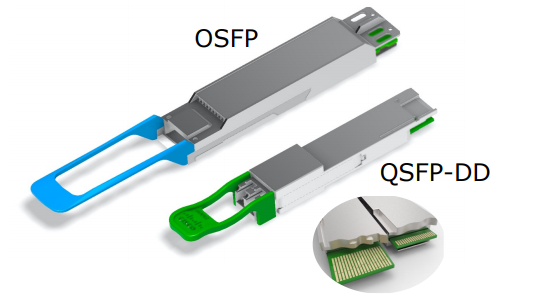
Different package form factors' physical dimensions directly determine switch panel port deployment capability. QSFP-DD width is 18.35mm, inheriting the QSFP series' compact design; OSFP width is approximately 22.58mm, reserving space for higher power and thermal requirements; CFP2 width reaches 41.5mm, primarily targeting long-distance coherent optical applications. On a standard 1RU switch (approximately 440mm panel width), QSFP-DD can deploy 36 ports, OSFP approximately 32, and CFP2 only 10. For data center Spine-Leaf architectures, higher port density means fewer switches, lower rack space occupancy, and simplified cabling management. QSFP-DD's density advantage directly translates to dual savings in CAPEX and OPEX.
Power Consumption and Thermal Design
High-speed module power management is a critical constraint in system design. QSFP-DD mainstream module power consumption ranges from 10W-14W, managed thermally through CMIS (Common Management Interface Specification), supporting active heat sinks and airflow optimization. OSFP design power ceiling can reach 15W-20W, with larger thermal contact area and reserved liquid cooling interfaces making it suitable for 800G/1.6T ultra-high-speed scenarios or integrated complex DSP coherent detection modules. CFP2 optics support the highest power consumption (up to 24W), with modules internally accommodating complete coherent transceivers (TIA, Laser Driver, temperature control circuits), achieving heat conduction through metal housings. Power consumption differences reflect application scenario divergence: QSFP-DD prioritizes density and cost, OSFP balances performance with thermal management, and CFP2 focuses on functional integration for long-distance transmission.
Application Scenario Positioning
The three packages form layered complementarity in network architectures. QSFP-DD focuses on data center Ethernet short/medium-distance interconnects (SR4/DR4/FR4), covering Spine-Leaf layer OM4/OM5 multimode fiber connections within 100m, server NIC uplinks, and ToR (Top of Rack) switch interconnects. Its core competitiveness lies in port density, cost efficiency, and backward compatibility. When comparing OSFP vs QSFP-DD, OSFP targets 800G and higher rates in hyperscale data center core layers and InfiniBand networks (such as NDR 400G, XDR 800G). Some high-end AI training clusters adopt OSFP due to extremely high bandwidth requirements between GPUs (such as NVLink over Ethernet), with its power and thermal capabilities supporting more aggressive signal rates and complex encoding schemes. CFP2 occupies the metro/long-distance DCI (Data Center Interconnect) market, supporting DCO (Digital Coherent Optics) technology with high-order modulation schemes like DP-QPSK and DP-16QAM. Transmission distances extend from hundreds of kilometers to thousands of kilometers across intercontinental submarine cables. Typical applications include metro OTN wavelength division multiplexing, cloud service provider cross-region interconnects, and carrier backbone network expansion.
Comprehensive comparison of the three packages:
|
Comparison Dimension |
QSFP-DD |
OSFP |
CFP2 |
|
Physical Width |
18.35mm |
22.58mm |
41.5mm |
|
1RU Port Count |
36 |
32 |
10 |
|
Typical Power |
10-14W |
15-20W |
15-24W |
|
Mainstream Rates |
200G/400G/800G |
400G/800G/1.6T |
100G-400G (coherent) |
|
Lane Architecture |
8-lane |
8-lane |
Coherent or multi-wavelength |
|
Cooling Method |
Air cooling + heat sink |
Air/liquid cooling + large-area cooling |
Metal housing + active temperature control |
|
Transmission Distance |
100m-10km |
100m-10km |
Hundreds to thousands of kilometers |
|
Typical Applications |
Data center Spine-Leaf, server uplinks |
Hyperscale core, AI clusters |
Metro/long-distance DCI, coherent transmission |
|
Cost Positioning |
Cost priority |
Performance-density balance |
Functional integration priority |
|
Ecosystem Maturity |
High (large-scale deployment) |
Medium (rapid growth) |
High (carrier-grade) |
FAQ
What's the difference between QSFP-DD and QSFP112?
QSFP-DD: an 8-lane approach (achieves higher aggregate bandwidth by using more lanes).
QSFP112: a 4-lane approach (relies on higher per-lane data rates and more aggressive signaling).
QSFP-DD vs QSFP112: what's the core debate?
QSFP112: 4 lanes with higher per-lane speed, typically requiring higher-grade SerDes/SI performance and PAM4 processing.
QSFP-DD: 8 lanes scaling via lane count, which can reduce per-lane stress in certain speed segments.
What management bus do QSFP-DD modules use, and why does it matter for operations?
Most QSFP-DD modules use an I²C management interface (with the CMIS management model). This matters because the host reads/writes registers/pages to obtain the module's capability set, alarm thresholds, DOM diagnostics, and state machines.
Why do some modules get "downshifted" or rate-limited after insertion?
Common reason: based on the capabilities advertised via EEPROM/CMIS, the host determines that the port does not support the target Host Interface (or current policies enforce a more conservative power/thermal limit), and therefore automatically brings the datapath up in a compatible lower mode.