


What is a BiDi Transceiver
A BiDi transceiver (short for bidirectional transceiver), also known as a bidirectional SFP module, is an optical fiber transceiver that enables bidirectional communication over a single fiber strand. Unlike traditional dual-fiber optical modules, BiDi SFP transceivers use wavelength division multiplexing (WDM) technology to simultaneously transmit signals at different wavelengths within the same fiber, thereby conserving fiber resources. This technology is currently widely deployed in FTTH access networks, data center interconnects, enterprise campus networks, and other scenarios.

Working Principle of BiDi SFP Modules
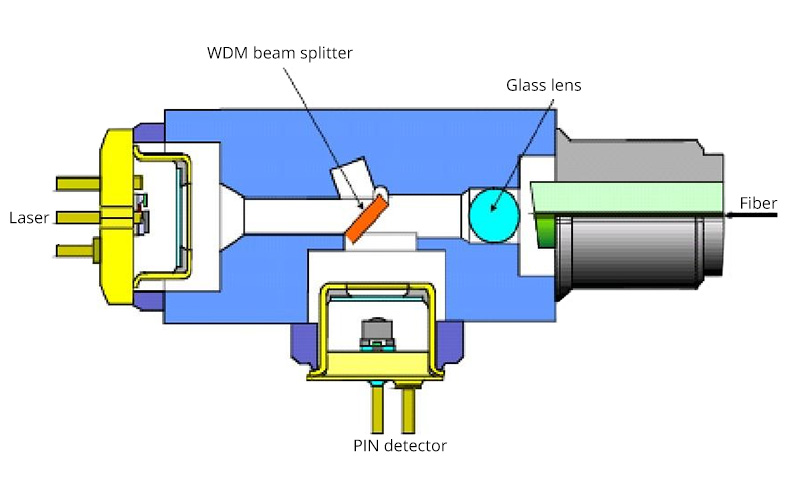
The core component of a BiDi SFP module is the WDM filter (also called a duplexer or diplexer). This device separates and combines optical signals at different wavelengths, enabling bi-directional communication over a single fiber strand.
The specific working process: The transmitter's laser generates an optical signal at a specific wavelength (such as 1310nm fiber), which is coupled into the fiber through the WDM filter and transmitted. Simultaneously, an optical signal at another wavelength (such as 1550nm) received from the fiber is separated by the WDM filter and sent to the photodetector for conversion into an electrical signal.
BiDi SFP transceivers must be used in pairs. If end A transmits at 1310nm and receives at 1550nm, then end B must transmit at 1550nm and receive at 1310nm. Incorrect wavelength pairing will prevent link establishment. Common wavelength combinations include: 1310nm/1490nm, 1310nm/1550nm, 1270nm/1330nm, and others.
Different wavelength combinations are suitable for different transmission distances. The 1310nm/1550nm combination is commonly used for medium to long-distance transmission (20-120km) because these two wavelengths have lower attenuation in single-mode fiber; 1270nm/1330nm is primarily used for 10G and higher rate short to medium-distance applications (10-40km).
Internal Structure of BiDi SFP Modules
BiDi SFP modules mainly consist of the following components:
TOSA (Transmitter Optical Sub-Assembly): Contains a laser diode (LD) and driver circuit, responsible for converting electrical signals into optical signals at a specific wavelength. Common lasers include DFB (distributed feedback) lasers and FP (Fabry-Perot) lasers. DFB lasers have excellent wavelength stability and are suitable for long-distance transmission; FP lasers are cost-effective and mostly used for short-distance applications.
ROSA (Receiver Optical Sub-Assembly): Contains a photodetector (PIN or APD) and preamplifier circuit, responsible for converting received optical signals into electrical signals. PIN detectors are used for conventional applications, while APD detectors have higher sensitivity and are used for long-distance transmission.
WDM Filter: The critical component of BiDi modules, using thin-film filter technology or grating technology to separate transmit and receive optical signals at different wavelengths. The filter's performance directly affects the module's insertion loss and isolation specifications. High-quality filters can achieve channel isolation of over 30dB, ensuring that transmit and receive signals do not interfere with each other.
Circuit Board and Interface: Provides power management, signal processing, and DDM (Digital Diagnostic Monitoring) functions. Compliant with standards such as SFF-8472, it allows reading of module parameters like temperature, voltage, and optical power through an I²C interface.
The entire module is packaged in standard SFP, SFP+, QSFP, or other housings, with SC or LC simplex interfaces at the port.
Advantages of BiDi SFP Transceivers
Reduced Fiber Usage: The single-fiber transmission solution reduces fiber usage by 50%, which offers significant advantages in projects where fiber resources are limited or cabling costs are high. Particularly in large-scale deployment scenarios such as metropolitan area networks and FTTH access networks, the cost savings on fiber are substantial. A data center case study showed that adopting the BiDi solution reduced fiber procurement and construction costs by approximately 35%.
Simplified Cabling Installation: Reduces the number of fiber fusion splices and ODF ports, lowering construction complexity and labor costs. In retrofit projects, existing single-core fiber resources can be fully utilized without the need for rewiring. This is particularly important for legacy data centers with tight equipment room space and full cable trays.
Reduced Space Occupancy: The single-port design reduces the space occupied by patch panels and cabinets, making it suitable for high-density deployment environments. A 24-port BiDi patch panel can manage 48 links, doubling space utilization efficiency.
High Flexibility: During network upgrades, if existing fiber resources are insufficient, BiDi fiber deployment can quickly expand capacity without large-scale rewiring. This flexibility is highly valuable for scenarios requiring high business continuity.
However, the BiDi solution also has limitations. Single-fiber transmission places higher demands on fiber quality, with factors such as bend radius and cleanliness having greater impact on transmission performance. Fiber end-face contamination or excessive bending can increase crosstalk between the two wavelength signals, affecting link stability. Additionally, during fault isolation, unlike dual-fiber solutions where TX and RX links can be tested separately, BiDi fiber requires holistic assessment, making maintenance slightly more challenging.
BiDi SFP Modules vs. Traditional Dual-Fiber Optical Modules
The fundamental difference between BiDi SFP modules and traditional dual-fiber optical modules lies in how they use the physical transmission medium. Duplex fiber deployment uses two independent fibers, one dedicated to transmission and one to reception, with complete physical layer isolation. BiDi transceivers achieve bidirectional transmission over a single fiber through wavelength division multiplexing technology.
Interface Form
Dual-fiber optical modules use LC or SC duplex interfaces with two ports; bidirectional SFP modules use simplex interfaces with only one port.
Paired Usage
Traditional dual-fiber optical modules can use identical modules at both ends (such as 1000BASE-LX at both ends) because their transmit and receive wavelengths are the same. BiDi SFP transceivers must be used in pairs with different wavelength combinations (such as 1310nm TX/1550nm RX at one end and 1550nm TX/1310nm RX at the other).
Cost Perspective
BiDi SFP module unit prices are typically 20%-40% higher than comparable dual-fiber modules because WDM filters add manufacturing costs. However, in projects requiring long-distance cabling or where fiber resources are limited, the total cost (module + fiber + construction) may be lower.
Reliability
Dual-fiber solutions have slightly stronger anti-interference capability due to physical isolation of transmission and reception; BiDi solutions depend on filter performance and have stricter fiber quality requirements. However, with improved manufacturing processes, modern BiDi SFP modules have reliability approaching that of dual-fiber modules.
It's important to note that "bidirectional" and "duplex" are two different concepts. Duplex refers to the data transmission method (full duplex or half duplex), while BiDi refers to the physical medium usage method. BiDi SFP transceivers still operate in full duplex mode, just implemented over a single fiber.

Types of BiDi Transceivers
Classification by Speed
1G BiDi SFP: Used for Gigabit Ethernet, this is currently the most widely deployed BiDi module type. Typical wavelength combinations are 1310nm/1490nm or 1310nm/1550nm, with transmission distances covering 3km to 120km. Mainly applied in enterprise networks, campus networks, FTTH access, and other scenarios.
10G BiDi SFP+: Used for 10 Gigabit Ethernet, wavelength combinations are typically 1270nm/1330nm (short to medium distance) or 1490nm/1550nm (long distance). Transmission distances range from 10km to 80km. Widely applied in data center interconnects, metropolitan area networks, and other scenarios.
25G BiDi SFP28: Used for 25G Ethernet, employing narrower wavelength spacing (such as 1295nm/1309nm), with transmission distances of 10-40km. Primarily used for server access and storage networks in high-performance data centers.
40G BiDi QSFP+: Uses a dual-fiber design but integrates WDM technology, with each fiber carrying 20Gbps bidirectional transmission. Uses the 832-918nm wavelength range, operating on OM3/OM4 multimode fiber, with transmission distances of 100-150 meters. Suitable for high-density interconnection within data centers.
100G BiDi QSFP28: Employs PAM4 modulation technology, with a single wavelength carrying 50Gbps, achieving 100G bidirectional transmission over a single single-mode fiber. Transmission distances of 10-40km, used for inter-data center connections.
Classification by Wavelength Technology
Standard BiDi: Uses fixed wavelength pairs, such as 1310nm/1550nm. Lower cost and most widely applied.
CWDM BiDi: Employs coarse wavelength division multiplexing technology, wavelength range 1270nm-1610nm, with 20nm wavelength spacing. Can multiplex multiple wavelengths on a single fiber, suitable for metropolitan area networks and long-distance transmission.
DWDM BiDi: Employs dense wavelength division multiplexing technology, with wavelength spacing of only 0.8nm (100GHz) or 0.4nm (50GHz), compliant with ITU-T G.694.1 standards. Used for backbone networks and ultra-long-distance transmission, achieving extremely high fiber spectrum utilization.
Classification by Application Scenario
PON BiDi Modules: Specifically designed for FTTH/FTTB passive optical networks, such as EPON, GPON, 10G-EPON, etc. OLT side and ONU side use different wavelength combinations, with typical configurations being downstream 1490nm/upstream 1310nm. Some PON systems also overlay a 1550nm wavelength for CATV signal transmission.
Data Center BiDi Modules: Optimized for data center environments, supporting DDM functionality, low power consumption, and high-density deployment. Common rates are 10G, 25G, and 100G.
Carrier-Grade BiDi Modules: Meet carrier-grade reliability requirements, with operating temperature ranges of -40°C to +85°C, passing rigorous environmental testing. Used in outdoor base stations, metropolitan area network nodes, and other harsh environments.
Industrial-Grade BiDi Modules: Enhanced anti-interference capability and mechanical strength, suitable for industrial automation, intelligent transportation, and other scenarios.
|
Speed |
Package Type |
Common Wavelength Combinations |
Transmission Distance |
Typical Application Scenarios |
|
1G |
SFP |
1310/1490nm |
3-120km |
Enterprise networks, surveillance, FTTH |
|
10G |
SFP+ |
1270/1330nm |
10-80km |
Data centers, metropolitan networks |
|
10G |
XFP |
1270/1330nm |
10-80km |
Early 10G systems |
|
25G |
SFP28 |
1295/1309nm |
10-40km |
High-performance data centers |
|
40G |
QSFP+ |
832-918nm |
100-150m (OM3/OM4) |
Data center internal interconnect |
|
100G |
QSFP28 |
1310/1550nm |
10-40km |
Data center interconnect, metropolitan networks |
|
1.25G |
SFP (EPON ONU) |
Receive 1490nm/Transmit 1310nm |
20km |
Fiber-to-the-home access |
|
2.5G |
SFP (GPON ONU) |
Receive 1490nm/Transmit 1310nm |
20km |
Fiber-to-the-home access |
Application Areas of BiDi Transceivers
FTTH Fiber-to-the-Home: The primary application scenario for carrier broadband access networks. BiDi solutions between OLT and ONU save 50% of optical distribution network (ODN) costs. Hundreds of millions of FTTH users worldwide use BiDi technology. Downstream data typically uses the 1490nm wavelength, upstream data uses the 1310nm wavelength, and some systems also use 1550nm for CATV signal transmission, achieving three-wavelength multiplexing.
Data Center Networks: Rack-to-rack, floor-to-floor, and campus-to-campus interconnection. In high-density cloud data centers, BiDi solutions can reduce fiber usage by 50%, lowering cabling complexity. Particularly in retrofit projects, when existing fiber resources cannot meet bandwidth upgrade requirements, BiDi is the most economical solution. 10G BiDi SFP+ and 25G BiDi SFP28 are commonly used models in data centers.
Enterprise Campus Networks: Cross-building and cross-block enterprise network interconnection. Compared to deploying double the amount of fiber optic cables, BiDi solutions can significantly reduce construction costs and timelines. Suitable for distributed networks in schools, hospitals, industrial parks, and other locations.
Security Surveillance Systems: Large surveillance projects often involve hundreds or even thousands of cameras, with massive fiber cabling workloads. BiDi solutions can reduce fusion splices and ODF ports by 50%, accelerating construction progress and reducing failure rates. Particularly in retrofit projects, existing single-core fiber resources can be fully utilized.
5G Fronthaul/Midhaul Networks: Data transmission between mobile communication base stations and core networks. With high 5G base station density and bandwidth requirements, BiDi technology effectively conserves fiber resources. 10G/25G BiDi modules are widely applied in 5G networks.
Industrial Ethernet: Scenarios such as smart factories, power systems, and traffic control. Industrial environments have high reliability requirements but often limited cabling space. BiDi solutions reduce fiber usage while lowering cabling difficulty. Industrial-grade BiDi modules feature wide temperature design and enhanced anti-interference capability.
Broadcasting Networks: CATV signal transmission and IPTV services. Some broadcasting networks use BiDi technology to achieve fiber optic transformation of HFC networks, upgrading network capacity using existing fiber resources.
Smart City Applications: IoT scenarios such as intelligent transportation, smart street lighting, and environmental monitoring. These applications typically have scattered deployment points and long distances, with BiDi solutions significantly reducing fiber infrastructure costs.
It's important to note that choosing between BiDi and traditional dual-fiber solutions requires comprehensive consideration of project-specific circumstances: if fiber resources are abundant, distances are short, and budgets are ample, dual-fiber solutions may be simpler and more reliable; if fiber resources are limited, cabling costs are high, and rapid deployment is needed, BiDi solutions offer clear advantages.
FAQ
Q: How do BiDi optical modules achieve bidirectional transmission?
A: The core is the WDM filter. The transmitter generates an optical signal at a specific wavelength (such as 1310nm) for transmission while receiving an optical signal at another wavelength (such as 1550nm). The filter separates and combines signals at different wavelengths.
Q: Must BiDi modules be used in pairs?
A: Yes. If end A transmits at 1310nm and receives at 1550nm, end B must transmit at 1550nm and receive at 1310nm. Incorrect wavelength pairing will prevent link establishment, which is an important difference from traditional dual-fiber modules.
Q: What are the common wavelength combinations?
A: 1310nm/1490nm, 1310nm/1550nm: Commonly used for 1G and medium to long-distance transmission (20-120km)
1270nm/1330nm: Primarily used for 10G and higher rate short to medium-distance applications (10-40km)
1490nm/1550nm: Used for 10G long-distance transmission
Q: What are the main advantages of BiDi solutions?
A: Reduce fiber usage by 50%, lowering procurement and construction costs by approximately 35%
Simplify cabling, reducing fusion splices and ODF ports
Reduce space occupancy, suitable for high-density deployment
Fully utilize existing single-core fiber in retrofit projects


