"Heat-shrink closure" and "mechanical-seal closure" are useful shorthand, but they can hide the real maintenance question: which interface is being sealed, and what must a technician replace or recondition when that interface is opened?
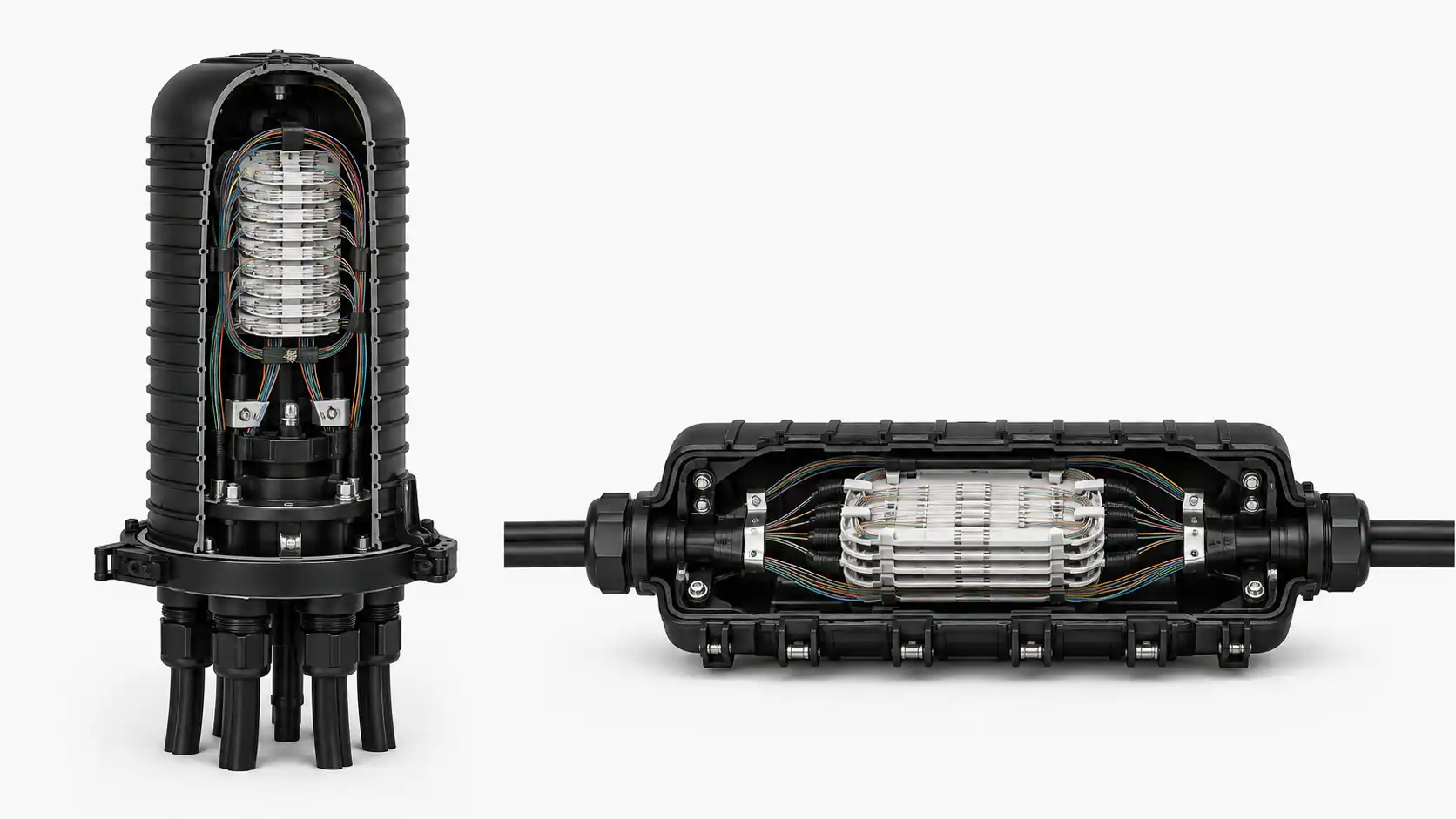
A single closure can combine more than one sealing method. CommScope's current FOSC 400 documentation, for example, describes a mechanical base-to-dome seal for re-entry and heat-shrink sleeves with hot-melt adhesive at cable entries. That makes the most useful comparison a lifecycle comparison at the actual seal point-not a claim that one entire closure technology is always better than the other.
This guide focuses on cable-entry and housing seals where re-entry planning matters. For general enclosure selection, capacity, body shape, environment and standards, use DIMI's fiber optic splice closure selection guide.

Define the Seal Before You Compare It
A splice closure can contain several independent sealing interfaces:
- closure body or dome-to-base seal;
- round cable-entry seals;
- oval or express/mid-span cable ports;
- branch-off seals for multiple cables in one entry;
- unused-port plugs;
- valves or accessory penetrations where the design includes them.
Do not write "mechanical" or "heat shrink" in the RFQ without identifying the interface. A closure with a reusable body gasket may still use consumable heat-shrink sleeves at the cable ports. Conversely, a mechanically sealed cable port can still have other parts that require replacement after re-entry.
What Changes During Re-Entry?
| Lifecycle question | Heat-shrink cable-entry approach | Mechanical compression / gasket approach |
|---|---|---|
| How is the seal formed? | A specified sleeve/sealant system is heated and conforms around the approved port/cable configuration. | A gasket, grommet, O-ring, gland or other sealing element is compressed by the closure hardware. |
| What controls workmanship? | Surface preparation, approved sleeve/branch components, heat application, cable position and visual completion criteria. | Clean sealing surfaces, correct seal size, cable position, compression sequence, fastener/clamp condition and model-specific tightening instructions. |
| What happens at re-entry? | Some systems require the existing sleeve or related sealing components to be cut away and replaced; follow the exact manufacturer procedure. | Some systems are designed to open and reseal, but the gasket/grommet/seal must still be inspected and replaced if the procedure requires it. |
| What spares matter? | Correct replacement sleeves, branch clips or other specified sealing consumables. | Correct gaskets, grommets, plugs, compression parts or approved lubricant where specified by the manufacturer. |
| Main planning risk | A crew can open the closure but cannot restore the cable-entry seal because the correct replacement kit or heat tool is missing. | A crew can reassemble the closure but reuse damaged/dirty seals or compress the wrong seal around the cable. |
These are planning patterns, not universal product rules. Corning, CommScope and other closure manufacturers use multiple sealing systems across their portfolios. The installation and re-entry instructions for the exact model must control the field method.

Heat-Shrink Seals: Plan the Re-Sealing Kit Before You Open the Closure
Heat-shrink cable entries are process-dependent. CommScope's current FOSC 400 information describes heat-shrink cable seals using hot-melt adhesive and installation with a hot-air gun. That example shows why the field procedure must control tool type, surface preparation, sleeve placement and heating-not a generic instruction such as "apply heat until tight."
Before a planned re-entry, identify:
- the exact closure and cable-entry kit;
- the cable outside diameter and branch configuration;
- which existing sealing parts will be disturbed;
- which replacement sleeves, clips, plugs or seal components are required;
- the approved heat tool and accessories;
- surface-preparation and cleaning materials;
- the manufacturer's completion/inspection criteria;
- the post-work seal verification method.
Do not assume an old sleeve can simply be reheated and returned to its original qualified condition. If the re-entry procedure requires a replacement seal, treat that replacement kit as part of the maintenance BOM before the outage begins.
Where heat-shrink can fit the maintenance model
Heat-shrink can be a practical choice when cable entries are expected to remain stable for long periods and the organization can reliably provide the approved tools, consumables and work method when a port must be rebuilt. The decision should be based on the exact closure procedure and operating model, not on a generic claim that heat-shrink is "more permanent" or "more waterproof."
Mechanical Seals: Reusable Does Not Mean Maintenance-Free
Mechanical sealing systems use compression and controlled sealing surfaces rather than a heat-shrink sleeve at the compared interface. Corning's current fiber dome closure information describes an O-ring-based closure system designed for ease of installation and re-entry. CommScope also uses mechanical body seals in closure families intended for re-entry. Those examples support a useful planning principle: mechanical designs can reduce the need to rebuild a heat-shrink interface when repeated access is expected.
But a mechanical seal is only serviceable if the sealing system is still in acceptable condition. During re-entry, inspect the items that the model's procedure identifies, which can include:
- O-ring or gasket condition;
- sealing groove and mating surface cleanliness;
- grommet or cable-seal size relative to actual cable OD;
- cuts, permanent deformation, debris or foreign material;
- unused-port plugs and branch components;
- clamps, latches, bolts or compression hardware;
- cable movement that could unload or misalign the seal.
Do not add grease, lubricant, tape, sealant or substitute gaskets unless the product procedure explicitly permits that material. An improvised material can change compression, contamination, chemistry or future serviceability.
Cable Diameter Is a Re-Entry Variable, Not Just an Initial Purchase Field
Both sealing approaches depend on the cable/port combination being within the approved design range. The maintenance team therefore needs the actual cable OD and construction in the as-built record, not only the closure model.
This becomes especially important when adding a branch cable. A new cable may be smaller, larger, flatter, armored differently, or routed through a different port than the original cable. The existing seal kit cannot be assumed compatible simply because there is physical space in the port.
For each existing and future cable, record:
- outside diameter;
- cable construction and armor/strength-member details relevant to the closure;
- port or entry position;
- cut cable versus express/mid-span use;
- required seal kit, grommet, sleeve, insert or branch component;
- strain-relief hardware;
- spare part number or kit reference where available.
Re-Entry Workflow: What Should Happen Before, During and After Opening
Before opening
- Identify the exact closure model, revision and installed seal configuration.
- Review the manufacturer's re-entry instructions rather than relying on the original installation memory.
- Photograph cable entries, labels, clamps and existing routing before disturbing them.
- Confirm that the required replacement sealing kit and tools are on site.
- Record the cables that will remain untouched and the cable/port that will be changed.
- Where the operator uses a pre-work optical baseline, capture it before the splice area is disturbed.
During re-entry
Protect the fibers and sealing surfaces as separate work zones. Keep removed gaskets, plugs and hardware clean and identifiable if the procedure permits reuse. For a heat-shrink port, remove the old sealing components only by the approved method so the cable jacket and closure port are not damaged. For a mechanical seal, avoid dragging dirty seals across the mating surface or mixing parts from different ports.
When adding a cable, establish strain relief before final sealing so cable movement is not transferred directly into the sealing interface or splice trays.
Before closing
- confirm that every cable is in the intended port;
- verify that unused ports are sealed with the specified plugs;
- check that no fiber, tube, label or debris crosses a sealing surface;
- replace any seal component that the manufacturer's procedure identifies as non-reusable or damaged;
- restore clamps, latches, fasteners or compression components in the specified sequence;
- complete the model-specific seal verification before the closure is returned to service.

Acceptance After Re-Sealing
"The lid is closed" is not an acceptance criterion. The closure should be checked using the verification method specified for that product and project. Depending on the design, this may include a visual seal check, a pressure/leak test, or another manufacturer-defined procedure. Do not invent a universal pressure, dwell time, torque or pass/fail value.
The post-work record should connect the sealing work to the actual asset:
- closure ID and location;
- date and technician/crew;
- ports opened or changed;
- cable IDs and diameters;
- replacement seal-kit identifiers;
- photographs before and after re-sealing;
- seal verification result/method;
- optical test or service verification required by the project;
- remaining spare kits stored for the next intervention.
Failure Patterns That Point Back to the Seal Process
| Observed condition | Possible process gap | What to review |
|---|---|---|
| Seal fails after a cable addition | New cable/port combination was not matched to the approved seal range or branch kit. | Cable OD, port map, seal kit and installation procedure. |
| Mechanical seal will not seat evenly | Debris, displaced gasket, wrong grommet, cable movement or uneven compression may be present. | Seal condition, groove/mating surface, cable restraint and compression sequence. |
| Heat-shrink sleeve appears incomplete or distorted | Preparation, sleeve placement, heating method or incompatible components may be involved. | Exact kit instructions and visual completion criteria; do not continue heating by guesswork. |
| Closure passes initial work but has repeated issues after service visits | The maintenance process may lack controlled replacement parts, inspection points or as-built records. | Re-entry history, seal replacements, training and spare-parts plan. |
| Cable shifts when the closure is handled | Strain relief may not be carrying the mechanical load independently of the seal. | Cable anchoring and closure-specific strain-relief hardware. |
Choose by Maintenance Model, Not by a One-Line Technology Ranking
The broader DIMI dome vs inline closure guide separates closure geometry from sealing method. That distinction matters here too. A dome is not automatically mechanical, and an inline closure is not automatically heat-shrink.
A practical decision starts with the expected service pattern:
- Low expected re-entry: compare the full closure qualification, cable-entry compatibility, installation procedure and availability of future replacement kits. Heat-shrink may fit well if the approved process is readily supported.
- Frequent planned re-entry: give more weight to a serviceable seal design, repeatable opening/closing procedure, seal inspection criteria and on-hand spares.
- Mixed lifecycle: a closure can legitimately use a serviceable mechanical body seal with different cable-entry technologies. Compare each interface rather than forcing the entire closure into one label.
What to Ask a Fiber Optic Splice Closure Supplier
The procurement keyword "fiber optic splice closure supplier" belongs to the commercial product owner, not to this technical article. In a real supplier evaluation, however, the following re-entry questions are useful because they expose lifecycle requirements that a headline IP rating or capacity figure does not.
- Which closure interfaces use mechanical, heat-shrink, gel or other sealing methods?
- What cable OD and construction range is approved for each entry kit?
- Which seal components must be replaced after opening or after adding a branch cable?
- What tools and heat/compression controls are required?
- Which spare kits should be stocked for the expected maintenance events?
- Is there a model-specific re-entry procedure and current installation manual?
- How should sealing surfaces be inspected and cleaned?
- What strain-relief hardware is required for each cable configuration?
- What post-installation or post-re-entry seal verification method is specified?
- Which qualification or test documentation applies to the exact closure and seal configuration being quoted?
For product selection and quotation, use the DIMI fiber optic splice closure category. This page should remain the maintenance and re-entry decision resource.

Final Re-Entry Rule
Choose a sealing system by the full maintenance cycle: install, inspect, open, modify, reseal, verify and document. Heat-shrink and mechanical sealing can both be appropriate when the cable range, tools, consumables and field procedure are controlled. The best design is the one whose re-entry method can be executed repeatedly by the real maintenance team with the correct spares and verifiable acceptance criteria.
FAQ
Q: Is a mechanical-seal closure always easier to re-enter?
A: Not universally. Many mechanical systems are designed for serviceable access, but the opening procedure, gasket/grommet condition, replacement criteria and compression method are product-specific.
Q: Can a heat-shrink seal be reused after re-entry?
A: Do not assume it can. Some closure systems require replacement sleeves or other sealing components after an entry is disturbed. Follow the exact re-entry instructions and have the correct replacement kit available before opening the closure.
Q: Can one splice closure use both mechanical and heat-shrink sealing?
A: Yes. CommScope's FOSC 400 is a current example: its base-to-dome seal is mechanical, while cable entries use a heat-shrink sleeve system. Compare the seal at the interface being serviced.
Q: Does IP68 tell me which sealing method is better?
A: No. An IP designation is an enclosure protection classification under stated test conditions; it does not by itself define re-entry procedure, cable compatibility, replacement parts or maintenance workflow. Review qualification data and instructions for the exact closure configuration.
Q: What spare parts should be stored with a closure?
A: Use the model-specific maintenance plan. Typical needs can include replacement cable-entry sleeves or branch components for heat-shrink systems, or gaskets, grommets, plugs and compression components for mechanical systems. Store only the parts approved for the exact closure and cable configuration.