If you are comparing MTP/MPO vs LC fiber cables, here is the practical answer: choose MTP/MPO fiber cables when your design requires high-density patching, parallel-optics connectivity, or a trunk-and-cassette architecture that scales across racks. Choose LC fiber cables when you need simple duplex links, broad compatibility with SFP/SFP+ transceivers, and straightforward day-to-day patching.
That split is not just a rule of thumb. It reflects how the cabling industry actually segments these two connector families: LC handles one- or two-fiber connections, while MPO handles connections requiring more than two fibers, as defined in the ANSI/TIA-568.3-E optical fiber cabling standard. The real decision, however, goes beyond the connector. It is a network design decision shaped by fiber count, transceiver interface, link topology, upgrade plans, and how much operational complexity your team is prepared to manage.

MTP/MPO vs LC: Key Differences

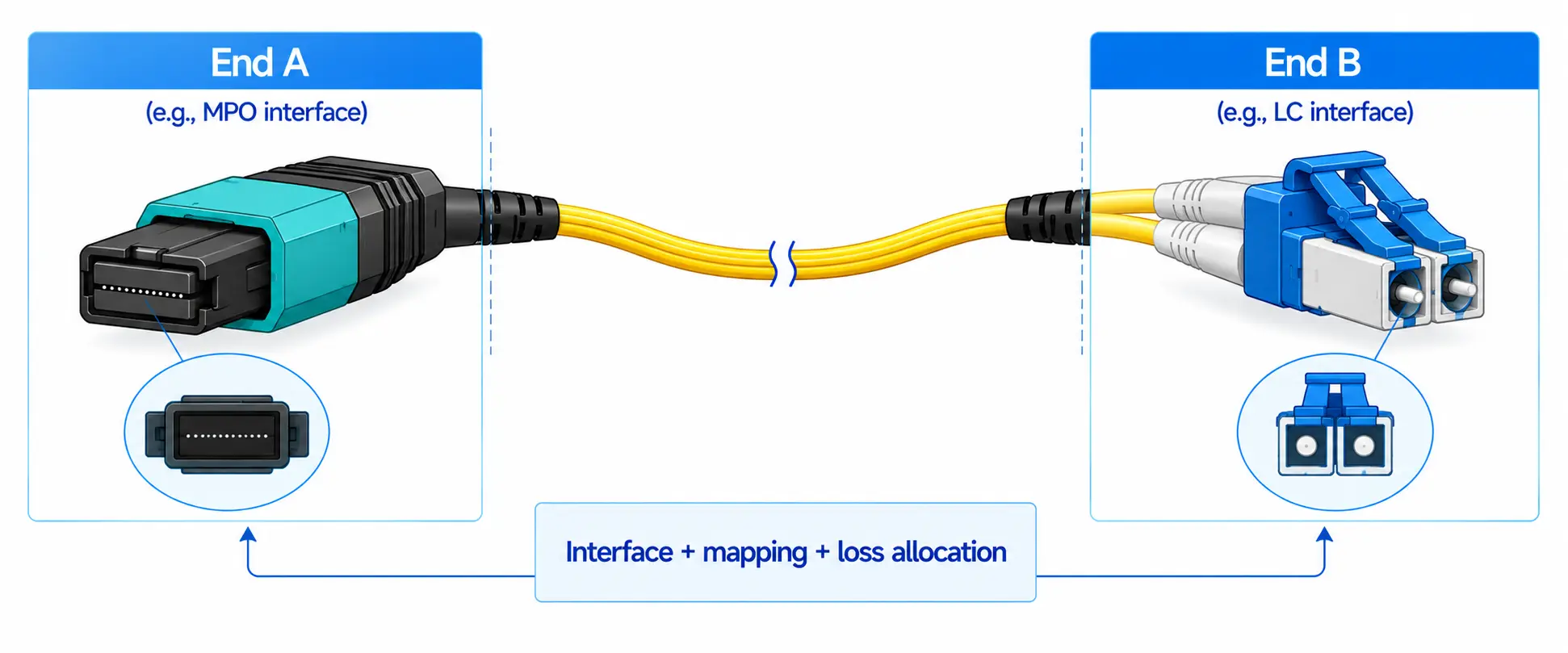
An LC fiber cable uses a small-form-factor duplex connector designed for one or two fibers. It pairs natively with SFP, SFP+, and SFP28 transceivers and remains the most widely deployed connector type in enterprise access layers, campus backbones, and standard fiber patch cord environments. If you open a typical telecom room or access-layer rack, the vast majority of patch panels and switch ports are LC-based.
An MPO (Multi-fiber Push-On) connector, by contrast, terminates 8, 12, or 24 fibers in a single ferrule.
It is the physical interface required by parallel-optics standards such as IEEE 802.3ba (40GBASE-SR4) and IEEE 802.3bm (100GBASE-SR4), both of which transmit across multiple parallel lanes over MPO-terminated multimode fiber. MPO-based cabling is therefore not just a higher-density patch cord - it is the backbone of structured cabling in modern data center rows, where trunks, cassettes, and breakout assemblies work together to deliver scalable connectivity.
MTP® is a registered brand of MPO connector manufactured by US Conec. According to US Conec, the MTP design provides patented features, tighter ferrule tolerances, a removable housing for field re-polarity, and measurable insertion-loss improvements over generic MPO connectors - while remaining fully intermateable with all standard MPO interfaces per TIA-604-5 (FOCIS 5) and IEC 61754-7. So when buyers ask "MTP vs MPO," they are comparing a premium MPO implementation against generic alternatives, not two separate connector families. For a deeper breakdown, see our MTP vs MPO engineer's selection guide.
MTP/MPO vs LC Comparison Table
| Parameter | MTP/MPO | LC |
|---|---|---|
| Fiber count per connector | 8, 12, or 24 fibers | 1 fiber (simplex) or 2 fibers (duplex) |
| Typical transceivers | QSFP+ (40G), QSFP28 (100G), QSFP-DD (400G) | SFP (1G), SFP+ (10G), SFP28 (25G) |
| Primary topology | Parallel optics, trunk-and-cassette, breakout | Point-to-point duplex |
| Port density | High - fewer cables per rack unit | Moderate - one duplex link per port |
| Best use cases | Data center spine/leaf, 40G/100G/400G backbone, structured cabling | Access layer, campus backbone, enterprise patching, 1G/10G links |
| Polarity management | Requires planning (Methods A, B, C, U1, U2 per TIA-568.3-E) | Straightforward A-to-B crossover |
| Operational complexity | Higher - cassette planning, gender/pin management, multi-fiber troubleshooting | Lower - simple swap-and-test per duplex link |
| Scalability | Designed for modular growth via trunks and cassettes | Scales by adding individual patch cords |
When to Choose MTP/MPO Over LC?

High-Density Data Center Cabling
MTP/MPO becomes the practical choice when you need to run dozens or hundreds of fiber connections through limited pathway space. A single 12-fiber MPO trunk replaces six duplex LC patch cords, which directly reduces cable congestion, simplifies cable management, and frees rack space. This is why structured cabling designs for leaf-spine fabrics and high-density colocation rows are overwhelmingly built on MPO/MTP trunk cables rather than individual duplex runs.
Parallel Optics and Breakout Connectivity
If your switches use QSFP+ or QSFP28 modules for 40G or 100G, the physical interface is an MPO connector. The Cisco 40GBASE-SR4 QSFP data sheet specifies 12-fiber parallel fiber terminated with MPO/MTP connectors, and the same applies to Cisco's 100GBASE-SR4 QSFP28 modules. When you also need to break out a single 40G uplink into four 10G connections for downstream SFP+ ports, an MPO-to-LC breakout cable or breakout cassette is the standard approach. Without MPO infrastructure in place, that breakout path simply does not exist.
Future-Oriented Structured Cabling
If your facility is likely to migrate from 10G to 40G/100G within the next few years, deploying MPO-based trunks and cassettes now saves significant recabling cost later. The trunk-and-cassette model lets you change the cassette modules (for example, swapping an MPO-to-LC cassette for an MPO-to-MPO pass-through) without pulling new trunk cables. For teams evaluating next-generation interfaces like QSFP-DD for 400G, an MPO backbone is the infrastructure foundation those optics expect.
When to Choose LC Over MTP/MPO

Simple Point-to-Point Duplex Links
For a straightforward connection between two devices - a server NIC to a top-of-rack switch, an access switch uplink to a distribution switch, or a short cross-connect in a campus MDF - LC is almost always the right answer. The link uses two fibers, the transceiver is an SFP or SFP+ with a duplex LC receptacle, and the patch panel accepts standard LC adapters. Adding MPO infrastructure to this scenario introduces cost and complexity with no density or bandwidth benefit. To understand the optical performance characteristics of LC terminations, our LC fiber connector guide covers insertion loss and return loss in detail.
Existing LC-Based Infrastructure
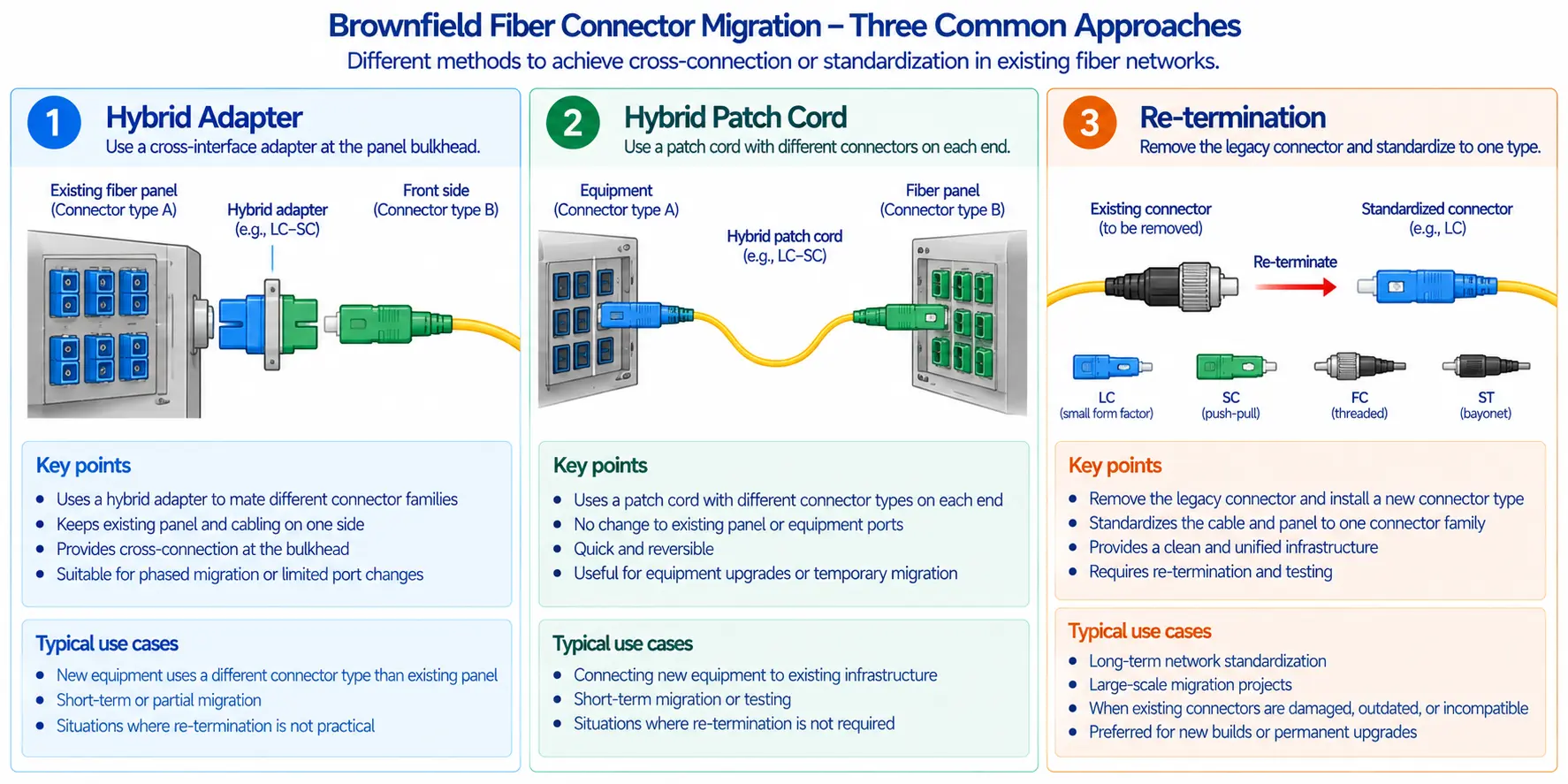
Many enterprise networks have years of installed LC cabling in their horizontal runs, patch panels, and equipment rooms. If your current infrastructure is LC-heavy and your bandwidth requirements stay within 1G or 10G per port, replacing all of that with MPO is rarely justified. The practical path is to keep LC where duplex links remain appropriate and introduce MPO selectively - in new backbone trunks, high-density rows, or specific cabinets that require breakout connectivity.
Operational Simplicity and Smaller Teams
With duplex LC patching, a technician can identify, test, and replace an individual circuit in minutes. Troubleshooting is channel-by-channel: one fiber pair, one link, one set of insertion loss and return loss measurements. MPO environments, by contrast, require attention to polarity methods, pin orientation (male/female), cassette mapping, and multi-fiber continuity - all of which increase the training and documentation burden. According to US Conec's FAQ, proper cleaning and inspection before every mating is a best practice for MPO connectors, and failure to do so can cause fiber damage, debris buildup, or ferrule degradation. For smaller teams without dedicated cabling specialists, LC keeps operations simpler.
How to Choose Between MTP/MPO and LC: A 4-Step Selection Checklist
Rather than defaulting to whichever cable sounds more advanced, walk through these four steps to match the cable to the actual link design.

Step 1: Check the transceiver and port type. Look at the equipment port on each end. If both sides accept SFP/SFP+ modules with duplex LC receptacles, LC is the natural match. If one or both sides use QSFP+, QSFP28, or QSFP-DD modules with an MPO receptacle, then MPO-based cabling is required. This is not a preference - it is dictated by the physical interface.
Step 2: Determine whether the link is duplex or parallel. A duplex link carries one transmit fiber and one receive fiber - two fibers total. A parallel link splits the signal across multiple lanes (for example, 4×10G for 40GBASE-SR4), requiring 8 or 12 fibers. If the design is duplex, LC is the standard termination. If the design is parallel, MPO is the standard termination. This distinction matters more than headline speed: a 100G link can be either duplex (100GBASE-LR1 over LC) or parallel (100GBASE-SR4 over MPO).
Step 3: Evaluate breakout requirements. If you need to fan out a single multi-fiber uplink into multiple duplex connections - for instance, breaking a 40G QSFP+ port into four 10G SFP+ ports - you need an MPO breakout cable or cassette module. The choice between a direct breakout harness and a cassette-based approach depends on whether the breakout point is permanent or reconfigurable. Our guide to MPO cable types - trunk, breakout, and patch explains the trade-offs in detail.
Step 4: Factor in density, migration path, and operational capacity. If you are building out multiple racks with plans to increase bandwidth within a few years, MPO trunks and cassettes give you a modular upgrade path - change the cassette, not the trunk. If you are adding a handful of links to an established LC plant with no near-term density pressure, keeping LC avoids unnecessary infrastructure changes. The right answer for most growing facilities is a hybrid: MPO in the backbone and high-density zones, LC at the edge and in legacy areas.
Common Mistakes When Choosing MTP/MPO vs LC
Choosing by Speed Alone
A 40G or 100G label does not automatically mean you need MPO. Several 100G transceiver options - including 100GBASE-LR1, 100GBASE-CWDM4, and BiDi modules - use duplex LC interfaces rather than parallel MPO. Always check the specific transceiver data sheet before selecting the cable type. The deciding factor is the physical port and lane architecture, not the aggregate bandwidth.
Ignoring Polarity Planning
This is where many MPO deployments run into trouble. The TIA-568.3-E standard defines five polarity methods (A, B, C, U1, U2) for array-based cabling, and mixing methods within a single installation can cause transmit-to-receive misalignment that is difficult to diagnose. Before ordering trunks and cassettes, decide on one polarity method and document it. If field reconfigurability matters - for example, in a multi-tenant data center where pinning requirements vary - the MTP PRO connector from US Conec allows tool-free polarity and gender changes, which reduces the risk of ordering errors.
Assuming MTP/MPO Is Always the Better Investment
MPO infrastructure has a higher upfront cost per connection, requires more planning, and demands more care in cleaning and handling. For a small office with eight 10G links, deploying an MPO trunk-and-cassette system would be overengineered. LC gives those links lower total cost, faster installation, and easier maintenance. The goal is to match the cabling to the actual topology, not to chase maximum connector density where it adds no value.
Selection Examples

Example 1: Enterprise Access Layer - 10G SFP+ Links
A mid-sized enterprise is connecting 48-port 10G switches to servers using SFP+ SR transceivers. Each link is duplex, each port has an LC receptacle, and the existing patch panels are LC-terminated. The correct cable here is a standard LC duplex patch cord over OM3 or OM4 multimode fiber. Introducing MPO would not improve speed, reduce cost, or simplify operations - it would only add connector complexity to a fundamentally duplex environment.
Example 2: Data Center Spine-Leaf - 40G/100G QSFP28 Links
A colocation provider is deploying a leaf-spine fabric with QSFP28 100GBASE-SR4 optics between spine and leaf switches. Each spine port requires an 8-fiber MPO-12 connection. The design calls for 12-fiber MPO trunk cables running through overhead pathways, terminated into MPO cassette panels at each cabinet. For leaf switches that also need 10G breakout connections to servers, MPO-to-LC breakout cables (8-fiber, OM3/OM4) fan out each QSFP+ port to four individual SFP+ server connections. This is the scenario where MPO infrastructure directly solves density, bandwidth, and cable management problems that LC patching alone cannot address.
Example 3: Staged Migration - LC Today, MPO Backbone for Growth
An enterprise currently runs 1G and 10G over LC but plans to add 40G uplinks within 18 months. Rather than rip-and-replace, the team installs MPO trunk cables in the backbone between MDFs and IDFs, with MPO-to-LC cassettes providing duplex breakout to existing LC equipment. When the 40G QSFP+ switches arrive, the team swaps the cassettes for MPO pass-through panels - no new trunk pulls needed. This hybrid approach preserves the existing LC investment at the edge while creating a migration-ready backbone.
MTP/MPO vs LC: Cost and Compatibility Considerations
On a per-connection basis, MPO cabling typically costs more than LC. An MPO trunk cable, cassette panel, and associated adapters represent a larger upfront investment than individual LC patch cords. However, in high-density deployments, the total cost picture shifts: fewer cable runs, less pathway space, faster installation, and lower labor hours during moves and changes can offset the higher per-connector price. The breakeven point depends on scale. For facilities with fewer than 50 connections per cabinet, LC is usually more cost-effective. For facilities running hundreds of connections per row with 40G or 100G optics, MPO structured cabling often delivers lower total cost of ownership.
Compatibility is rarely an issue at the connector level - LC mates with LC, MPO mates with MPO - but it matters at the system level. Mixing polarity methods, using trunk cables with mismatched pin configurations, or pairing generic MPO connectors with equipment tested for MTP-grade tolerances can introduce unexpected insertion loss. When building an MPO plant, it is worth standardizing on a single connector type and polarity method from the outset, and verifying that trunk, cassette, and breakout components all come from a tested, interoperable system.
Polarity and Gender: Why They Matter More with MTP/MPO

In a duplex LC environment, polarity is handled by a simple A-to-B crossover in the patch cord - transmit on one end connects to receive on the other. With MPO, the same principle applies across 8, 12, or 24 fibers simultaneously, and maintaining correct fiber-to-position mapping requires adherence to one of the polarity methods defined in TIA-568.3-E. Getting this wrong means some channels work while others do not, and the failure mode is not always obvious during initial testing.
Gender (pinned vs. unpinned) adds another layer. An MPO mated pair requires one pinned (male) and one unpinned (female) connector. The TIA-568.3-E guidance recommends that trunk cables be pinned and that cassettes, breakout cables, and patch cords be unpinned - a convention that supports future migration to end-to-end MPO systems. The MTP PRO connector simplifies this by allowing field pin-change without removing the housing, but the planning requirement does not disappear.
Frequently Asked Questions
What is the main difference between MTP/MPO and LC fiber cables?
LC is a duplex connector designed for one or two fibers, typically paired with SFP-family transceivers. MPO is a multi-fiber connector that terminates 8, 12, or 24 fibers and is used with QSFP-family transceivers for parallel-optics and high-density applications. MTP is a premium brand of MPO connector made by US Conec.
Is MTP the same as MPO?
MTP is a specific brand of MPO connector, not a different connector type. All MTP connectors comply with MPO intermateability standards (TIA-604-5, IEC 61754-7), but MTP connectors offer tighter tolerances, removable housings, and field-reconfigurable polarity that generic MPO connectors do not.
When should I choose LC instead of MTP/MPO?
Choose LC when your ports use SFP/SFP+ transceivers, your links are duplex, your existing infrastructure is LC-based, or your team values simple patching and troubleshooting. LC is also the more cost-effective option for smaller installations without high-density requirements.
When is MTP/MPO the better choice?
MTP/MPO is the better fit when your equipment uses QSFP+/QSFP28/QSFP-DD transceivers, your links require parallel optics or breakout connectivity, or your cabling design prioritizes density, scalability, and a modular upgrade path. It is the standard infrastructure for data center MPO/MTP patch cord deployments.
Does higher speed always mean I need MTP/MPO?
No. Speed alone does not determine the connector. Many 100G transceivers - including 100GBASE-LR1 and 100GBASE-CWDM4 - use duplex LC connectors. The deciding factor is whether the link is duplex (two fibers, typically LC) or parallel (multiple lanes, typically MPO). Always check the transceiver data sheet.
Why does polarity matter more with MTP/MPO?
Because an MPO connector carries 8 to 24 fibers, each fiber position must map correctly from transmit to receive across trunks, cassettes, and patch cords. The TIA-568.3-E standard defines five polarity methods (A, B, C, U1, U2) to ensure this alignment. Mixing methods or failing to document the chosen method can cause partial link failures that are time-consuming to diagnose.
Can I use both MTP/MPO and LC in the same network?
Yes, and many networks do. A common architecture uses MPO trunk cables in the backbone with MPO-to-LC breakout cassettes providing duplex connections to LC-based equipment at the edge. This hybrid approach delivers MPO density where it matters while preserving LC simplicity where it is sufficient.
What is the cost difference between MTP/MPO and LC?
MPO cabling has a higher per-connector cost than LC due to the multi-fiber ferrule, tighter manufacturing tolerances, and associated cassette/panel hardware. However, in high-density environments, MPO reduces total cable count, installation labor, and pathway usage - which can lower overall infrastructure cost at scale. For small deployments, LC is almost always more economical.
What is an MPO breakout cable, and when do I need one?
An MPO breakout cable fans out a single multi-fiber MPO connector into multiple duplex connectors (usually LC). You need one when a parallel-optics port - such as a 40G QSFP+ - must connect to individual 10G SFP+ ports on downstream equipment. This is the standard method for 40G-to-4×10G migration scenarios.
Conclusion
The MTP/MPO vs LC decision is not about which connector is better in the abstract. It is about which one matches the transceiver interface, link topology, density requirements, and operational model of your specific deployment. MTP/MPO is the stronger choice for parallel-optics environments, high-density structured cabling, and facilities planning bandwidth upgrades around QSFP-based equipment. LC is the stronger choice for duplex links, established infrastructure, and environments where patching simplicity and lower upfront cost are priorities.
To make the right call: check the transceiver port, confirm whether the link is duplex or parallel, map out any breakout requirements, and plan for the next upgrade cycle. If you need help selecting the right MPO or LC cable assemblies for your project, contact our engineering team or browse our full range of fiber optic solutions.