A fiber optic attenuator is a passive optical component that intentionally reduces signal power by a specific amount, measured in decibels (dB). It does not convert, amplify, or reshape the signal - it simply lowers the optical power reaching the receiver.
Why would anyone want to weaken a fiber signal on purpose? Because in many real-world links, the signal arriving at the receiver is too strong. When received power exceeds the detector's maximum input level, the result is receiver saturation - bit errors, signal distortion, and degraded link performance. This is especially common on short single-mode runs where path loss is minimal and the transceiver's output easily overwhelms the far-end receiver. Attenuators solve this by bringing the signal back within the receiver's operating window.
Beyond receiver protection, fiber optic attenuators are widely used in lab testing, system margin validation, and channel power balancing. This guide covers how they work, the main types available, and a practical selection method based on link budget analysis rather than guesswork.
What Does a Fiber Optic Attenuator Do?
Every optical receiver has a defined input power range. The lower boundary is receiver sensitivity - the minimum power needed for acceptable bit error rate (BER). The upper boundary is the maximum input power, sometimes called the overload point or saturation level. These values are published in transceiver datasheets and vary by module type, data rate, and wavelength.
If the received optical power falls below sensitivity, the link drops or produces excessive errors. If it exceeds the maximum input level, the photodetector saturates and the receiver can no longer distinguish between ones and zeros reliably. An optical attenuator addresses the second problem: it adds a controlled, predictable amount of loss so the signal arriving at the receiver stays within the safe operating range.
This controlled loss is distinct from the unintentional insertion loss caused by dirty connectors, poor splices, or fiber bends. An attenuator provides a precise, repeatable reduction - typically specified with a tolerance of ±0.5 dB for values under 10 dB and ±10% for higher values, according to qualification standards such as Telcordia GR-910-CORE.
When Do You Need a Fiber Optic Attenuator?
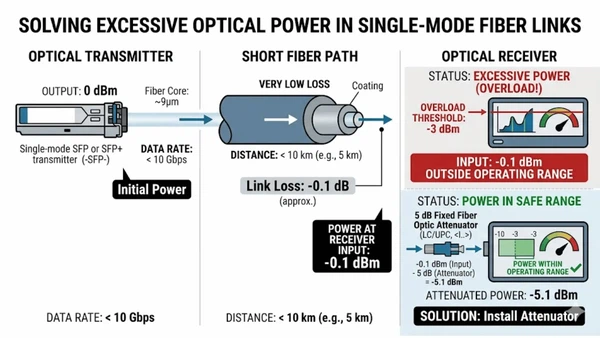
Short-Distance Links with Excess Power
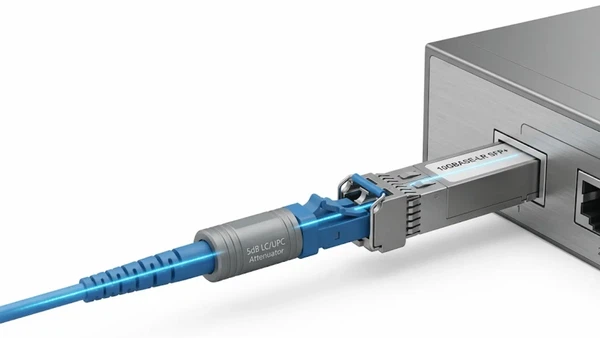
The most common scenario is a short fiber run - for example, a 1 km or 2 km single-mode link between two switches in the same building. The transmitter launches at, say, 0 dBm, and total path loss from fiber, connectors, and patch panels is only 1–2 dB. If the receiver's maximum input is −3 dBm, the received power is well above the overload threshold. A 5 dB fixed attenuator at the receiver port brings the level back into range. This situation occurs frequently in data centers, campus backbones, and short metropolitan links where single-mode SFP modules are deployed over distances far below their rated maximum.
Testing and System Margin Validation
During acceptance testing or troubleshooting, engineers use variable optical attenuators (VOAs) to sweep the receiver input power across a range and observe where errors begin. This process, sometimes called a sensitivity test or margin test, reveals how much headroom the link has before it fails. VOAs are also used to simulate longer fiber runs without physically adding fiber, which is useful for qualifying links in the lab before field deployment. The Fiber Optic Association's loss budget guide explains how power budget calculations relate to receiver input limits and system margin.
Channel Power Balancing in WDM Systems
In wavelength-division multiplexed (WDM) networks, different channels may arrive at the receiver with unequal power levels due to amplifier gain tilt or varying span losses. Attenuators - often per-channel VOAs - are used to equalize power across channels so the receiver array processes all wavelengths within a consistent power window.
How Do Fiber Optic Attenuators Work?

The internal mechanism depends on the attenuator design. Common approaches include doped fiber absorption, where a short length of specially treated fiber absorbs a fixed fraction of the light; controlled air-gap misalignment, where a small gap or lateral offset between fiber cores reduces coupling efficiency; and neutral-density filter elements, where a thin absorptive glass element is placed in the optical path.
The specific mechanism affects insertion loss, return loss, polarization dependent loss (PDL), and wavelength sensitivity.
For instance, doped-fiber attenuators tend to have very low back reflection, making them suitable for links where return loss performance is critical - such as those using APC-polished connectors. Air-gap attenuators, by contrast, may exhibit higher back reflection unless specifically designed to minimize it.
Industry qualification of fiber optic attenuators typically follows Telcordia GR-910-CORE, which defines requirements for attenuation accuracy, environmental stability, and mechanical durability. Component-level attenuation and insertion loss measurements are described in IEC 61300-3-4. These standards ensure that a labeled "5 dB" attenuator actually provides close to 5 dB of loss across its specified operating conditions.
Fixed vs. Variable Fiber Optic Attenuators: Which One Should You Choose?
The two fundamental categories are fixed attenuators, which provide a single unchangeable attenuation value, and variable optical attenuators (VOAs), which allow the user to adjust attenuation over a continuous or stepped range.

| Type | Best for | Typical attenuation range | Key advantage | Key limitation |
|---|---|---|---|---|
| Fixed attenuator | Permanent installations with known, stable power levels | 1 dB to 25 dB (standard increments) | Simple, stable, low cost, no moving parts | Cannot be adjusted after installation |
| Variable attenuator (VOA) | Lab testing, margin sweeps, systems with changing conditions | 0–30 dB or wider, depending on model | Adjustable, reusable across different scenarios | Higher cost, more complex, may drift over time |
When to use a fixed attenuator: Choose fixed when the link power budget is well-understood and the required attenuation value is stable. A short production link that consistently delivers 6 dB more power than the receiver maximum is a clear case for a fixed 7 dB attenuator. Fixed attenuators are the standard choice for permanent deployment in patch panels, equipment racks, and structured cabling.
When to use a variable attenuator: Choose variable when you are still characterizing the link, performing acceptance tests, or need one tool that works across multiple setups. Engineers doing receiver sensitivity sweeps, or technicians validating margin on newly installed links, typically use a VOA first. Once the required attenuation value is confirmed, many teams then replace the VOA with a fixed attenuator for long-term deployment.
Fiber Optic Attenuator Types by Physical Form
Beyond the fixed/variable distinction, attenuators come in different physical configurations. The right form factor depends on where the attenuator sits in the link and how the surrounding cabling is structured.

Plug-Style Attenuators (Male-to-Female, Build-Out)
A plug-style or build-out attenuator has a male connector on one end and a female adapter port on the other. You plug it directly into a transceiver port or patch panel, then connect the patch cord into the attenuator's adapter side. This is the most common form factor for permanent fixed installations. It is compact, requires no additional hardware, and stays in place once installed.
Bulkhead or Adapter-Style Attenuators (Female-to-Female)
An adapter-style attenuator works like a standard fiber optic adapter - with a female port on each side - but introduces a defined attenuation between the two connected fibers. These are useful in patch panel environments where you want to add attenuation without changing the cabling layout.
Inline or Patch-Cable-Style Attenuators
Some attenuators are built into a cable assembly, with connectors on both ends and an attenuating element in the middle. Inline variable attenuators are common in lab and bench-test environments, where they serve as a convenient adjustment point in the optical path.
Fiber Optic Attenuator Types by Connector, Polish, and Fiber Mode
Attenuators are not interchangeable across connector types, polish styles, or fiber modes. Mismatching any of these parameters is one of the most common ordering mistakes.

LC, SC, FC, and ST Fiber Attenuator Connectors
Attenuators are available with all standard fiber optic connector types. The most widely used today are LC attenuators (dominant in modern data center and enterprise equipment) and SC attenuators (common in telecom, PON, and older enterprise networks). FC and ST attenuators are still found in legacy installations and some specialized test environments. Always match the attenuator connector to the port or patch panel it will mate with.
UPC vs. APC Attenuators
Connector polish type matters. UPC (Ultra Physical Contact) attenuators have a flat-polished endface and provide typical return loss around −50 dB. APC (Angled Physical Contact) attenuators have an 8-degree angled endface that directs reflected light into the cladding, achieving return loss around −60 dB or better. APC attenuators are required in systems sensitive to back reflection, including FTTx, PON, and WDM networks. UPC and APC connectors are physically incompatible and must never be mated together - doing so damages both endfaces and causes severe signal loss.
Single-Mode vs. Multimode Attenuators
Attenuators are designed for either single-mode fiber (typically 9/125 μm, operating at 1310 nm or 1550 nm) or multimode fiber (50/125 μm or 62.5/125 μm, operating at 850 nm or 1300 nm). The fiber core size, numerical aperture, and operating wavelength differ between the two, so an attenuator designed for single-mode will not perform correctly on a multimode link, and vice versa. Check the transceiver and fiber type before selecting the attenuator's fiber specification.
How to Choose the Right Fiber Optic Attenuator: A Step-by-Step Method
Correct attenuator selection is a link budget problem. The goal is to calculate received power and compare it against the receiver's operating range. Here is a practical workflow:

Step 1: Find the transmitter output power. Open the transceiver datasheet and locate the minimum and maximum transmit (Tx) output power. For example, a 10GBASE-LR SFP+ module might specify Tx output of −8.2 dBm to +0.5 dBm.
Step 2: Estimate total link loss. Add up all sources of loss in the path: fiber attenuation (dB/km × distance), connector loss (typically 0.2–0.5 dB per mated pair), splice loss if applicable, and any other passive components. Juniper's power budget guide provides a worked example of this calculation.
Step 3: Calculate estimated receive power. Subtract total link loss from the transmitter output: Estimated Rx Power = Tx Output − Total Link Loss.
Step 4: Compare with the receiver's input range. Check the transceiver datasheet for receiver sensitivity (minimum Rx power) and maximum Rx input power (overload level). If the estimated receive power exceeds the maximum input, you need attenuation.
Step 5: Determine the required attenuation value. The attenuator should reduce received power to a level safely within the receiver's range - not just barely below the overload point, but with 1–3 dB of margin. For instance, if estimated Rx power is +1 dBm and the receiver maximum is −3 dBm, you need at least 4 dB of attenuation. A 5 dB attenuator provides reasonable margin.
Step 6: Verify other parameters. Confirm that the attenuator matches the connector type, polish (UPC or APC), fiber mode (single-mode or multimode), and operating wavelength of the link.
Step 7: Fixed or variable? If the link is permanent and the required value is clear, deploy a fixed attenuator. If you are still validating the link or expect conditions to change, use a variable attenuator during testing, then transition to fixed for production.
How Many dB of Attenuation Do You Need?
This is the question that causes the most ordering mistakes. The correct answer always comes from the link budget - not from a "most popular" default value.
A common error is selecting a higher-than-needed value "just to be safe." A 10 dB attenuator on a link that only needs 3 dB pushes the signal below receiver sensitivity, creating the opposite problem. Under-attenuation is also risky: a 3 dB attenuator on a link that needs 7 dB still leaves the receiver in overload.
If you do not have exact numbers yet, use the worst-case transmitter output (maximum Tx) and best-case link loss (minimum loss) to estimate the highest possible received power. That gives you a conservative starting point. If uncertainty remains, test with a variable attenuator first, measure received power with an optical power meter, and record the actual value needed before ordering fixed attenuators in quantity.
Common Mistakes When Selecting Fiber Optic Attenuators
Ordering by dB value alone. Attenuation value is only one parameter. An SC/UPC single-mode 5 dB attenuator is the wrong part for an LC/APC port, even though the dB value may be correct. Always verify connector type, polish, fiber mode, and wavelength.
Mixing UPC and APC. Plugging a UPC attenuator into an APC port (or the reverse) causes high insertion loss, poor return loss, and potential physical damage to the connector endfaces. Color coding helps - UPC connectors are typically blue, APC connectors are green - but always check the labeling.
Ignoring the link budget. Picking a "popular" value like 5 dB or 10 dB without checking the transceiver datasheet is a guess, not a design decision. The result is either residual overload or unnecessary signal loss.
Using a variable attenuator permanently where a fixed would suffice. VOAs are valuable test tools, but they cost more, can drift, and add unnecessary complexity to a permanent link. Once the required attenuation is confirmed, replace the VOA with a fixed unit.
Forgetting that a short link is the cause. An attenuator treats the symptom (excess power), but the root cause is usually a transmitter designed for much longer reaches than the actual link. In some cases, using a shorter-reach transceiver module or adjusting the transmit power (if the module supports it) may be a better long-term solution than adding passive attenuation.
When an Attenuator May Not Be the Right Solution
Not every power-related issue is best solved with an attenuator. If the link is experiencing intermittent errors that are not clearly caused by receiver overload, the problem may be dirty connectors, excessive insertion loss, a fiber break, or a wavelength mismatch. Adding attenuation to a link that is already under-powered will only make things worse. Always confirm - ideally with an optical power meter - that the received power is genuinely above the receiver's maximum before installing an attenuator.
Similarly, in links where the transceiver supports configurable output power, adjusting the Tx level electronically may be simpler and more maintainable than adding a physical attenuator in the path.
Frequently Asked Questions
What is the difference between a fixed and variable fiber optic attenuator?
A fixed attenuator provides a single, permanent attenuation value (for example, 3 dB, 5 dB, or 10 dB) and cannot be adjusted. A variable optical attenuator (VOA) lets you dial in different attenuation levels over a continuous range. Fixed attenuators are used for permanent installations with known power levels; VOAs are preferred for testing, margin validation, and situations where the required attenuation value has not been finalized.
How do I know how many dB my attenuator should be?
Calculate your link budget. Find the transmitter output power and receiver maximum input power from the transceiver datasheet, estimate total link loss, and determine whether the received power exceeds the receiver's overload level. The attenuator value should reduce received power to within the receiver's safe range with 1–3 dB of margin.
Can I use a single-mode attenuator on a multimode link?
No. Single-mode and multimode attenuators differ in core size, numerical aperture, and operating wavelength. A single-mode attenuator designed for 9/125 μm fiber at 1310 nm will not produce correct attenuation on a 50/125 μm multimode link at 850 nm. Always match the attenuator to the fiber type and wavelength used in the link.
Is it safe to mate a UPC attenuator with an APC port?
No. UPC and APC endfaces are physically incompatible. UPC connectors have a flat-radius polish; APC connectors have an 8-degree angle. Mating them together causes high insertion loss, degraded return loss, and can permanently damage both connector endfaces. Always match UPC to
UPC and APC to APC.
What connector types are available for fiber optic attenuators?
Attenuators are manufactured for all standard fiber optic connector types, including LC, SC, FC, and ST. LC attenuators are the most common in current data center and enterprise deployments. SC attenuators are widely used in telecom and PON applications. Match the attenuator connector to the port it will be installed in.
Do fiber optic attenuators affect return loss or insertion loss?
Yes. Every attenuator introduces a small amount of additional insertion loss beyond its rated attenuation value, and its return loss performance depends on the internal design and endface polish. High-quality fixed attenuators using doped-fiber absorption typically achieve return loss better than −50 dB (UPC) or −60 dB (APC). Attenuation accuracy, return loss, and environmental stability are covered by industry standards including Telcordia GR-910-CORE and IEC 61300-3-4.
Where should I physically install the attenuator in the link?

In most cases, the attenuator is installed at or near the receiver end of the link - either plugged directly into the receiver port or placed in the patch panel closest to the receiver. This ensures the signal is reduced before it reaches the photodetector. Placing the attenuator at the transmitter end achieves the same net attenuation, but receiver-side placement is the more common practice.
Can I stack multiple attenuators to reach a higher dB value?
Technically, yes - two 5 dB attenuators in series provide approximately 10 dB of total attenuation. However, each additional connector pair adds insertion loss and a potential reflection point. Where possible, use a single attenuator with the correct value instead of stacking multiple units. If exact values are unavailable, stacking is acceptable as a temporary measure, but it is not ideal for permanent installations.
Summary
Fiber optic attenuators are straightforward components, but choosing the right one requires attention to several parameters beyond just the dB value. Match the fiber type, connector, polish, and wavelength to the link. Base the attenuation value on a link budget calculation, not a guess. Use a variable attenuator during testing if the required value is uncertain, then deploy a fixed unit for production. And when in doubt, measure received power with an optical power meter before and after installing the attenuator - that single verification step eliminates most selection errors.
If you are sourcing fiber optic attenuators or related passive components, explore our full range of fiber optic connectors, adapters, and patch cords to ensure compatibility across your installation.