An SC connector is a square-bodied, push-pull fiber optic connector built around a 2.5 mm ceramic (zirconia) ferrule. It was developed by NTT (Nippon Telegraph and Telephone) in the mid-1980s as an improvement over earlier threaded connectors like the FC, and it quickly became one of the most widely deployed simplex fiber connectors in the world. The SC is standardized under TIA-604-3 (FOCIS-3) and conforms to IEC 61754-4.
Today, the SC remains a practical choice in telecom demarcation points, FTTH handoffs, media converters, and legacy patch panels - anywhere you need to match existing SC ports or prioritize easy field handling. When port density is the priority and equipment uses SFP-style interfaces, the smaller LC connector is usually the better fit. This guide covers SC connector structure, types, real-world applications, comparison with LC, and a step-by-step selection framework.

SC Connector Structure and How It Works
The SC connector mates through a snap-in, push-pull mechanism: you push the plug into the adapter until it clicks, and pull it straight back to disconnect. There is no twisting or threading involved, which makes one-handed operation straightforward - a significant advantage over the older FC connector and ST connector, both of which require rotational coupling.
Inside the plug, a spring-loaded 2.5 mm zirconia ferrule holds and aligns the bare fiber. When two SC plugs mate inside a split-sleeve adapter, the ferrules press together under spring force to form a physical contact (PC) interface, minimizing the air gap and reducing both insertion loss and back reflection. Well-made SC connectors typically achieve insertion loss below 0.25 dB per mated pair. For a deeper look at how these optical parameters affect link performance, see our guide on insertion loss vs. return loss.
SC connectors are available in simplex (single-fiber) and duplex (two-fiber) configurations. In a duplex assembly, two simplex plugs are joined by a clip so they can be inserted and removed as a unit - useful for bidirectional links where separate transmit and receive fibers are required.
Types of SC Connectors
When purchasing an SC connector or fiber patch cord, you will encounter three main classification dimensions: polish type, fiber mode, and configuration. Getting any one of them wrong can cause signal degradation or physical damage to the endface.
SC/UPC vs. SC/APC: Polish Type
This is the single most critical distinction. SC/UPC (Ultra Physical Contact) has a slightly curved, flat-polished endface and is typically identified by a blue connector body for singlemode or beige/aqua for multimode. SC/APC (Angled Physical Contact) has an 8-degree angled endface and uses a green connector body. The angled polish redirects reflected light away from the fiber core, producing significantly higher return loss - which is why APC is preferred in reflection-sensitive systems such as FTTH/GPON networks, CATV RF overlay, and analog video links. For a detailed comparison, see our SC/APC fiber optic cable guide.
APC and UPC must never be mated together. The Fiber Optic Association (FOA) warns that connecting an angled endface to a flat endface creates an air gap that raises insertion loss, increases back reflection, and can permanently scratch both ferrules. Always match the polish type exactly to the port specification - color coding helps, but confirming the equipment datasheet is the safest practice.
Singlemode vs. Multimode
SC connectors work with both singlemode fiber and multimode fiber. Singlemode SC connectors (typically yellow jacket, OS2) are standard in telecom, outside plant, and long-distance links. Multimode SC connectors (orange OM1/OM2, aqua OM3/OM4, or lime green OM5) appear in enterprise LANs and data center short-reach runs - though in new multimode builds, LC has largely taken over due to density advantages.
Simplex vs. Duplex
A simplex SC connector carries one fiber path. It is common in PON handoffs and single-fiber bidirectional (BiDi) links where wavelength-division multiplexing handles both directions on one strand. A duplex SC assembly pairs two fibers for traditional bidirectional Ethernet-style links where separate transmit and receive fibers are needed.
Patch Cord vs. Pigtail vs. Field-Installable
Beyond the optical specifications, SC connectors come in different product forms. A patch cord is a factory-terminated cable with connectors on both ends, ready for plug-and-play use. A pigtail has a connector on one end and a bare fiber tail on the other, designed for fusion splicing to trunk cables. A field-installable (fast) connector uses a pre-polished ferrule with a mechanical splice inside, allowing technicians to terminate fiber on-site without epoxy or polishing equipment - a practical option for FTTH and building-entry deployments where speed matters.
SC/APC vs. SC/UPC Comparison
| Parameter | SC/UPC | SC/APC |
|---|---|---|
| Endface angle | 0° (flat, curved polish) | 8° angled polish |
| Typical return loss | ≥ 50 dB | ≥ 60 dB |
| Color code | Blue (SM) / Beige or Aqua (MM) | Green |
| Best for | General data, LAN, digital links | FTTH/GPON, CATV, analog, reflection-sensitive systems |
| Cross-mating | Not permitted - APC and UPC endfaces are physically incompatible | |
Where SC Connectors Are Used Today
Despite the industry shift toward LC in high-density environments, SC connectors remain firmly established in several deployment scenarios. Understanding why each scenario favors SC helps you avoid both over-specifying and under-specifying your connector choice.
Telecom demarcation and outside plant. At the demarcation point where a service provider's fiber enters a building, SC/APC singlemode connectors are among the most common interfaces. Telecom operators adopted SC early, and generations of optical network terminals (ONTs), fiber distribution boxes, and PLC splitters were built around the SC form factor. Replacing these with LC would require changing adapters, panels, and sometimes the terminal equipment itself - a cost that rarely makes sense for an existing plant.
FTTH and PON networks. In GPON and XGS-PON deployments, SC/APC is the default connector at the subscriber end in many regions. The angled polish provides the high return loss that passive optical network equipment requires to function correctly over shared splitter trees. For guidance on building these networks, refer to our FTTH network planning guide.
Media converters and multiplexers. Many copper-to-fiber media converters, particularly those designed for enterprise edge and industrial
applications, ship with SC ports. The same is true for certain CWDM/DWDM multiplexer modules. If the equipment port is SC, the patch cord must be SC - there is no advantage in converting to LC upstream of that device.
Legacy enterprise patch panels. Offices and campuses cabled in the 1990s and early 2000s often have fiber optic adapter panels populated entirely with SC adapters. When maintaining or extending these plants, staying with SC is usually the most cost-effective approach unless a full panel replacement is already planned.
Test and measurement equipment. Many optical power meters, light sources, and OTDRs use SC or universal 2.5 mm adapters as their reference port. This means SC test jumpers are still a standard item in most fiber technician toolkits.
SC vs. LC Connector Comparison
| Feature | SC Connector | LC Connector |
|---|---|---|
| Ferrule diameter | 2.5 mm | 1.25 mm |
| Latching style | Push-pull snap | Latch tab (RJ-style) |
| Relative size | Larger - easier to grip in the field | About half the footprint of SC |
| Port density | Lower - fewer ports per panel U | Higher - roughly 2× the SC density |
| Dominant in | Telecom demarc, FTTH, legacy LAN, media converters | Data centers, SFP/SFP+ transceivers, high-density switching |
| Standard | TIA-604-3 (FOCIS-3) | TIA-604-10 (FOCIS-10) |
The comparison is not about which connector is "better" in the abstract. It is about which one matches your equipment interface, density requirement, and installed base. For a more detailed look at LC specifications, see our LC fiber connector guide.
How to Choose the Right SC Connector: A Step-by-Step Checklist
Before ordering, confirm these five parameters. Missing any one of them is the most common source of purchasing errors.
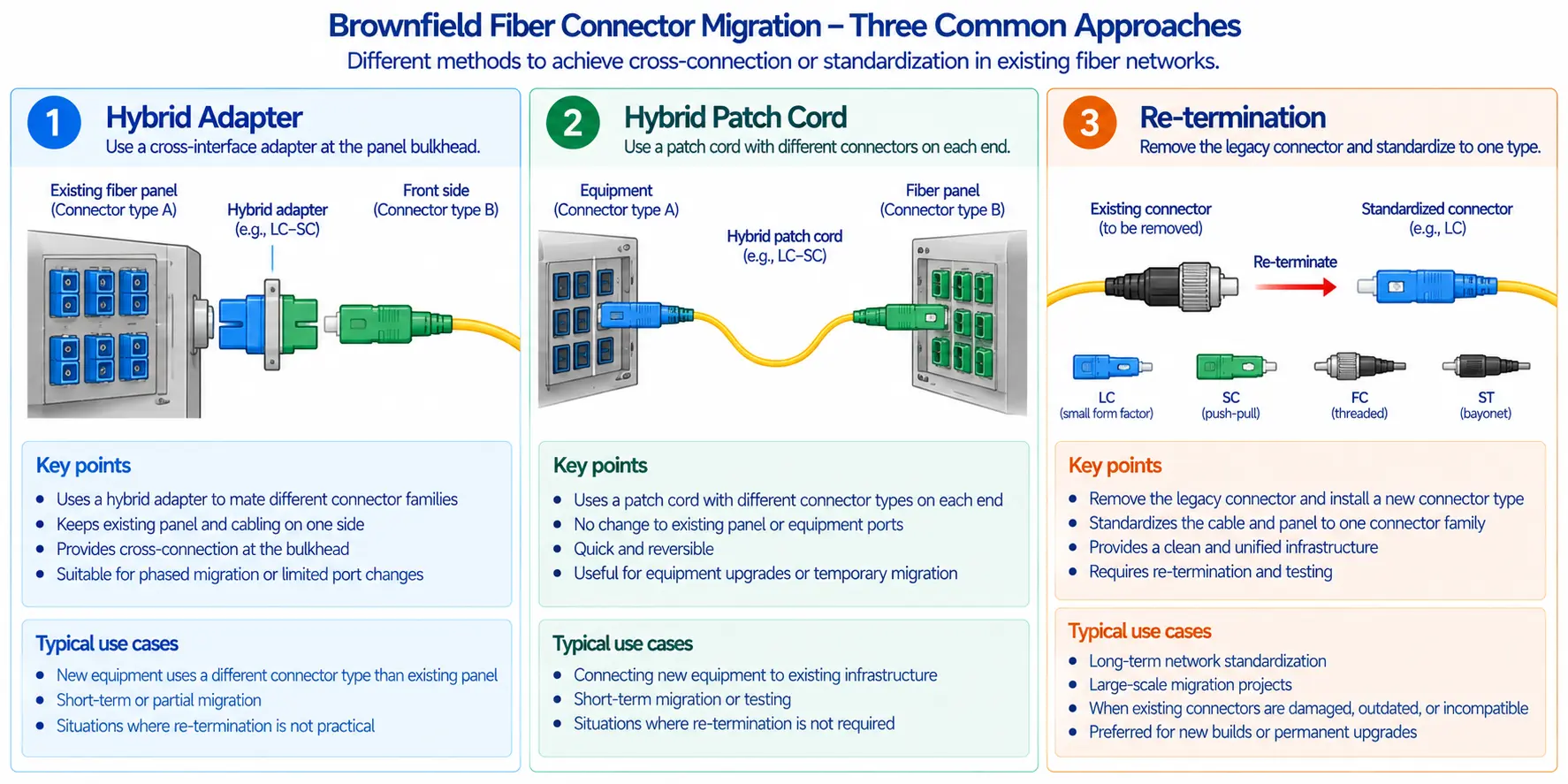
Step 1 - Identify the port connector type. Check the equipment or panel. If the port accepts SC, use SC. If it accepts LC, do not order SC hoping to adapt it - hybrid adapters exist, but they add loss and failure points.
Step 2 - Confirm the polish type. Is the port labeled APC or UPC? Look at the adapter color: green almost always means APC; blue means UPC. If the equipment documentation specifies APC, you must use SC/APC. Mixing polish types is the most damaging mistake you can make with fiber connectors.
Step 3 - Match the fiber mode. Singlemode equipment requires singlemode SC connectors and singlemode fiber. Multimode equipment requires multimode SC connectors. Cross-connecting singlemode connectors to multimode fiber (or vice versa) will cause severe loss or a non-functional link.
Step 4 - Choose simplex or duplex. If the link uses one fiber (common in PON or BiDi applications), use simplex. If the link needs separate transmit and receive fibers, use duplex.
Step 5 - Consider density and future growth. If you are cabling a new rack or panel with dozens of ports, evaluate whether SC still makes sense or whether migrating to LC will save space and simplify future expansion. For a single media converter or a demarc handoff, this question rarely applies.
Quick-Reference: Scenario-to-Connector Guide
| Deployment scenario | Typical SC choice |
|---|---|
| FTTH / GPON subscriber drop | SC/APC, simplex, singlemode (OS2) |
| Telecom demarc or outside plant handoff | SC/APC, simplex or duplex, singlemode |
| Legacy enterprise patch panel maintenance | SC/UPC, duplex, singlemode or multimode (match existing) |
| Copper-to-fiber media converter | SC/UPC or SC/APC (match converter port), simplex or duplex |
| New high-density data center rack | Consider LC instead - SC is usually not the best fit here |
Common Mistakes to Avoid
Mating APC with UPC. This is the single most destructive error. Because the APC ferrule is angled at 8 degrees and the UPC ferrule is flat, forcing them together creates a point contact instead of a full-face contact. The result is high insertion loss, poor return loss, and potential permanent scratching of both endfaces.
Skipping inspection and cleaning before mating. According to Fluke Networks, end-face contamination is the leading cause of fiber network failures. Microscopic dust, oils, and debris cause excess insertion loss and back reflection. Worse, mating a dirty connector can crush particles into the glass, causing permanent damage. The standard practice is to inspect every endface with a fiber scope and clean with lint-free wipes or a one-click cleaner before every connection - including brand-new factory-terminated patch cords.
Confusing simplex and duplex. A simplex patch cord cannot replace a duplex link that requires separate transmit and receive paths. Always verify the link topology before ordering.
Ignoring fiber mode mismatch. Plugging a singlemode SC connector into multimode fiber (or the reverse) will either fail outright or produce unacceptable loss. Jacket color is a helpful guide - yellow for singlemode OS2, orange for OM1/OM2, aqua for OM3/OM4 - but always verify against the cable and equipment specifications.
FAQ
Is the SC connector obsolete?
No. LC has overtaken SC in high-density electronics and data center environments, but SC is still widely deployed in telecom demarcation, FTTH, CATV, media converters, and installed fiber plants worldwide. The connector itself continues to be manufactured, standardized, and supported by all major vendors.
Is SC better than LC?
Neither is universally better. SC is larger, easier to handle in the field, and entrenched in telecom and FTTH infrastructure. LC is about half the size, enables higher port density, and is the standard interface for SFP and SFP+ transceivers. The right choice depends on the equipment port and the network design requirements. Our fiber optic connector types guide covers additional connector options.
Can I connect SC/APC to SC/UPC?
You should not. APC and UPC endfaces have different geometries and are physically incompatible. Forcing a connection between them will degrade signal quality and risk permanent damage to the ferrules.
Are SC connectors used for singlemode or multimode?
Both. SC connectors are manufactured for singlemode (OS2) and multimode (OM1 through OM5) applications. The correct version must match the fiber type and the equipment interface.
What does "SC" stand for?
The abbreviation is most commonly expanded as "subscriber connector" or "standard connector." Some industry references also interpret it as "square connector," reflecting its rectangular housing shape. The connector was developed by NTT in the 1980s.
Where can I find SC connector products?
You can browse SC connector options, including SC/UPC and SC/APC in various configurations, on our product page. For complete patch cord assemblies, visit our fiber optic patch cord section.
Summary
The SC connector is a proven, standards-backed fiber optic interface with a push-pull design, a 2.5 mm zirconia ferrule, and decades of deployment across telecom, FTTH, and enterprise networks. It remains the right choice when you are matching existing SC infrastructure, working at a telecom demarcation point, or deploying in scenarios where field handling ease matters more than port density. For new high-density builds centered on SFP-based switches and transceivers, LC is typically the smarter path forward.
Before purchasing any SC patch cord, pigtail, or connector, confirm these four parameters: port type (SC vs. LC vs. other), polish type (APC vs. UPC), fiber mode (singlemode vs. multimode), and link configuration (simplex vs. duplex). If all four match your equipment and network design, you are on the right path. For further reading on fiber infrastructure, explore our fiber optic cable installation guide or browse the full range of fiber optic connectors available from DIMI Fiber.