


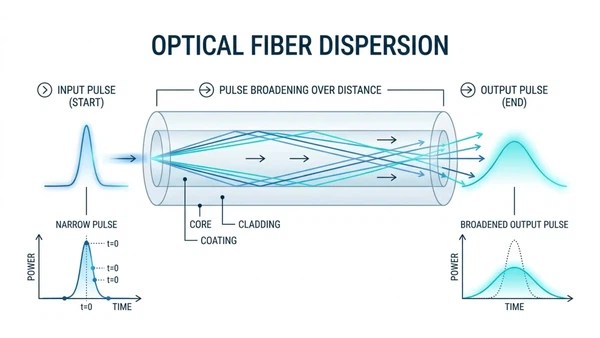
Optical fiber dispersion is the broadening of light pulses as they travel through a fiber, caused by different signal components arriving at the receiver at slightly different times. In fiber optic communication, this broadening reduces signal clarity, limits how far data can travel, and makes it harder for receivers to tell one bit from the next.
But understanding dispersion is not just about physics. The real engineering question is: when does dispersion become a problem you actually need to solve? The answer depends on fiber type, link length, data rate, operating wavelength, and the modulation format your system uses. A 100-meter multimode link inside a data center may never need dispersion management. A 200-km single-mode fiber link carrying 100G traffic almost certainly will.
What Is Optical Fiber Dispersion?
Optical fiber dispersion refers to the way a transmitted pulse spreads out as it propagates through the fiber core. The spreading occurs because the various components of the optical signal - whether different wavelengths, different spatial modes, or different polarization states - do not all travel at exactly the same speed.
This matters because digital optical communication depends on clean, well-separated pulses. When pulses broaden enough to overlap with their neighbors, the receiver can no longer distinguish individual bits reliably. This phenomenon, called inter-symbol interference (ISI), degrades bit error rate (BER) and reduces usable transmission distance. According to the ITU-T G.652 recommendation, which defines standard single-mode fiber parameters, chromatic dispersion accommodation is a key factor in system design for high-bit-rate applications.
Dispersion vs. Attenuation: A Critical Distinction

One of the most common mistakes in evaluating fiber links is confusing dispersion with attenuation. They are fundamentally different impairments:
Attenuation reduces optical power. It is a loss of signal strength over distance, measured in dB/km. Dispersion distorts signal timing. A dispersed signal may still carry enough power to be detected, but its pulses are smeared in time, making the information unreadable.
A fiber link can pass an optical power budget with comfortable margin and still fail because of excessive pulse broadening. That is why experienced engineers evaluate both the power budget and the dispersion budget when designing a link. Understanding insertion loss and return loss is important, but it only covers the power side of the equation.
What Causes Dispersion in Optical Fiber?

Dispersion arises whenever different components of the optical signal experience different propagation delays. The specific mechanism depends on the fiber design and signal characteristics, but the root causes fall into three categories:
Path differences between modes. In multimode fiber, light travels along multiple spatial paths (modes) through the core. Each mode follows a slightly different trajectory, which means they arrive at the receiver at different times. This is the dominant dispersion mechanism in multimode fiber systems.
Wavelength-dependent velocity. Even a narrow-linewidth laser source emits light across a small range of wavelengths. Because the refractive index of glass varies with wavelength - a property described by the Sellmeier equation - different spectral components travel at different speeds. This is the primary dispersion mechanism in single-mode fiber at most operating wavelengths.
Polarization-dependent delay. Real optical fibers are never perfectly symmetric. Stress, bending, and manufacturing imperfections cause birefringence, which means the two orthogonal polarization states of the guided light experience slightly different propagation constants and arrive at different times.
Main Types of Optical Fiber Dispersion
Modal Dispersion (Intermodal Dispersion)

Modal dispersion occurs when multiple guided modes in a multimode fiber propagate with different group velocities. In step-index multimode fiber, the difference in path length between the lowest-order mode (traveling near the axis) and the highest-order mode (bouncing off the cladding boundary at steep angles) can be significant. For a step-index fiber with a core refractive index of 1.48 and a numerical aperture of 0.3, the intermodal delay can exceed 50 ns/km.
Graded-index multimode fiber was developed specifically to reduce this problem. By shaping the refractive index profile so that higher-order modes travel faster near the cladding, graded-index designs reduce modal dispersion by one to two orders of magnitude. This is why modern data center links overwhelmingly use OM3, OM4, or OM5 graded-index multimode fiber rather than step-index designs.
Modal dispersion is essentially eliminated in single-mode fiber, which supports only the fundamental LP01 mode. That is the primary reason single-mode fiber is used for longer-distance and higher-speed transmission.
Chromatic Dispersion
Chromatic dispersion is typically the most important dispersion type in single-mode fiber systems. It is the combined result of two physical mechanisms:
Material dispersion arises because the refractive index of silica glass changes with wavelength. This relationship is well characterized and means that shorter wavelengths generally travel slower than longer wavelengths in the normal dispersion regime (below the zero-dispersion wavelength), and the opposite in the anomalous regime.
Waveguide dispersion arises because the fiber's geometry affects how light is confined. The fraction of optical power traveling in the core versus the cladding depends on wavelength, which introduces an additional wavelength-dependent propagation effect. Engineers can shape waveguide dispersion through fiber design - this is how dispersion-shifted and non-zero dispersion-shifted fibers achieve their modified dispersion characteristics.
For standard single-mode fiber (ITU-T G.652), the zero-dispersion wavelength falls near 1310 nm. At the commonly used 1550 nm transmission window, the chromatic dispersion coefficient is approximately +17 ps/(nm·km), as documented in the Corning SMF-28 fiber specification. Over a 100 km link, that accumulates to roughly 1700 ps/nm - enough to severely distort a 10 Gbps signal if left uncompensated.
Polarization Mode Dispersion (PMD)
Polarization mode dispersion results from the differential group delay (DGD) between the two orthogonal polarization states of the fundamental mode. Unlike chromatic dispersion, which is deterministic and stable, PMD is stochastic - it varies with time, temperature, and mechanical stress on the fiber.
PMD is specified statistically. For modern fibers compliant with ITU-T G.652.D, the PMD link design value is typically below 0.1 ps/√km. This may seem small, but at 40 Gbps and above, where bit periods shrink to 25 ps or less, even modest PMD accumulation becomes relevant. According to industry design guidelines, the maximum tolerable DGD is typically about 10% of the bit period.
For systems running at 10 Gbps over moderate distances, PMD is rarely a limiting factor with modern fiber. At 40 Gbps and 100 Gbps, PMD-aware design - including fiber selection, route engineering, and receiver-side equalization - becomes part of standard practice.
Comparing Dispersion Types at a Glance
| Dispersion Type | Primary Cause | Most Affected Fiber/System | Key Effect | Primary Mitigation |
|---|---|---|---|---|
| Modal dispersion | Multiple modes with different path delays | Multimode fiber (step-index worst, graded-index better) | Pulse spreading from intermodal delay | Use single-mode fiber; use graded-index MMF; control launch conditions |
| Chromatic dispersion | Wavelength-dependent refractive index and waveguide effects | Single-mode fiber, especially long-haul and WDM systems | Pulse broadening and inter-symbol interference | DCF/DCM, fiber Bragg grating, DSP/EDC, fiber and wavelength selection |
| Material dispersion | Wavelength-dependent refractive index of silica | Component of chromatic dispersion in all silica fibers | Spectral components separate in time | Fiber design, wavelength planning |
| Waveguide dispersion | Fiber geometry and mode confinement | Engineered single-mode fibers (DSF, NZ-DSF) | Modifies total chromatic dispersion profile | Fiber profile engineering, dispersion-shifted fiber design |
| PMD | Birefringence from fiber asymmetry and stress | High-speed single-mode systems (≥40 Gbps) | Random, time-varying pulse distortion | Low-PMD fiber, PMD compensation, coherent DSP equalization |
Which Fiber Links Are Most Affected by Dispersion?
Multimode Fiber Links: Modal Dispersion Dominates
In multimode fiber systems - typically used for short-reach applications in data centers, enterprise LANs, and building backbones - modal dispersion is the primary bandwidth limiter. The fiber's modal bandwidth, rated in MHz·km, determines how far and how fast you can transmit before pulse overlap becomes unacceptable.
For example, OM3 fiber has an effective modal bandwidth of 2000 MHz·km at 850 nm with laser-optimized launch, supporting 10 Gbps up to about 300 meters. OM4 extends that to roughly 400 meters. Chromatic dispersion also exists in multimode fiber, but modal effects are almost always the binding constraint at these distances.
Single-Mode Fiber Links: Chromatic Dispersion and PMD
Once modal dispersion is removed by using single-mode fiber, chromatic dispersion becomes the next concern. On short single-mode links (a few kilometers), accumulated chromatic dispersion is usually within system tolerance for 10G and below. As distance increases to tens or hundreds of kilometers, especially at data rates of 10 Gbps and above, dispersion management becomes necessary.
In long-haul and optical transport network (OTN) systems, chromatic dispersion compounds over every kilometer. A 400 km link on G.652 fiber at 1550 nm accumulates roughly 6,800 ps/nm of chromatic dispersion. Without compensation, that level of dispersion would make even a 2.5 Gbps signal unrecoverable.
PMD becomes a relevant factor primarily at 40 Gbps and above, or on older fiber plant where the PMD coefficient may exceed 0.5 ps/√km. Modern fibers have much tighter PMD specifications, and coherent receivers with DSP can tolerate significantly more PMD than traditional direct-detection systems.
DWDM Systems: Every Impairment Compounds
In dense wavelength-division multiplexing (DWDM) systems carrying 40, 80, or more channels across the C-band, dispersion management is not optional. Each channel sits at a different wavelength and accumulates a slightly different amount of chromatic dispersion due to the dispersion slope. This means per-channel compensation may be needed, not just a single bulk correction for the whole band.
Furthermore, in DWDM systems, the interaction between chromatic dispersion and fiber nonlinearities (self-phase modulation, cross-phase modulation, four-wave mixing) creates a more complex optimization problem. System designers often intentionally maintain a small residual dispersion per span to suppress nonlinear crosstalk - which is why "zero dispersion everywhere" is not actually the design goal.
Optical Fiber Dispersion Compensation Methods

Fiber Selection and Wavelength Planning
The most fundamental way to manage dispersion is to make the right choices before any compensating hardware is added. This includes selecting the appropriate fiber type and operating wavelength for the application.
For new deployments, standard G.652.D single-mode fiber remains the most common choice for metro and long-haul networks. For ultra-long-haul submarine or terrestrial links, G.654.E low-loss fiber may be specified. In older networks where G.653 dispersion-shifted fiber was installed, the near-zero dispersion at 1550 nm was an advantage for single-channel systems but became a liability for DWDM due to enhanced four-wave mixing - a lesson that reinforced the importance of maintaining some residual dispersion.
Wavelength planning also matters. Operating near the zero-dispersion wavelength minimizes chromatic dispersion but may increase nonlinear effects. Operating further from zero dispersion allows nonlinear suppression but requires compensation. There is no single "best" wavelength - the right choice depends on the system architecture.
Dispersion Compensating Fiber (DCF) and Dispersion Compensating Modules (DCM)
Dispersion compensating fiber is a specialty fiber engineered to have a large negative chromatic dispersion coefficient, typically in the range of −80 to −120 ps/(nm·km) at 1550 nm. By inserting a calculated length of DCF into the link, the accumulated positive dispersion from the transmission fiber can be offset. In packaged form, this is called a dispersion compensating module (DCM).
As a practical reference: to compensate for 80 km of standard G.652 fiber (which accumulates roughly +1,360 ps/nm of dispersion at 1550 nm), approximately 14 km of DCF with a dispersion coefficient of −95 ps/(nm·km) is required, as noted in the ScienceDirect encyclopedia entry on DCF.
DCF is effective and well-proven, but it introduces trade-offs. The additional fiber adds insertion loss (typically 0.5–0.7 dB/km for DCF, versus 0.2 dB/km for transmission fiber), which may require additional amplification and degrade optical signal-to-noise ratio. DCF also has a smaller effective area than standard fiber, which makes it more susceptible to nonlinear effects. These trade-offs are evaluated using the figure of merit (FOM), defined as the ratio of dispersion coefficient to attenuation.
Chirped Fiber Bragg Gratings (FBG)
A chirped fiber Bragg grating compensates dispersion by reflecting different wavelengths from different positions along the grating, creating a wavelength-dependent delay. Shorter wavelengths may be reflected near the front of the grating while longer wavelengths travel deeper before being reflected, or vice versa. The result is a controllable group delay that can offset chromatic dispersion.
Compared to DCF, FBG-based compensators are compact, have lower insertion loss, and introduce negligible nonlinear distortion, as described in the RP Photonics encyclopedia on dispersion compensation. However, they can suffer from group delay ripple - small periodic variations in the delay characteristic - which can cause signal distortion. Modern manufacturing has largely reduced this issue, but it remains a design consideration for high-performance systems.
Electronic Dispersion Compensation (EDC) and Digital Signal Processing (DSP)
Not all dispersion compensation happens in the optical domain. Electronic dispersion compensation and digital signal processing at the receiver can equalize many of the distortions introduced by fiber dispersion.
In modern coherent optical systems - 100G, 200G, 400G, and beyond - DSP-based compensation is a fundamental part of the receiver architecture. Coherent receivers recover both the amplitude and phase of the optical signal, which gives the DSP engine enough information to digitally reverse chromatic dispersion, PMD, and other linear impairments. This is one reason why coherent 100G systems can often operate over thousands of kilometers of G.652 fiber without any inline optical dispersion compensation modules.
For direct-detection systems at 10G, electronic equalization (feed-forward equalization, maximum-likelihood sequence estimation) can extend dispersion-limited reach, but with more modest improvements than coherent DSP. When upgrading older links, the choice between adding optical compensation (DCM) and upgrading to a coherent transceiver with built-in DSP depends on cost, expected traffic growth, and the existing amplifier infrastructure.
Why "Zero Dispersion" Is Not Always the Goal
Engineers new to fiber optics sometimes assume the ideal link would have zero net dispersion everywhere. In practice, that is often not the best design target. There are two reasons:
First, in WDM systems, operating near zero dispersion enhances certain nonlinear impairments - especially four-wave mixing - which can cause crosstalk between channels. Maintaining a moderate level of local dispersion in each span actually suppresses these effects. The total accumulated dispersion is then compensated at the end of the link or at periodic compensation sites.
Second, overcorrecting dispersion can introduce its own problems. If the compensation is not matched precisely to the actual accumulated dispersion (accounting for temperature variations, fiber aging, and wavelength-dependent dispersion slope), the residual mismatch can degrade performance. This is why the industry uses the term "dispersion management" rather than "dispersion elimination." The goal is to keep net dispersion within an acceptable window, not to force it to exactly zero at every point.
How to Decide if Your Link Needs Dispersion Compensation

Rather than treating dispersion compensation as a default requirement, work through these diagnostic questions:
What is your fiber type? If you are using multimode fiber, modal dispersion is your primary concern, and you address it through fiber grade selection and launch conditions - not through DCMs or FBGs. If you are on single-mode fiber, continue to the next question.
What is the link distance and data rate? As a rough guideline, chromatic dispersion becomes significant for 10 Gbps NRZ signals at approximately 60–80 km on G.652 fiber at 1550 nm. At 2.5 Gbps, the tolerance extends to several hundred kilometers. At 40 Gbps, the dispersion limit drops to roughly 4–6 km without compensation. Higher-order modulation formats (used in 100G+ coherent systems) have their own dispersion tolerance characteristics.
Is this a legacy link or a new build? On legacy fiber plant, adding DCMs at amplifier sites is a common and proven approach. For new deployments, choosing the right fiber type and planning for coherent transceivers with DSP may be more cost-effective than building in optical compensation from the start.
What receiver technology are you using? A coherent receiver with DSP can compensate tens of thousands of ps/nm of chromatic dispersion digitally. A direct-detection receiver has much lower tolerance. The transceiver module specification is a key input to the dispersion budget calculation.
Is PMD a factor? Check your fiber plant's PMD characterization. On modern G.652.D fiber, PMD is unlikely to be a concern below 40 Gbps. On older fiber with unknown PMD history, testing before deployment is advisable.
Practical Scenarios: Applying Dispersion Knowledge to Real Links
Scenario 1: Enterprise Data Center Multimode Link
A campus data center connecting two buildings 150 meters apart using OM4 multimode fiber at 10 Gbps (850 nm). At this distance, modal bandwidth is well within the OM4 specification (4700 MHz·km effective modal bandwidth). Chromatic dispersion at 850 nm is present but negligible at this length. No dedicated dispersion compensation is needed. The primary design consideration is ensuring proper cable installation quality and connector cleanliness to keep insertion loss within budget.
Scenario 2: Metro Single-Mode Link at 10 Gbps
A metropolitan network operator running 10G DWDM over 120 km of G.652.D fiber at 1550 nm. Accumulated chromatic dispersion is approximately 2,040 ps/nm. This exceeds the typical tolerance window for a 10G NRZ direct-detection receiver (roughly 1,000–1,200 ps/nm). The operator deploys a DCM at the mid-span amplifier site to bring net dispersion within tolerance. PMD on this modern fiber is well below 0.1 ps/√km and does not require separate treatment at 10 Gbps.
Scenario 3: Long-Haul Coherent 100G Transport
A long-haul link of 800 km using G.652.D fiber with EDFA amplification every 80 km, carrying 100G DP-QPSK traffic. Total accumulated chromatic dispersion exceeds 13,000 ps/nm. However, the coherent receiver's DSP compensates chromatic dispersion digitally, eliminating the need for inline DCMs. The amplifier site design focuses on noise figure management and OSNR optimization rather than optical dispersion compensation. PMD tolerance of the coherent receiver is typically 20–30 ps of DGD, which is well above what this fiber plant produces. The net result is a simpler, lower-cost amplifier chain compared to a legacy 10G direct-detection system over the same route.
Common Mistakes When Evaluating Fiber Dispersion
Confusing dispersion with attenuation. As discussed above, these are different impairments. A link that passes its optical power budget may still fail from excessive dispersion. Always calculate both budgets.
Treating all dispersion types as interchangeable. Modal dispersion in multimode fiber, chromatic dispersion in single-mode fiber, and PMD are caused by different mechanisms, affect different system types, and require different mitigation strategies. Using a DCM on a multimode link, or trying to fix modal bandwidth issues with a coherent receiver, would be a misapplication of technology.
Assuming compensation is always required. Many fiber optic patch cord connections and short-reach links operate well within their dispersion tolerance. Adding unnecessary compensation hardware increases cost, insertion loss, and system complexity. Always start from the link budget, not from a default assumption.
Ignoring the dispersion slope. In DWDM systems, the chromatic dispersion coefficient varies across the wavelength band. A DCM that perfectly compensates the center channel may leave edge channels with significant residual dispersion. Slope-matched compensation modules or per-channel tunable compensators may be needed for broadband systems.
Overlooking fiber plant records. Accurate knowledge of the installed fiber type, length, and measured dispersion is essential for designing compensation. Assuming generic values when actual plant data is available is a common source of design margin waste or, worse, under-compensation.
Frequently Asked Questions
What is optical fiber dispersion in simple terms?
It is the spreading of light pulses as they travel through fiber, caused by different parts of the signal arriving at different times. The result is blurred pulses that reduce the receiver's ability to recover the transmitted data.
What are the main types of optical fiber dispersion?
The three main categories are modal dispersion (dominant in multimode fiber), chromatic dispersion (dominant in single-mode fiber), and polarization mode dispersion (relevant at high bit rates in single-mode systems). Chromatic dispersion is further composed of material dispersion and waveguide dispersion.
Which type of dispersion matters most in single-mode fiber?
Chromatic dispersion is the primary concern for most single-mode fiber links. PMD becomes additionally relevant at 40 Gbps and above, particularly on older fiber with higher PMD coefficients. Modal dispersion does not occur in single-mode fiber since only one mode propagates.
How is chromatic dispersion compensated?
The three main approaches are: optical compensation using DCF/DCM or fiber Bragg gratings; electronic compensation using DSP at the receiver (especially in coherent systems); and prevention through appropriate fiber type selection and wavelength planning. In modern networks, DSP-based compensation in coherent optical transceivers is increasingly the default approach for high-speed links.
Does every fiber link need dispersion compensation?
No. Short links and lower-speed systems often operate well within their dispersion tolerance without any dedicated compensation. The need depends on the combined effect of fiber type, distance, data rate, wavelength, and receiver sensitivity. A proper link budget calculation should always precede any compensation decisions.
What causes dispersion in optical fiber?
Dispersion is caused by differences in propagation speed among the components of the optical signal. In multimode fiber, different spatial modes travel different paths. In single-mode fiber, different wavelengths travel at different speeds due to the material and waveguide properties of the fiber. Birefringence in the fiber causes the two polarization states to experience different delays.
Is zero dispersion always the ideal target?
Not in practice. In WDM systems, a small amount of local dispersion in each fiber span helps suppress nonlinear impairments like four-wave mixing. The engineering goal is to manage net dispersion within an acceptable window at the receiver, not to eliminate it at every point in the link.
Conclusion
Optical fiber dispersion is one of the fundamental transmission impairments in fiber optic networks, alongside attenuation and nonlinear effects. Understanding which type of dispersion affects your specific system - modal, chromatic, or PMD - is the first step toward effective management. The next step is matching the right mitigation strategy to the link: fiber selection, optical compensation, electronic compensation, or simply confirming that no compensation is needed.
For engineers working with single-mode fiber in metro and long-haul networks, chromatic dispersion management remains a core design discipline. For those deploying multimode fiber in shorter-reach applications, understanding modal bandwidth limitations is equally important. And as coherent DSP continues to advance, the boundary between "dispersion-limited" and "DSP-manageable" keeps moving - making it more important than ever to approach dispersion as a system-level engineering problem rather than a single-component fix.


