Quick Answer: OSFP or OSFP-XD?
- Choose OSFP (OSFP1600) if you already operate 400G or 800G OSFP platforms, want ecosystem continuity, and your switch roadmap supports 8x200G electrical lanes.
- Choose OSFP-XD if you are designing a new high-density AI or HPC switch, need maximum front-panel port density, and want a clearer path toward 3.2T using 16 electrical lanes.
OSFP-XD is not a drop-in replacement for OSFP. It is a different mechanical and electrical form factor with its own cage, paddlecard, and keying. Any migration plan should start with switch port type, thermal budget, and vendor qualification - not with the module label.
OSFP vs OSFP-XD: Key Differences at a Glance
- Lane architecture: OSFP reaches 1.6T with 8x200G; OSFP-XD reaches 1.6T with 16x100G and can scale to 3.2T with 16x200G.
- Mechanical compatibility: OSFP-XD uses a thicker paddlecard, different module height, and keyed cages. It does not fit existing OSFP ports.
- Front-panel density: OSFP-XD approximately doubles density versus 8-lane OSFP or QSFP-DD at comparable throughput.
- Power headroom: OSFP-XD targets up to 40W per module, designed for future high-power 1.6T and 3.2T optics.
- Ecosystem maturity: OSFP benefits from existing 400G/800G deployments; OSFP-XD is newer and depends on systems designed around it from day one.

What Is 1.6T OSFP (OSFP1600)?
OSFP1600, commonly called 1.6T OSFP, is an evolution of the OSFP form factor already widely deployed in 400G and 800G optics. According to the OSFP MSA, OSFP1600 supports 8x200 Gb/s host electrical interfaces while retaining mechanical continuity with OSFP800.
The engineering logic is straightforward: rather than adding lanes, OSFP1600 doubles lane speed from 100G to 200G. Eight lanes at 200G each deliver 1.6T in the same general module envelope. For operators already running OSFP platforms, this preserves cage design, thermal integration, and - in many cases - the broader transceiver ecosystem they have already qualified.
What this really means for procurement: the 1.6T OSFP upgrade is gated less by the module and more by switch ASIC readiness for 200G PAM4 electrical signaling, PCB routing quality, and SerDes qualification. The module is only one piece of the chain.
What Is OSFP-XD?
OSFP-XD stands for OSFP eXtra Dense. It was developed to support 1.6T optics using the mature 100G electrical lane ecosystem and to provide a credible roadmap to 3.2T. Instead of eight lanes at 200G, OSFP-XD uses sixteen lanes at 100G today, and is engineered to scale to sixteen lanes at 200G for 3.2T in the future.
The OSFP MSA describes three design priorities for OSFP-XD: support for up to 40W module power, passive copper cable compatibility for short-reach connections, and system density of 32 ports in 1RU or 64 ports in 2U. These specifications are not incidental - they directly target AI cluster leaf-spine architectures where GPU-to-GPU bandwidth and rack space pressure every design decision.
Critically, OSFP-XD is not a taller or denser OSFP. It is a separate mechanical and electrical form factor. The paddlecard is thicker, module height changes, and keying features are added to the cage so OSFP-XD modules cannot be inserted into OSFP ports, and vice versa.
OSFP vs OSFP-XD: Detailed Comparison
| Feature | 1.6T OSFP (OSFP1600) | OSFP-XD |
|---|---|---|
| Full name | OSFP1600 / 1.6T OSFP | OSFP eXtra Dense |
| Lane architecture | 8x200G | 16x100G for 1.6T; 16x200G for 3.2T |
| Best fit | Incremental 800G-to-1.6T migration | New high-density AI/HPC switch design |
| Port compatibility | Mechanically aligned with existing OSFP cages | Separate cage, keyed, not interchangeable with OSFP |
| Front-panel density | High | Approximately 2x OSFP / QSFP-DD at same throughput |
| Power budget | Strong, integrated heatsink | Targeted up to 40W for high-power optics |
| Copper cable support | DAC / AEC supported | Designed around dense passive copper from the start |
| Typical deployment | 800G OSFP switch refresh, AI/HPC optics retrofit | Greenfield 1RU AI leaf switches, 3.2T-ready systems |
| Primary risk | Requires 200G electrical lane readiness | Requires OSFP-XD-specific ports, cages, thermal design |
Design Differences That Matter in Real Deployments
Electrical Lane Architecture
The core divergence between the two form factors is how they reach 1.6T. OSFP pushes lane speed to 200G on eight lanes; OSFP-XD keeps lanes at 100G but doubles the count to sixteen. For network architects, this means the decision is really about which electrical signaling ecosystem is more mature in your target timeframe. 200G PAM4 SerDes adoption gates OSFP1600; switch ASIC channel count and PCB breakout complexity gate OSFP-XD.
Mechanical Compatibility
A common procurement mistake is assuming OSFP-XD is simply a denser OSFP. It is not. OSFP-XD changes paddlecard thickness and module height, and the OSFP MSA specifications define keying features that prevent incorrect insertion. If your switch has OSFP ports, it will not accept OSFP-XD modules - and treating the two as interchangeable during spare parts planning or multi-vendor sourcing can create real field failures.
Thermal and Power Budget
At 1.6T, power and heat stop being secondary concerns. OSFP already benefits from an integrated heatsink and proven airflow integration. OSFP-XD pushes further, engineered for up to 40W per module to accommodate future high-power optics and active copper solutions. In practice, that means the following items need to be verified before any module order is placed:
- Maximum per-port module power supported by the switch firmware
- Airflow direction (port-to-power, power-to-port) and cooling capacity at full load
- Rack-level ambient intake temperature and exhaust management
- Media type mix: optical, DAC, AEC, or AOC, and their respective power profiles
- Whether vendor qualification testing covers your target module in your exact switch SKU

Front-Panel Density
OSFP-XD's headline advantage is density. By moving from 8 to 16 electrical lanes per module, it roughly doubles front-panel bandwidth per rack unit compared with 8-lane OSFP or QSFP-DD form factors. In AI and HPC networks, where leaf switches may need to fan out hundreds of GPU links within a single rack, this density directly translates into fewer switches, shorter cable runs, and lower overall network cost.
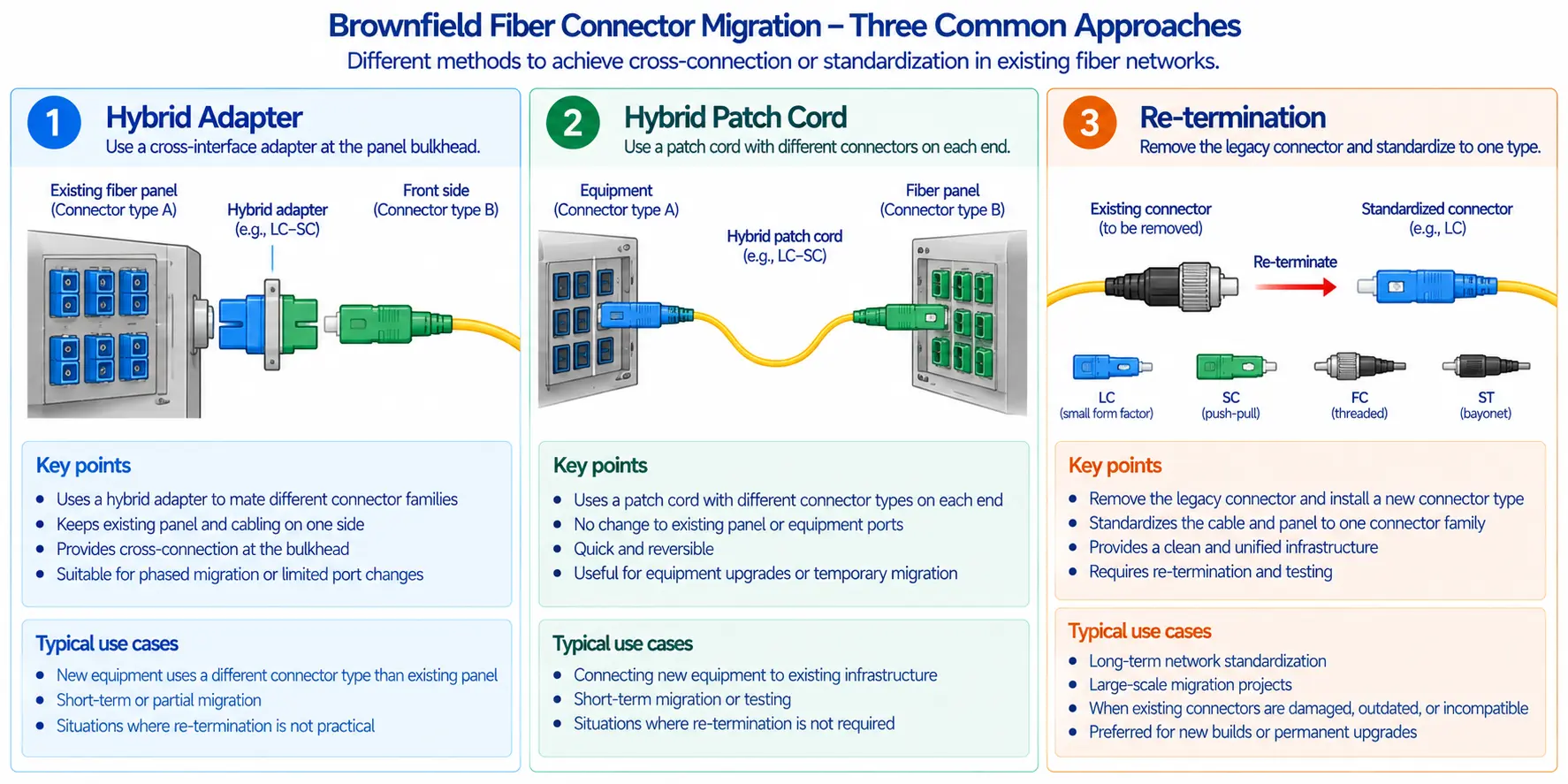
For brownfield deployments where the existing platform is OSFP-based, the density gain alone rarely justifies changing form factors. For greenfield 1RU AI leaf designs targeting 3.2T upgradeability, OSFP-XD's density math usually wins.
Copper Cable and Short-Reach Interconnects
Short-reach copper - DAC (Direct Attach Cable) and AEC (Active Electrical Cable) - remains the most power-efficient option for rack-internal and adjacent-rack GPU connections. OSFP-XD was designed with passive copper support as an explicit objective, which matters for high-density racks where dozens of short links run between servers and leaf switches.
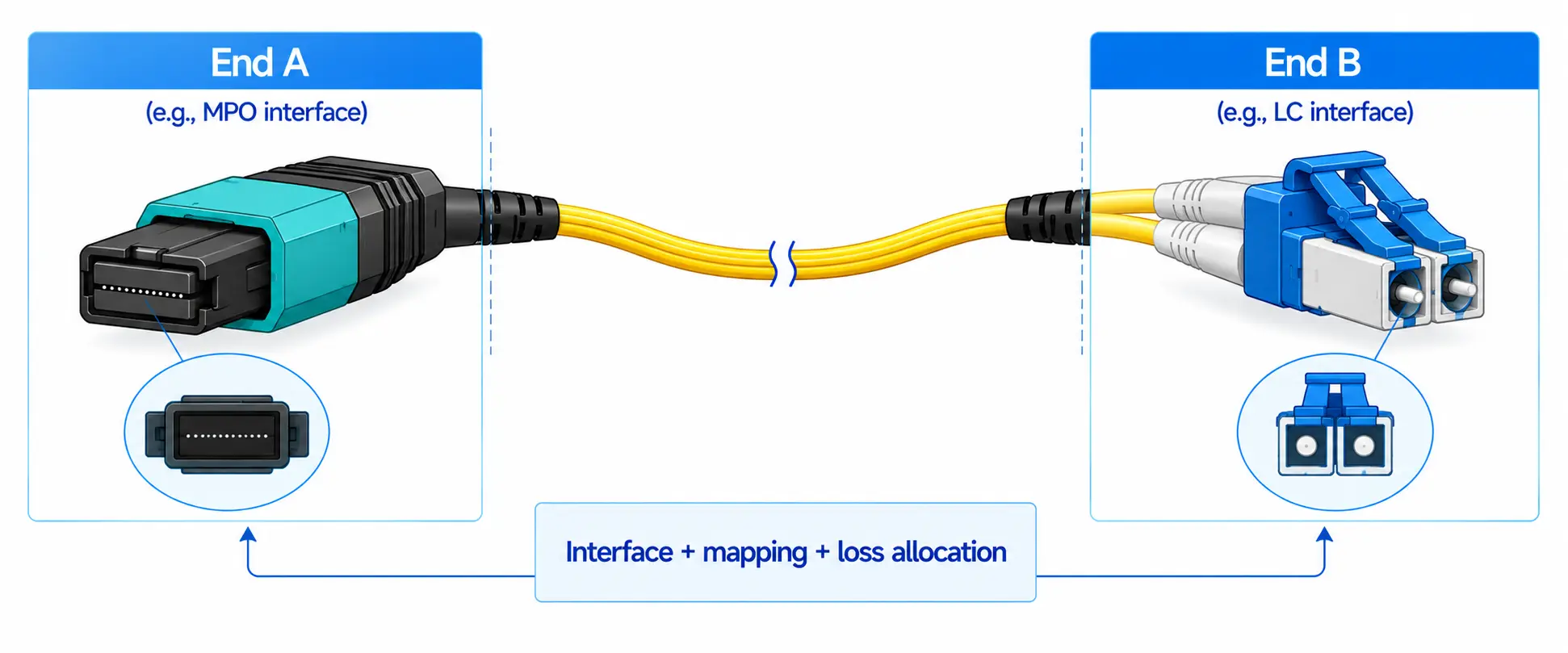
That said, a form factor alone does not guarantee a workable copper solution. Cable length, insertion loss, bend radius, connector quality, and airflow all contribute. For longer reaches that still need to stay structured and manageable, many operators pair 1.6T transceivers with high-density MPO/MTP fiber cabling and MPO breakout cables to split one transceiver port into multiple lower-speed links.
How to Decide: OSFP or OSFP-XD
| Decision Factor | Lean Toward OSFP | Lean Toward OSFP-XD |
|---|---|---|
| Existing 800G OSFP infrastructure | Yes - preserves investment | No - would mean a port architecture change |
| 200G electrical lane readiness on switch ASIC | Required | Not required for 1.6T |
| Front-panel density priority | Moderate | Maximum |
| 3.2T roadmap within 2–3 years | Limited by 8-lane architecture | Direct path via 16x200G |
| Passive DAC-heavy rack design | Supported | Explicit design target |
| Cage, firmware, and spares compatibility risk | Lower | Higher - requires full system qualification |
| Deployment type | Incremental upgrade of existing fabric | Greenfield AI/HPC high-density platform |

Before You Choose
Procurement teams should not rely on marketing datasheets alone. Before issuing a 1.6T module order, confirm the following with your switch vendor in writing:
- Which port type is physically installed - OSFP, OSFP-XD, or dual-support cages?
- What is the maximum per-port power budget supported by the current firmware, and does it match the target module's power class?
- Is the switch's 200G PAM4 electrical interface qualified for the exact OSFP1600 module you plan to order, or only for a small approved vendor list?
- What airflow direction does your rack support, and does the module SKU match it?
- Which DAC, AEC, and optical media are on the vendor's qualified module list for this switch model?
- Is there a defined 3.2T migration path for this platform, and does it retain the same cage and firmware architecture?
These questions cost nothing to ask and regularly surface incompatibilities that would otherwise only appear at rack turn-up.
When Should You Choose OSFP?
1.6T OSFP is usually the better fit when:
- Your network already runs 400G or 800G OSFP platforms and you want to preserve operational continuity.
- Your switch silicon roadmap supports 200G PAM4 electrical signaling within your project timeline.
- You need 1.6T bandwidth but do not need the absolute maximum front-panel density.
- Your spare parts, NOC tooling, and optics qualification workflows are already built around OSFP.
- Your reach requirements depend on mature optical media - including single-mode fiber for longer links and OM4/OM5 multimode fiber for short reaches.
For the majority of operators upgrading from 800G infrastructure, OSFP is the lower-risk path.
When Should You Choose OSFP-XD?
OSFP-XD becomes the stronger choice when:
- You are designing new high-density leaf switches from scratch, especially 1RU AI/HPC platforms.
- You want to reach 1.6T today using mature 100G electrical lanes rather than waiting on 200G SerDes qualification.
- You want a pre-committed path to 3.2T without another cage transition.
- Your architecture depends heavily on short-reach DAC or AEC inside racks for GPU interconnect.
- Rack space, cable volume, and port density are first-order constraints, not secondary optimizations.
Network teams evaluating OSFP-XD should engage the switch vendor early in the design phase. Retrofitting OSFP-XD into an OSFP-based chassis is not feasible - the mechanical and thermal design must be built around it.
Common Mistakes When Comparing OSFP and OSFP-XD
Mistake 1: Comparing Only Bandwidth
Both form factors can deliver 1.6T, but they get there through different electrical architectures. Two modules with identical throughput numbers can still demand entirely different switch silicon, PCB routing, and SerDes qualification.
Mistake 2: Assuming Backward Compatibility
OSFP-XD is mechanically distinct from OSFP. An OSFP-XD module will not insert into an OSFP port, and the cages are keyed specifically to prevent this. Spare parts strategy, second-sourcing plans, and cross-site standardization all need to account for this.
Mistake 3: Underestimating Thermal Limits
A module that meets datasheet power numbers can still exceed the practical thermal budget of a dense switch at full load. Power at the module is not the same as power the rack can dissipate.
Mistake 4: Treating Form Factor as the Whole Decision
The module is one component of a system that includes switch ASIC, PCB, connector, fiber or copper media, firmware, and qualification testing. Strong form factor choice does not compensate for weak system integration.
Mistake 5: Skipping the Fiber Plant
High-speed transceivers are only as good as the cabling behind them. Insertion loss, connector quality, and MPO cable selection can make or break a 1.6T link even when the modules themselves are perfect.
Final Recommendation
There is no single correct answer - there is only the answer that fits your roadmap.
If your goal is a practical, lower-risk upgrade from existing OSFP 400G or 800G systems, 1.6T OSFP is usually the more natural path. It preserves ecosystem continuity and limits the number of variables changing at once.
If your goal is maximum density, high-power headroom, and a clean path to 3.2T in a greenfield AI or HPC build, OSFP-XD is the more forward-looking choice - but only when the switch platform is designed around it from the start.
Before committing, confirm three things with engineering and procurement: the exact switch port type, the full thermal budget at target load, and the qualified media list. The module label on the box matters far less than these three.
Frequently Asked Questions
Is OSFP-XD backward compatible with OSFP ports?
No. OSFP-XD uses a different paddlecard thickness, module height, and keying. It is not insertable into an OSFP cage, and an OSFP module will not work in an OSFP-XD cage. Any plan that assumes interchangeability is incorrect.
What is the difference between OSFP1600 and OSFP-XD?
OSFP1600 (also called 1.6T OSFP) reaches 1.6T using 8 electrical lanes at 200G each and is mechanically aligned with existing OSFP800. OSFP-XD reaches 1.6T using 16 electrical lanes at 100G each in a denser mechanical form factor that is not OSFP-compatible.
Why does OSFP use 8x200G while OSFP-XD uses 16x100G?
They optimize for different constraints. OSFP prioritizes mechanical continuity with existing 800G platforms and rides the 200G PAM4 SerDes transition. OSFP-XD prioritizes front-panel density and future 3.2T scalability, which is easier to achieve by doubling lanes rather than doubling lane speed.
Which form factor is better for AI data centers?
It depends on the build stage. Existing AI clusters upgrading from 800G OSFP typically favor OSFP1600 for continuity. Greenfield AI leaf-spine designs targeting maximum GPU-to-GPU bandwidth per rack unit, and planning for 3.2T, more often favor OSFP-XD.
Does OSFP-XD support 3.2T?
Yes. OSFP-XD's 16-lane architecture is designed to support 3.2T by moving each lane from 100G to 200G. This gives it a clearer 3.2T roadmap than 8-lane OSFP within the same cage generation.
What power budget do OSFP-XD modules require?
The OSFP MSA specifies OSFP-XD designs targeting up to 40W per module to accommodate future high-power 1.6T and 3.2T optics. Actual supported power depends on the specific switch platform, firmware, and thermal design.
Can I use the same MPO fiber cabling for OSFP and OSFP-XD?
The fiber plant itself - including MPO/MTP trunk cables and patch cords - is largely independent of the transceiver form factor. What matters is fiber type (single-mode or multimode), connector polarity, fiber count per link, and insertion loss budget, all of which must match the specific 1.6T optical module's reach and wavelength plan rather than the module's mechanical form factor.