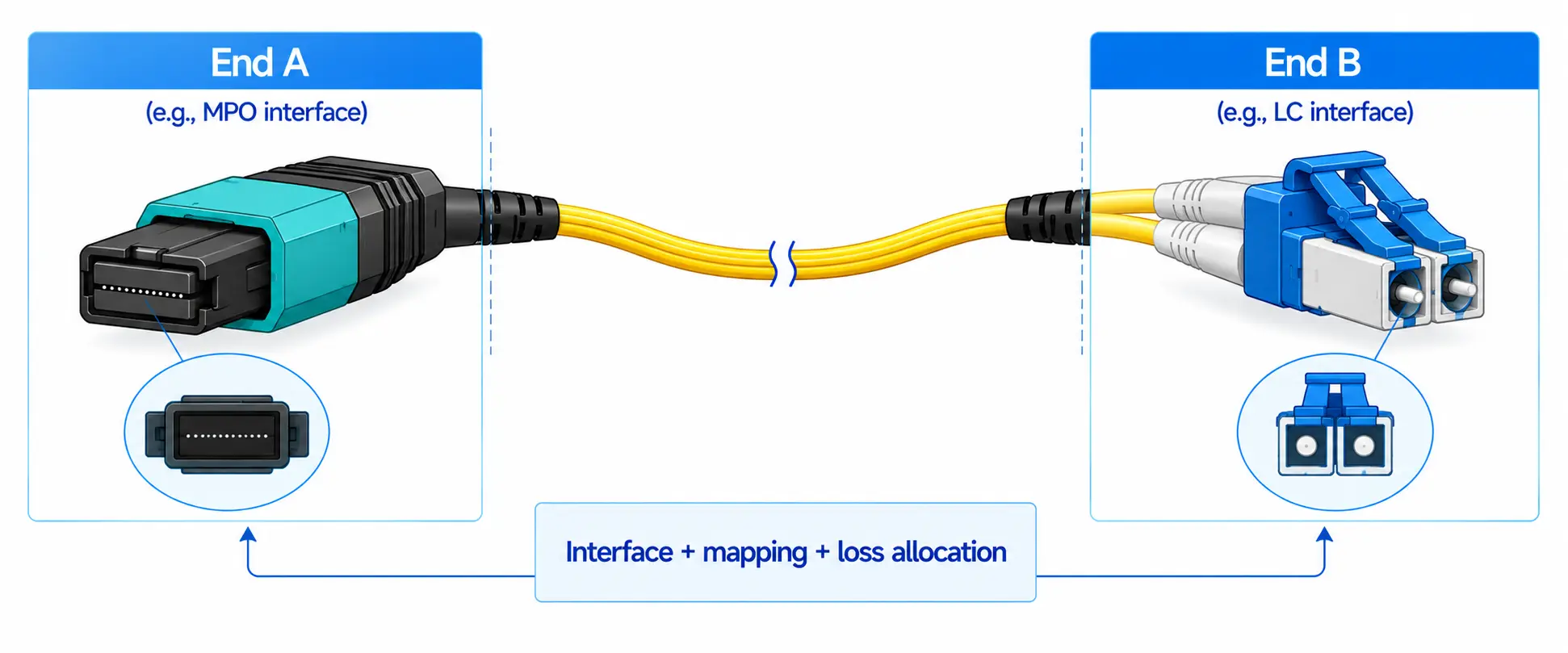
If you are comparing MPO vs MTP connectors, the first thing to understand is that they are not two unrelated connector families. MPO describes a standardized multi-fiber connector interface, while MTP® is US Conec's branded, engineered implementation of the MPO format.
That distinction changes the buying decision. The practical question is not whether the word "MTP" is automatically better than "MPO." It is whether a cable assembly matches the equipment interface, fiber count, keying, pinned or unpinned configuration, polarity, fiber type, end-face geometry, and optical loss budget-and whether any MTP-specific feature justifies its cost.
Should You Choose MPO or MTP?
- Choose genuine MTP when the equipment, customer specification, qualification list, or project documentation explicitly requires MTP components.
- A qualified MPO assembly may be sufficient when it matches the required standardized interface and meets the project's insertion-loss, return-loss, mechanical, environmental, and lifecycle requirements.
- Do not choose from Ethernet speed alone. 400G and 800G optics can use different connector interfaces, including MPO-12, MPO-16, dual MPO-12, and duplex LC.
- Do not compare brand labels instead of specifications. Compare the guaranteed performance of the complete cable assemblies you are actually buying.
For related connector terminology and formats, see this fiber optic connector types guide.

MPO vs MTP: Key Differences at a Glance
| Factor | MPO | MTP® |
|---|---|---|
| What it is | A standardized multi-fiber connector family/interface | A US Conec brand of MPO connector |
| Standards relationship | Defined by MPO interface standards | Designed to comply with corresponding MPO interface standards |
| Intermateability | Depends on matching standardized interface, fiber-count family, keying, and gender | Can intermate with corresponding standards-compliant MPO interfaces |
| Mechanical design | Varies by manufacturer and product | Includes defined US Conec design features such as ferrule float and controlled guide-pin geometry |
| Optical performance | Varies by manufacturer, ferrule grade, polishing, termination, and test specification | Available in defined MTP performance grades; actual assembly specification still matters |
| Polarity | Depends on the cabling architecture | Depends on the cabling architecture; some MTP products add field configurability |
| Cost | Broad supplier and performance range | Often carries a brand/component premium that should be justified by a project requirement |
| Best buying method | Specify the complete assembly and verify guaranteed performance | Specify genuine MTP only when its brand, performance, serviceability, or qualification value is required |
What Is an MPO Connector?
MPO stands for Multi-Fiber Push-On. It is a multi-fiber optical connector family used in high-density structured cabling, parallel-optics links, trunks, cassettes, breakout assemblies, and direct equipment connections. The IEC 61754-7-1 standard, for example, defines interface dimensions for one-row MPO connector variants.
An MPO ferrule aligns multiple fibers at the same time, which makes the format useful where density and installation speed matter. Common applications include data-center backbone trunks, cassette systems, parallel multimode links, parallel single-mode links, and high-density transceiver connections.
However, "MPO" by itself is not a complete cable specification. MPO assemblies can differ in fiber count, keying, gender, polarity, fiber type, end-face geometry, cable construction, and optical performance. If you are evaluating available assembly formats, start with the broader MPO/MTP fiber optic cable family and then narrow the configuration to the equipment requirement.
MPO-12 and MPO-16 Are Not the Same Interface
Traditional MPO systems commonly use one-row 12-position ferrules, although 8 active fibers may be used in many parallel-optics applications. Newer systems can also use 16-fiber MPO interfaces.
An MPO-16 interface is not simply an MPO-12 connector with four more fibers. It uses different keying. US Conec's MTP-16 product documentation identifies offset keying and compliance with MPO-16 interface standards. This is why a purchase request that says only "MPO cable" is inadequate when the active equipment requires a specific MPO-16 interface.

What Is an MTP Connector?
MTP® is a registered US Conec brand of MPO connector. US Conec describes its MTP connector portfolio as MPO-format solutions that incorporate patented mechanical features, enhanced precision, and defined performance options.
The manufacturer's documentation describes features such as a floating ferrule, tightly controlled elliptical guide-pin tips, a metal pin clamp, spring geometry intended to provide fiber-ribbon clearance, and removable housing on applicable configurations. These are real product-design differences, but they do not justify treating every non-MTP MPO connector as a single lower-performance category.
MPO products vary significantly by supplier, ferrule quality, termination process, polishing, test method, process control, and guaranteed loss. The correct comparison is therefore between qualified products, not between two labels in isolation.
Is MTP the Same as MPO?
Not exactly. A useful shorthand is:
MTP is an MPO connector platform, but MPO is the broader standardized connector category.
US Conec states in its MTP technical FAQ that MTP connectors comply with applicable MPO connector standards and are intermateable with corresponding compliant MPO-style connectors.

Are MPO and MTP Connectors Compatible?
They can be, when the interfaces actually match. Physical intermateability does not mean any MPO or MTP cable can be connected to any other MPO-style interface without checking the rest of the design.
Before mating or ordering an assembly, verify the following:
- fiber-count family, such as MPO-12-family or MPO-16;
- keying and key orientation;
- pinned or unpinned configuration;
- polarity and lane mapping;
- multimode or single-mode fiber;
- UPC or APC end-face requirement where applicable;
- maximum allowed insertion loss and any return-loss requirement.
Pinned vs Unpinned: Gender Must Match the Link Design
MPO-family connectors use guide pins to align the MT ferrules. A pinned connector is often called male, while an unpinned connector is often called female. A mated connection requires the correct pinned/unpinned relationship.
Do not assume that every transceiver or trunk uses the same gender. Equipment documentation should control the choice. For example, Cisco's current 800G OSFP data sheet specifies pinned MPO ports for the MPO-equipped modules listed there and therefore requires unpinned cable connectors at those ports.
Polarity Is a Channel Design Issue
Polarity determines how transmit and receive lanes map through the complete cabling system. Type A, Type B, and Type C methods are commonly discussed in structured cabling, but the correct implementation depends on adapters, cassettes, trunks, harnesses, and active equipment.
An MTP cable with the wrong polarity is still the wrong cable. MTP does not have a separate fundamental polarity standard. However, some products add serviceability features. The MTP PRO connector, for example, supports defined field pin and polarity reconfiguration.

Does MTP Always Have Lower Insertion Loss Than MPO?
No universal rule supports that conclusion because MPO is not a single optical-performance grade. Two MPO assemblies from different suppliers can have different ferrule tolerances, polishing quality, insertion-loss guarantees, return-loss performance, manufacturing controls, and test methods.
For channel design, compare:
- maximum guaranteed insertion loss for the complete assembly;
- return loss where the application makes it relevant;
- test wavelength and test method;
- random-mating or reference-mating assumptions, if stated;
- environmental and lifecycle qualifications;
- actual test reports for the assemblies supplied.
If you need a refresher on how connector, splice, and fiber attenuation accumulate, see this guide to insertion loss in fiber networks.
Why the Link Budget Matters More Than the Connector Name
Every passive element consumes part of the optical channel's allowable loss. High-speed multimode applications can leave relatively little margin for connectors and cassettes. As one published example, Fluke Networks lists 40GBASE-SR4 loss limits of 1.9 dB for OM3 and 1.5 dB for OM4 in its MultiFiber Pro guidance.
Those figures are application-channel limits, not generic MPO connector specifications. If two qualified cable assemblies both fit inside the project's loss budget with adequate margin, factors such as availability, serviceability, approved-vendor status, lifecycle needs, and cost may become more important than the connector brand.
MPO vs MTP Cost: When Is the MTP Premium Worth It?
MTP assemblies often cost more than broadly sourced MPO alternatives because the MTP name identifies a specific component platform with defined design features, performance grades, manufacturing controls, and licensing/brand value. The exact premium varies by configuration and supplier, so a fixed percentage is not useful for engineering decisions.
The premium is easier to justify when one or more of these conditions apply:
- the customer, OEM, or project specification explicitly requires genuine MTP components;
- a selected MTP performance grade provides the guaranteed loss needed for the link;
- field polarity or pin configurability reduces spare inventory or rework;
- repeated mating, maintenance, or reconfiguration is expected;
- the organization has standardized qualification and maintenance procedures around MTP components;
- the component platform reduces operational risk enough to offset higher initial BOM cost.
A standards-compliant MPO assembly can be the better commercial choice when it meets the same interface, optical, environmental, and lifecycle requirements without adding features the project will not use.
Compare Total Cost, Not Only Cable Price
For a fair comparison, include the initial assembly price plus testing, certification, spares, reconfiguration labor, replacement risk, lead time, and approved-vendor requirements. A cheaper cable that causes polarity rework or fails the loss budget is not actually cheaper. Likewise, paying a premium for a brand feature that the link does not need simply increases BOM cost.
MPO vs MTP for 40G, 100G, 400G, and 800G
Ethernet speed does not uniquely determine the connector. The transceiver's optical architecture does.
This becomes obvious at 400G. Cisco's 400G QSFP-DD transceiver data sheet lists, among other examples:
- QDD-400G-SR8-S with an MPO-16 APC multimode interface;
- QDD-400G-SR4.2-BD with an MPO-12 UPC multimode interface;
- QDD-400G-DR4-S with an MPO-12 APC single-mode interface;
- QDD-400G-FR4-S with a duplex LC single-mode interface.
The same principle applies at 800G. Cisco's 800G OSFP transceiver data sheet includes modules using dual MPO-12 APC, MPO-16 APC, and dual duplex LC interfaces.
So "I need an 800G cable" is not an actionable cable specification. You need the exact optic part number and interface. For broader module context, this QSFP-DD technical overview can help connect transceiver selection with cabling requirements.

How to Choose Between MPO and MTP
Step 1: Identify the Exact Equipment Interface
Start with the transceiver, switch, patch panel, cassette, or device documentation. Record the exact part number and connector interface. Determine whether the port requires a traditional MPO-family interface, MPO-16, duplex LC, or another connector.
Step 2: Confirm Fiber Type and Active Fiber Count
Verify whether the application uses multimode or single-mode fiber and how many fibers are actually active. An MPO ferrule may have more positions than the optical application uses.
Step 3: Verify Keying, Gender, Polarity, and End-Face Geometry
Document the required key orientation, pinned/unpinned status at both ends, end-to-end polarity, adapter orientation, breakout mapping, and UPC/APC requirement. These parameters determine whether the assembly can physically and optically work in the intended channel.
Step 4: Calculate the Loss Budget
Add the expected loss from fiber attenuation, every mated connector pair, cassettes or modules, splices, and other passive components. Compare that total with the maximum channel loss permitted by the optical application and leave practical engineering margin.
Step 5: Compare Actual Assembly Specifications
Request maximum guaranteed insertion loss, return loss where applicable, test method, qualification data, and production test documentation. If a lower-loss MTP grade is required to meet the channel budget, specify it. If a qualified MPO assembly provides adequate margin, the MTP brand may not be technically necessary.
Step 6: Consider Operations and Lifecycle
Think beyond first installation. Will the connection be repeatedly moved? Does the site need field polarity changes? Is the same connector platform used across many facilities? Are spares and technician training standardized?
US Conec states in its MTP FAQ that, under normal use and proper cleaning, MTP connectors can survive well over 1,000 mate/demate cycles. Treat that as a manufacturer-specific durability statement rather than a claim about every MPO product.
Step 7: Choose the Cable Construction
The connector decision is only part of the assembly. A project may need a patch cord, trunk, harness, or breakout cable. For the practical differences between these formats, see the MPO cable types and selection guide.
For backbone and cross-connect designs, MPO/MTP trunk cables are commonly used to carry multiple fibers between panels or equipment areas. Where parallel lanes need to fan out to individual duplex or simplex interfaces, an MPO/MTP breakout cable may be more appropriate.
Common MPO/MTP Buying Mistakes
Ordering by Connector Name Alone
"12-fiber MTP cable, 10 meters" is still incomplete. It does not define polarity, gender, key orientation, fiber type, end-face geometry, loss grade, jacket rating, or the connector required at the opposite end.
Confusing MPO-12 and MPO-16
They are different interface families with different keying. Confirm the transceiver interface before ordering or reusing installed cabling.
Assuming Every MPO Has the Same Optical Performance
MPO is an interface category, not a universal insertion-loss grade. Use the supplier's guaranteed maximum values and test documentation.
Designing With Typical Instead of Maximum Loss
Typical performance describes what a product often achieves. Worst-case channel design should use the appropriate guaranteed limits unless the engineering method explicitly allows something else.
Ignoring Inspection and Cleaning
Multi-fiber ferrules expose many optical interfaces in one connector, so contamination can affect several lanes at once. Fluke Networks' guidance on cleaning and inspecting MPO/MTP connectors recommends cleaning before connection and inspecting to verify the result. Use tools and probe tips designed for multi-fiber connectors.
Illustrative Procurement Scenario
Consider a team ordering a replacement link from a purchasing note that says only "12-fiber MTP cable." The cable arrives with the correct fiber count and connector brand but the wrong pinned/unpinned configuration for the transceiver ports. The connectors cannot form the intended mated pair, so the installation stops even though the product description looked superficially correct.
The fix is not to specify a more expensive connector. The fix is to specify the complete link: interface at each end, fiber count, gender, keying, polarity, fiber type, end-face geometry, length, cable construction, and optical performance.
FAQ
Is MTP the Same as MPO?
No. MPO is the standardized connector family. MTP® is US Conec's branded MPO connector platform. MTP fits within the broader MPO category.
Can an MTP Connector Plug Into an MPO Connector?
Corresponding standards-compliant MTP and MPO interfaces can intermate, but the fiber-count family, keying, pinned/unpinned configuration, polarity, fiber type, and optical requirements must still match.
Is MTP Always Better Than MPO?
Not for every project. MTP includes defined engineering features and performance options, but a qualified MPO assembly can be fully appropriate when it meets all interface, optical, mechanical, environmental, and lifecycle requirements.
Is MTP More Expensive Than MPO?
It often carries a premium because MTP identifies a specific branded component platform and performance ecosystem. The relevant question is whether that premium buys a requirement the project actually needs, such as a specified performance grade, field configurability, standardization, or approved-component status.
Is MTP Required for 400G or 800G?
No. 400G and 800G do not uniquely determine the connector. Depending on the transceiver, the interface may be MPO-12, MPO-16, dual MPO-12, duplex LC, or another format. Always check the exact module data sheet.
What Is the Difference Between MPO-12 and MPO-16?
They have different fiber-position arrangements and different standardized keying. Do not substitute one for the other unless the cabling design intentionally includes a compatible conversion or breakout assembly.
Do MPO and MTP Connectors Need Special Cleaning?
They require cleaning and inspection methods suitable for multi-fiber ferrules. Use compatible cleaners and inspection equipment, and verify the end face before mating.
Final Takeaway: Specify the Link, Not Just the Label
The most useful way to think about MPO vs MTP connectors is not "standard connector versus better connector." MPO is the broader standardized connector family; MTP is a specific engineered MPO platform with documented design and performance options.
For a real network, start with the equipment interface. Then define fiber count, keying, pinned/unpinned configuration, polarity, fiber type, end-face geometry, loss budget, cable construction, testing, and lifecycle requirements. Only after those variables are clear should you decide whether a qualified MPO assembly is sufficient or whether genuine MTP provides value that justifies the additional requirement.
Choose the interface first, define the performance second, and choose the product third.