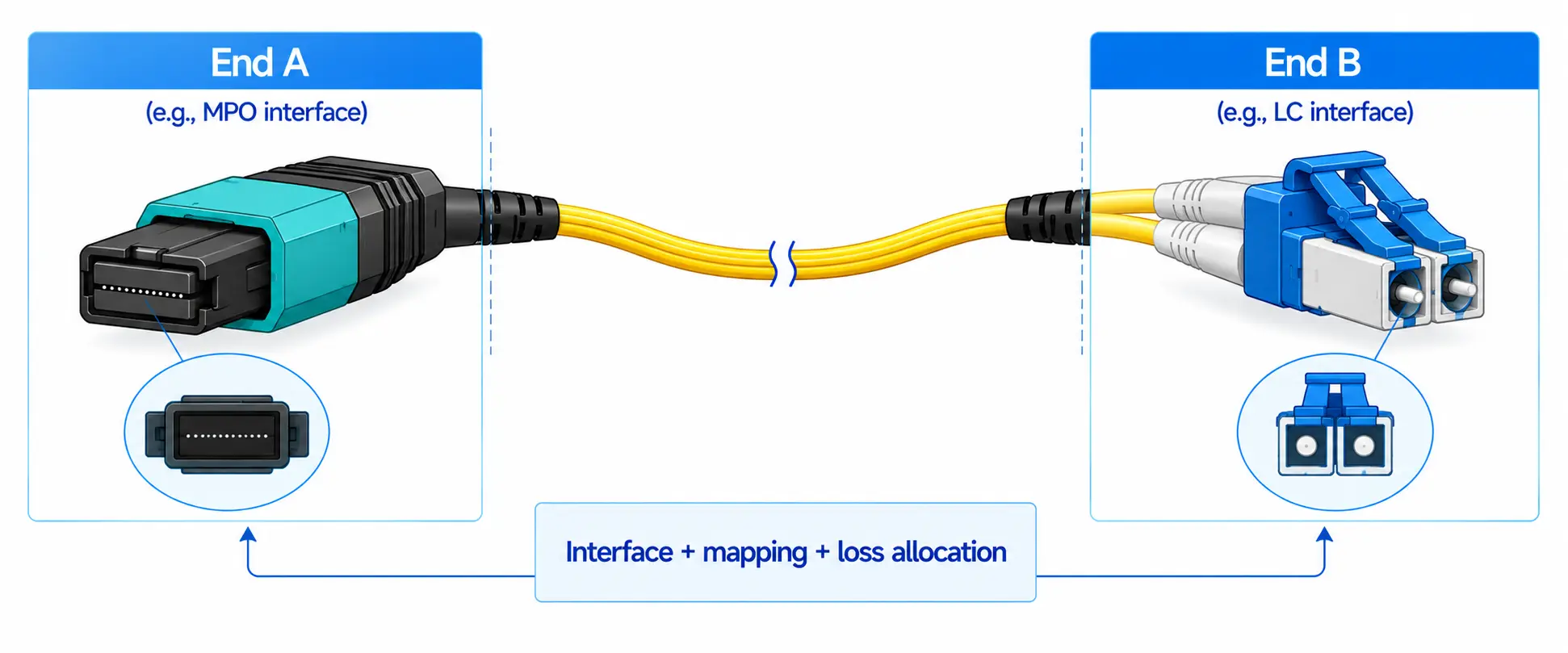
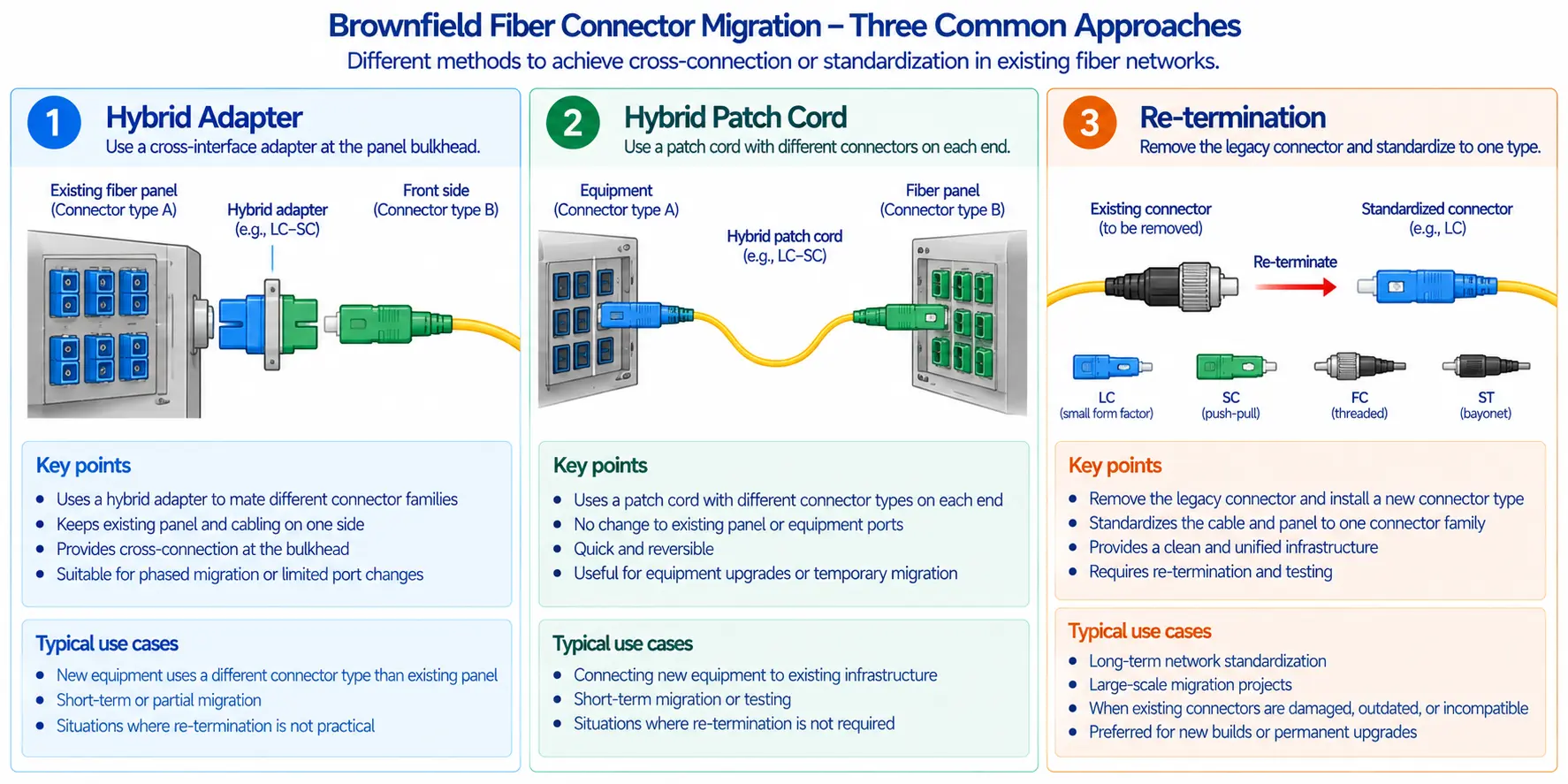
The right QSFP28 module type comes down to five practical variables: link distance, the fiber you already have installed, connector type, whether host-side FEC is required, and whether your switch platform actually supports the module. Get those five right and the rest of the decision follows.
- Same-rack, very short links - start with a passive DAC.
- Short 100G over installed multimode - SR4.
- Short single-mode where parallel MPO trunks already exist - PSM4.
- Duplex single-mode up to 2 km - CWDM4 or single-lambda FR1.
- Duplex single-mode up to 10 km - LR4 or single-lambda LR1.
- Beyond 10 km - ER4, extended-reach single-lambda optics, or vendor-specific ZR4.
Whatever the reach class, confirm the host platform, firmware, FEC mode and module coding before you place a volume order.
The key idea to hold onto: QSFP28 is only the pluggable form factor and electrical interface. The suffix - SR4, CWDM4, LR1 and so on - defines the optical architecture, and that is what dictates the fiber, connector, reach and interoperability you are actually committing to. Two modules can both plug into the same QSFP28 port and both run at 100G while being completely incompatible at the optical layer.

QSFP28 Module Types Compared
Fiber, connector, FEC and standard status usually eliminate most of the options before reach even matters.
| Module | Fiber | Connector | Typical reach | Host FEC | Native breakout | Standard status | Best when | Avoid when |
|---|---|---|---|---|---|---|---|---|
| SR4 | OM3/OM4 MMF | MPO-12 | 70 m (OM3), 100 m (OM4) | RS-FEC, usually host-enabled | Yes (4×25G) | IEEE 802.3bm | Parallel multimode already in place | Plant is duplex LC only |
| PSM4 | Parallel SMF | MPO-12 | 500 m | Commonly required | Yes (4×25G) | PSM4 MSA | Parallel single-mode trunks exist | Duplex LC single-mode plant |
| CWDM4 | Duplex SMF | Duplex LC | 2 km | Required | No | CWDM4 MSA | Duplex SMF, reach under 2 km | You need 10 km of margin |
| LR4 | Duplex SMF | Duplex LC | 10 km | Not required (NRZ) | No | IEEE 802.3ba | Up to 10 km, mature interop | Short link with high launch power and no attenuation |
| ER4 / ER4-Lite | Duplex SMF | Duplex LC | ~30 km (no FEC) to 40 km (host FEC) | Depends on reach | No | Vendor implementation of ER4 | Metro and regional links | Short links (receiver overload risk) |
| DR / DR1 | Duplex SMF | Duplex LC | 500 m | Required (PAM4) | As part of 400G DR4 | IEEE 802.3cd / 100G Lambda MSA | Short SMF, 400G DR4 breakout roadmap | Legacy platform without single-lambda support |
| FR1 | Duplex SMF | Duplex LC | 2 km | Required (PAM4) | No | IEEE 802.3cu / 100G Lambda MSA | Duplex SMF DCI, 400G migration path | Platform only validates CWDM4 |
| LR1 | Duplex SMF | Duplex LC | 10 km | Required (PAM4) | No | IEEE 802.3cu / 100G Lambda MSA | Modern platforms standardized on single-lambda | Mixed estate still on LR4 NRZ |
| BiDi | Duplex MMF | Duplex LC | Product-dependent | Vendor-specific | No | Vendor / proprietary | Reusing duplex MMF, matched pairs | Mixing suppliers at each end |
| SWDM4 | Duplex MMF (OM4/OM5) | Duplex LC | Fiber-grade dependent | Vendor-specific | No | SWDM MSA / vendor | Duplex MMF, OM5 preferred | OM3 or unknown fiber grade |
| ZR4 | Duplex SMF | Duplex LC | ~80 km (vendor-dependent) | Vendor-specific | No | Vendor / platform-specific | Long DCI on a qualified platform | Assuming cross-vendor interop |
These reach figures track IEEE and MSA material - 70 m on OM3 and 100 m on OM4 for SR4, 500 m for PSM4, 2 km for CWDM4 and FR, 10 km for LR4 and LR-class single-lambda. They are a starting filter, not a design. Confirmed reach, temperature limits, FEC behaviour and optical budget still have to come from the specific module and switch documentation.
What a QSFP28 Module Type Actually Defines
A module type carries far more information than a distance rating. It fixes whether the link runs on multimode or single-mode fiber, whether it needs an MPO/MTP or a duplex LC connector, whether the optics are parallel lanes or wavelength-multiplexed, whether host-side FEC is mandatory, whether optical breakout is possible, and whether the interface follows an IEEE standard, an industry MSA, or a single vendor's implementation.
SR4 makes the point cleanly. It sends four parallel multimode fibers through an MPO connector. LR4 sends four wavelengths down a single duplex single-mode pair. Both are QSFP28. Neither will ever light the other's cable plant.
Form Factor vs Optical Interface
The QSFP28 form factor exposes four high-speed electrical lanes to the host. Classic 100G optics map those to four 25G optical channels, carried one of two ways:
- Parallel optics - each channel travels on its own fiber (SR4, PSM4).
- Wavelength-division multiplexing - several wavelengths share one transmit and one receive fiber (CWDM4, LR4). If it helps to review the underlying idea, our overview of FDM, TDM and WDM multiplexing covers how those channels are combined onto a single pair.
Single-lambda modules break the four-channel pattern entirely. They use PAM4 modulation and onboard DSP to carry the full 100G signal on one wavelength while still presenting the electrical interface the switch expects.

IEEE Standard, MSA, or Vendor-Specific?
Not every QSFP28 name carries the same weight. SR4 and LR4 sit under IEEE Ethernet specifications. CWDM4 and PSM4 came out of multi-source agreements. Single-lambda FR and LR were defined first through the 100G Lambda MSA and later under IEEE work. ZR4, by contrast, varies significantly from one supplier to the next.
That hierarchy is why a shared product name is not a guarantee of interoperability. Before mixing modules from different suppliers, pin down the exact optical spec, the wavelengths, the FEC mode, the maximum channel loss, the host electrical interface, the module coding, and the switch firmware support. You can cross-check the base specifications against the IEEE 802.3 Ethernet Working Group materials.
Parallel 4-Lane Modules: SR4 and PSM4
QSFP28 SR4
SR4 is the default short-reach choice over multimode. It transmits four 25G lanes each way; an MPO-12 interface uses eight active fibers, four transmitting and four receiving. Standard SR4 reaches 70 m on OM3 and 100 m on OM4, which covers leaf-to-spine, row-to-row and short switch-to-switch links inside a single hall, plus 100G-to-4×25G breakout.
SR4 is the obvious pick when parallel multimode is already installed - but "cheap optic" is the wrong reason to choose it. The real cost lives in the cabling: MPO polarity, trunk type, patch-panel loss, connector cleanliness and fiber grade all decide whether the link works. If you are building on MPO/MTP trunk cabling, get the polarity scheme right before the modules arrive. And the reach numbers assume the right fiber grade - our reference on OM1–OM5 multimode distance limits is worth a look if the plant is mixed. On a duplex LC site, SR4 means new trunks or conversion hardware, which usually erases the price advantage.
QSFP28 PSM4
PSM4 uses the same four-lane parallel approach but over single-mode fiber, typically an MPO-12 connector to 500 m. It is not obsolete: Cisco still lists PSM4 for 500 m links and 4×25G breakout. PSM4 earns its place where parallel single-mode MPO trunks are already installed, where the link needs optical breakout, or where recabling would be disruptive and the distance exceeds SR4. In a duplex LC single-mode plant, though, CWDM4 or a single-lambda FR module gives you the same job on a simpler two-fiber connection.
Duplex WDM Modules: CWDM4, LR4, ER4 and ZR4
QSFP28 CWDM4
CWDM4 multiplexes four 25G channels onto four coarse wavelengths inside the module and sends them over one duplex single-mode pair. The CWDM4 MSA specifies 2 m to at least 2 km and requires host-implemented FEC (referencing IEEE Clause 91 RS-FEC) for reliable operation. Note the standard status: CWDM4 is an MSA interface, not an IEEE 100GBASE-CWDM4 PMD.
It fits building-to-building links, short DCI and sub-2 km campus runs on duplex LC infrastructure - anywhere LR4's extra reach is wasted. Two things to verify: that both ends support the required FEC mode, and the full channel loss once the route passes through several patch panels or cross-connects.
QSFP28 LR4
LR4 sends four LAN-WDM wavelengths over duplex single-mode fiber to 10 km. Unlike single-lambda PAM4 optics, standard 100GBASE-LR4 uses four 25G NRZ lanes, and a compliant LR4 implementation operates to 10 km without host FEC.
Don't reflexively reject LR4 on a sub-2 km link. Networks legitimately standardize on it for spare-inventory consistency, operational simplicity, FEC constraints or channel-loss headroom. The one extra check on short LR4 runs is maximum receiver input power - a higher-power optic on a short link can overload the receiver, so confirm both minimum sensitivity and maximum receive power, and add attenuation if the datasheet calls for it.
QSFP28 ER4 and ZR4
ER4-class modules push past LR4. Depending on the implementation, ER4 or ER4-Lite products reach roughly 30 km without host FEC and up to 40 km with it; Cisco documents exactly this split for its ER4-Lite. At these distances, selection has to account for maximum channel insertion loss, chromatic dispersion, required FEC, transmitter output range, maximum receiver input, possible attenuators, and platform-specific qualification.
ZR4 is the least uniform of the group. Products sold as ZR4 may support long direct-detect links, but reach and interoperability are frequently vendor-specific - Arista, for instance, limits its ZR4 support to named platforms. Never assume two "ZR4" modules will interoperate without comparing their detailed optical specs.
Single-Lambda 100G: DR, FR and LR
Where classic optics split 100G into four 25G channels, single-lambda modules carry the whole signal on one wavelength using PAM4. The reach classes are DR/DR1 at 500 m, FR/FR1 at 2 km, and LR/LR1 at 10 km. The 100G Lambda MSA published the 2 km FR and 10 km LR specifications, and IEEE later defined matching 100G-per-lane interfaces; you can trace the single-wavelength specs through the 100G Lambda MSA.
Naming: IEEE vs Vendor Shorthand
Vendor marketing often writes "DR1 / FR1 / LR1" as if they were interchangeable synonyms. They aren't quite. Keep the designations straight:
| Reach class | IEEE designation | MSA designation | Reach |
|---|---|---|---|
| DR | 100GBASE-DR (802.3cd) | 100G-DR | 500 m |
| FR1 | 100GBASE-FR1 (802.3cu) | 100G-FR | 2 km |
| LR1 | 100GBASE-LR1 (802.3cu) | 100G-LR | 10 km |
"DR1" in particular is a market/vendor label rather than the IEEE name (which is 100GBASE-DR). When a datasheet and a switch compatibility matrix disagree on the label, trust the IEEE or MSA designation.
Why Single-Lambda Matters - and Where FEC Comes In
Dropping from four wavelengths to one simplifies the optical engine (no internal four-channel mux) and aligns with 100G-per-wavelength designs and 400G breakout. That does not automatically make every single-lambda module cheaper, cooler or more reliable - that still depends on the optical design, DSP, volume, thermal limits and supplier.
Because PAM4 packs more bits per symbol into a smaller amplitude margin, FEC is not optional - it is part of the system design. Before ordering DR1, FR1 or LR1, confirm the required host FEC mode, that both ends use the same FEC configuration, that the OS recognizes the module and decodes DOM/DDM correctly, and that the module is approved for the target port. A module can have the right fiber, connector and reach and still refuse to link up when the two ends disagree on FEC.
Single-Lambda and 400G DR4 Breakout
Single-lambda 100G matters most for 400GBASE-DR4 breakout. A 400G DR4 interface contains four separate 100G optical lanes; a supported platform can expose them as four 100G links through the right breakout assembly and compatible remote optics. Cisco documents 400G DR4 products supporting up to four 100G breakout links.
Do not confuse this with 400G FR4. FR4 multiplexes four wavelengths onto one duplex pair - it is not four independent duplex 100G ports you can split with a passive cable. When you plan a 400G-to-4×100G migration, verify the exact 400G optical type (DR4, XDR4, FR4 or other), the supported breakout cable, the remote 100G optic, optical interoperability, the switch breakout configuration, and FEC at both ends.

BiDi and SWDM4: Two Different Answers for Duplex Multimode
Some sites have a large base of duplex multimode fiber but no parallel MPO trunks. Both BiDi and SWDM4 target that constraint - but they are not the same technology and should not be treated as one row on a spec sheet.
BiDi transmits in both directions over each fiber using different wavelengths per direction. Reach and wavelength plans are typically proprietary, and the two ends usually have to be a matched pair. If the direction-per-wavelength scheme is unfamiliar, our explainer on BiDi transceiver technology walks through it.
SWDM4 multiplexes four short wavelengths onto duplex multimode, and its reach is strongly tied to fiber grade - OM5 was designed specifically to extend SWDM distances, and OM3 will fall short of OM4/OM5. Wavelength plans and coding are again often vendor-specific.
Choose either one because it solves a genuine cable-plant problem, and qualify the exact fiber grade, reach, switch platform and optical pairing first. Neither is as freely interchangeable as SR4 or LR4.
DAC, AOC, or Optical Modules?
Not every 100G connection needs two transceivers. Match the connection type to the run, not to the sticker price:
| Option | What it is | Use it when |
|---|---|---|
| Passive DAC | Fixed copper assembly, no active electronics | Same-rack, within platform length limits, lowest power, structured cabling not needed |
| Active DAC | Copper with signal conditioning | Adjacent racks, slightly longer copper - but thicker and stiffer than AOC |
| AOC | Fixed cable with permanently attached optics | Too long or awkward for copper, lightweight run preferred, no field connector cleaning |
| Separate optical modules | Pluggable transceivers plus structured fiber | Route passes patch panels, may be reconfigured, exceeds DAC/AOC reach, parts need individual replacement |
The lowest module price rarely means the lowest deployment cost. Weigh cabling architecture, maintenance and flexibility alongside the unit price.
Worked Selection Examples
Same-rack switch-to-server. Start with a passive DAC. When length and routing allow it, it is the simplest and lowest-power answer, with no separate optics to manage.
80 m OM4 in a data hall. Standard SR4 with correct MPO infrastructure. Confirm total routed distance, MPO loss, polarity and connector condition first; SR4 has margin to 100 m on OM4.
1.5 km duplex single-mode. CWDM4 and FR1 are both candidates. Choose CWDM4 if the platform and your operational standard already validate CWDM4 host FEC; lean toward FR1 if the switch supports single-lambda and your roadmap includes 400G DR4 breakout. Decide on compatibility, optical budget, supplier qualification and total cost - not maximum reach.
8 km campus backbone. LR4 or LR1. LR4 brings a mature four-wavelength ecosystem; LR1 uses single-lambda PAM4 and needs the matching platform support and FEC. Check full channel loss and interoperability before committing.
Existing duplex multimode plant. Evaluate BiDi or SWDM4 before recabling, but confirm the supported fiber grade, reach, switch platform and optical pairing. These are not drop-in equivalents to SR4 or LR4.
Common QSFP28 Buying Mistakes
A handful of errors account for most of the returns and failed links:
- Choosing by maximum reach. A longer-reach optic can add cost, power, receiver-overload risk and needless complexity - it is not automatically the safe choice.
- Ignoring the connector. SR4 and PSM4 use MPO; CWDM4, LR4 and single-lambda use duplex LC. The right speed and distance can't rescue the wrong connector architecture.
- Treating physical fit as compatibility. A QSFP28 module may seat in a QSFP-DD or QSFP56 cage, but the platform still has to support the rate, coding, FEC and port mode.
- Assuming FEC is automatic. Defaults differ across switch generations and operating systems. Check FEC at both ends before chasing optical power.
- Confusing 400G DR4 and FR4 breakout. DR4 exposes four parallel 100G lanes; FR4 multiplexes wavelengths over a duplex pair. Their passive breakout behaviour is not the same.
- Designing on typical values. Production links should use guaranteed minimum and maximum datasheet figures.
- Buying on unit price. A cheaper optic that forces new trunks, conversion cassettes, extra patching or firmware changes ends up costing more.
FAQ
Q: Which QSFP28 module type should I choose?
A: Start from the installed fiber and the actual routed distance. SR4 for short parallel multimode, PSM4 for short parallel single-mode, CWDM4 or FR1 for duplex SMF to 2 km, LR4 or LR1 for duplex SMF to 10 km - then confirm FEC, switch support and optical budget.
Q: What is the difference between SR4 and LR4?
A: SR4 runs four parallel multimode fibers through an MPO connector for short data-center links. LR4 runs four wavelengths over a duplex single-mode LC pair to 10 km.
Q: What is the difference between CWDM4 and LR4?
A: CWDM4 reaches 2 km over duplex SMF and requires host FEC under the CWDM4 MSA. LR4 reaches 10 km and standard IEEE implementations run without host FEC. CWDM4 is not automatically better below 2 km - optical budget, platform support and standardization still decide.
Q: Is PSM4 obsolete?
A: No. It is less attractive in a duplex LC plant, but it remains useful wherever parallel single-mode MPO infrastructure or 4×25G optical breakout is needed.
Q: What is the difference between DR1, FR1 and LR1?
A: They are single-lambda 100G reach classes: roughly 500 m, 2 km and 10 km over single-mode fiber. The IEEE name for the 500 m class is 100GBASE-DR; "DR1" is a vendor label. Verify exact naming and interoperability in the datasheet.
Q: Can a QSFP28 module work in a QSFP-DD port?
A: QSFP-DD was designed for backward compatibility with traditional QSFP modules, but the switch still has to support the QSFP28 rate, module type, port configuration and firmware. Mechanical fit alone is not enough.
Q: Can 400G FR4 break out into four 100G FR1 modules?
A: Not as a generic passive breakout. 400G DR4 is the architecture that carries four parallel 100G lanes; 400G FR4 multiplexes wavelengths over a duplex pair and does not offer the same physical lane separation.
Q: Should I use DAC, AOC or optical modules?
A: DAC for the shortest, lowest-cost links; AOC when a lightweight fixed optical assembly is preferred; separate optical modules for structured cabling, patch panels and longer runs.
The Bottom Line
Distance is never enough on its own. A QSFP28 module has to match the switch port, the installed fiber, the connector, the complete channel loss, the FEC mode, the firmware and coding, the breakout architecture, and the operating environment - all of it. For any volume deployment, qualify samples in the real switch platform before you approve the order, and hand the supplier your switch model, software version, fiber type, connector, distance, FEC requirement and breakout plan so the module can be tested against the application it will actually run.